
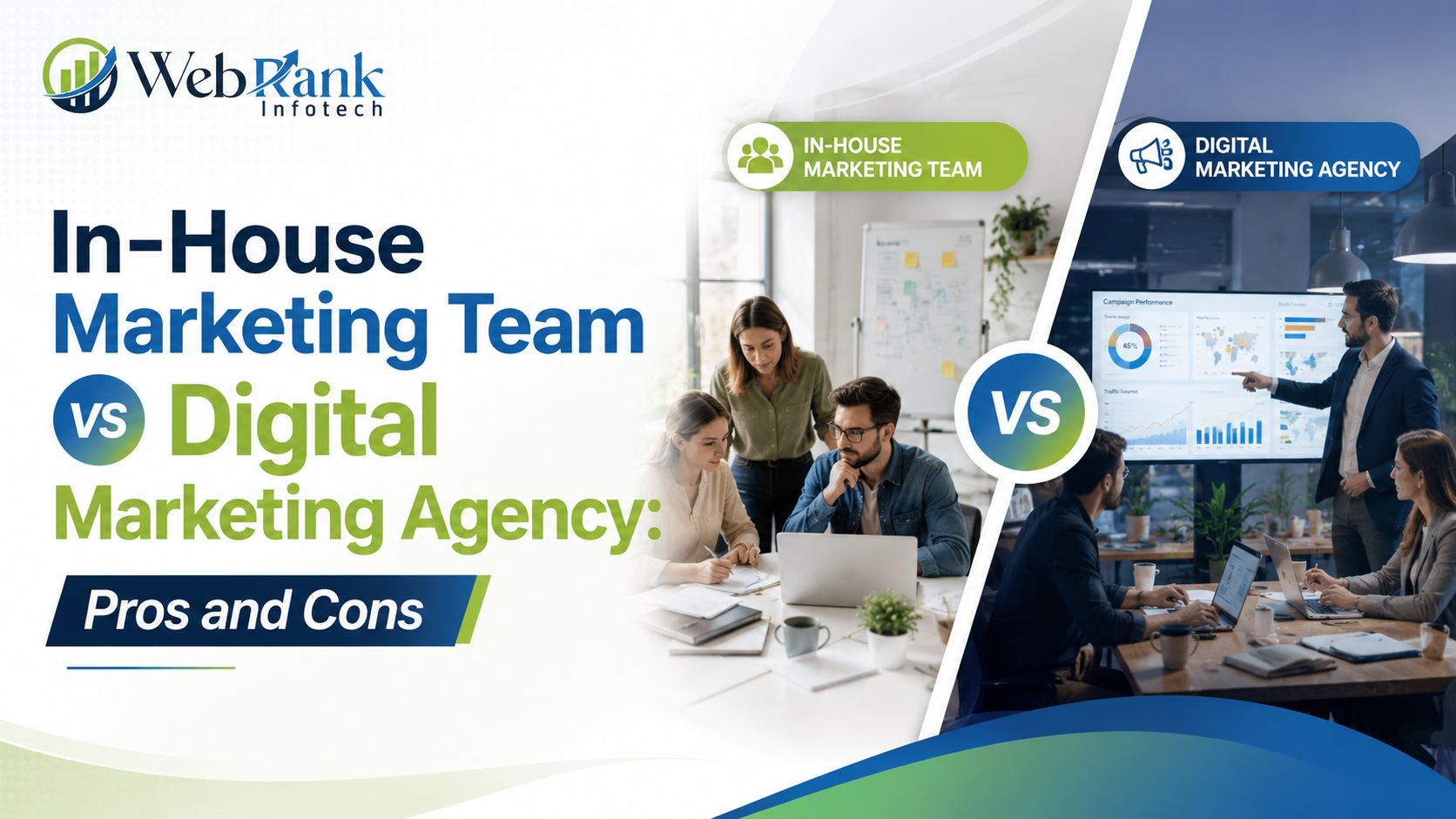
Choosing between an in-house marketing team vs digital marketing agency comes down to budget, growth stage, and control – an in-house team wins on brand alignment and long-term ownership, while a digital marketing agency wins on cost efficiency, specialist access, and speed to results.
Every growing business eventually hits this fork in the road: build a marketing team from scratch, or hand the work to a digital marketing agency. Both paths can work. Both can also waste six figures if chosen for the wrong reasons. This guide breaks down the in-house marketing team vs digital marketing agency decision in full – real pros, cons, costs, and a step-by-step framework so the choice stops feeling like a guess.
Table of Contents
- What Is the Real Difference Between an In-House Marketing Team and a Digital Marketing Agency?
- How Does an In-House Marketing Team Actually Work?
- How Does a Digital Marketing Agency Actually Work?
- Which Costs More in India?
- How to Decide (Step-by-Step Guide)
- Which Businesses Should Choose Which?
- Can You Combine Both?
- Scorecard: Rated Out of 5
- FAQs
What Is the Real Difference Between an In-House Marketing Team and a Digital Marketing Agency?
An in-house marketing team consists of full-time employees who work exclusively for one company, embedded in its culture, product, and daily operations. A digital marketing agency is an external company hired on contract to handle marketing execution – SEO, PPC, social media, content, or all of the above – often serving multiple clients across different industries at the same time.
The core difference isn’t just “internal vs external.” It’s ownership vs access. An in-house team is owned entirely by one business, with slower ramp-up but total brand alignment. A digital marketing agency gives access to a ready-made team of specialists without the overhead of hiring, training, or retaining them – but that expertise is shared across other client accounts too.
Skimmable summary: In-house marketing means hiring full-time staff dedicated to one brand; a digital marketing agency means outsourcing execution to an external specialist team serving multiple clients. The trade-off is control and brand immersion (in-house) versus speed, cost-efficiency, and breadth of expertise (agency).
How Does an In-House Marketing Team Actually Work?
An in-house team typically starts with one marketing generalist or manager and expands into specialists – SEO, content, paid ads, design – as the budget allows. They report directly to leadership, sit in on product meetings, and build marketing strategy around firsthand knowledge of the business.
Pros of an In-House Marketing Team
| Advantage | Why It Matters |
| Deep brand knowledge | The team lives and breathes the product daily, so messaging stays consistent |
| Faster internal communication | No client-agency lag – decisions happen in the same Slack channel as the rest of the company |
| Full control over priorities | Marketing sprints can be reshuffled instantly around business needs |
| Long-term institutional memory | Campaign history, customer insights, and lessons learned stay in-house |
Cons of an In-House Marketing Team
| Drawback | Why It Matters |
| High fixed cost | Salaries, benefits, software licenses, and training add up even in slow months |
| Narrower skill coverage | A 2-3 person team rarely covers SEO, PPC, design, and analytics equally well |
| Slower to scale | Ramping up for a big campaign means hiring, which takes weeks or months |
| Risk of stagnant ideas | Teams immersed in one brand for years can lose exposure to fresh industry trends |
Skimmable summary: An in-house marketing team offers unmatched brand alignment and internal speed of communication, but it comes with fixed overhead, narrower specialist coverage, and slower scalability – all real constraints for a business trying to grow fast on a lean budget.
How Does a Digital Marketing Agency Actually Work?
A digital marketing agency operates as an external partner. After an onboarding phase – where the agency studies the business, competitors, and target audience – it builds and executes a marketing strategy using a team of specialists who already have tools, processes, and experience across dozens of similar campaigns.
Pros of Hiring a Digital Marketing Agency
| Advantage | Why It Matters |
| Access to a full specialist team | SEO, PPC, content, and design experts work together without separate hiring |
| Lower fixed cost | Businesses pay for output, not salaries, insurance, or paid leave |
| Faster results from proven playbooks | Agencies reuse strategies validated across multiple clients and industries |
| Easy to scale up or down | Campaigns can expand for a product launch and shrink again without layoffs |
| Access to premium tools | Enterprise-grade SEO, ad, and analytics tools are already part of the agency’s stack |
Cons of Hiring a Digital Marketing Agency
| Drawback | Why It Matters |
| Shared attention | Agencies manage multiple clients, so response time can be slower than an internal team |
| Onboarding lag | New agencies need weeks to fully understand a brand before hitting full stride |
| Less day-to-day control | Strategy execution happens outside the building, on the agency’s workflow |
| Quality varies by agency | Results depend heavily on which agency gets chosen, making due diligence essential |
Skimmable summary: A digital marketing agency delivers specialist expertise, proven strategies, and flexible scaling at a lower fixed cost than hiring internally – the trade-off is shared attention and a shorter onboarding period before full alignment kicks in.
In-House Team vs Digital Marketing Agency: Which Costs More in India?
Cost is usually the deciding factor in the in-house marketing team vs digital marketing agency decision, so here’s a realistic breakdown for a small-to-mid-sized Indian business trying to run SEO, PPC, and social media together.
| Cost Component | In-House Team (Monthly) | Digital Marketing Agency (Monthly) |
| SEO specialist | ₹35,000 – ₹60,000 | Included in package |
| PPC specialist | ₹30,000 – ₹55,000 | Included in package |
| Social media manager | ₹25,000 – ₹45,000 | Included in package |
| Tools & software (SEO, ads, analytics) | ₹15,000 – ₹30,000 | Included in package |
| Recruitment & training cost | One-time, ₹20,000+ | None |
| Typical total | ₹1,05,000 – ₹1,90,000+ | ₹25,000 – ₹80,000 (varies by scope) |
A detailed breakdown of what full-service SEO packages typically include — audits, on-page work, technical fixes, and link building — is covered in WebRank Infotech’s SEO services in India, which is a useful benchmark for comparing agency pricing against in-house salary costs.
Skimmable summary: For most small and mid-sized businesses in India, an in-house team costs roughly 2-3x more per month than an agency once salaries, tools, and training are factored in — though the gap narrows for larger companies that need dedicated, full-time attention.
How to Decide Between an In-House Team and a Digital Marketing Agency (Step-by-Step Guide)
Step 1: Calculate the True Monthly Budget Available
Add up what marketing can realistically cost per month — not just what feels comfortable. Include software, training, and hiring costs if going in-house.
Step 2: List the Marketing Channels That Actually Matter Right Now
A business that only needs SEO and Google Business Profile optimization doesn’t need a five-person in-house team. Match resourcing to actual channel needs, not a wishlist.
Step 3: Check How Fast Results Are Needed
If a product launch is 60 days away, an agency with existing playbooks and tools will typically move faster than hiring, onboarding, and training new employees.
Step 4: Assess How Much Brand Nuance the Marketing Requires
Highly technical or heavily regulated industries (finance, healthcare, SaaS with complex products) often benefit from in-house staff who understand the product deeply — unless the agency has proven vertical experience.
Step 5: Test Before Committing Long-Term
Run a 3-month agency trial or hire one in-house generalist before scaling either model. This limits downside risk while validating which direction produces better ROI.
Step 6: Review Results Against Cost Per Lead, Not Just Traffic
Whichever model gets chosen, track cost per qualified lead monthly. A cheaper option that produces low-quality leads isn’t actually cheaper.
Skimmable summary: Choosing between in-house and agency comes down to budget reality, channel needs, speed requirements, brand complexity, and a willingness to test before fully committing — cost per qualified lead, not raw traffic, should be the final scorecard.
Which Businesses Should Choose an In-House Team vs an Agency?
| Business Type | Better Fit | Why |
| Early-stage startup (0-10 employees) | Agency | Low fixed cost, no time to manage hiring |
| Local service business (salons, clinics, retail) | Agency | Needs local SEO and reviews management without full-time staff |
| Mid-sized company scaling fast | Hybrid | In-house strategist + agency execution support |
| Enterprise with complex, ongoing campaigns | In-house (with agency support) | Needs daily alignment across departments |
| E-commerce brand running constant paid ads | Agency or Hybrid | Needs specialist PPC management and fast iteration |
Businesses evaluating local visibility specifically — like getting found on Google Maps and reviews — often benefit from combining SEO with dedicated support such as online reputation management services, something most early-stage in-house teams don’t have bandwidth to manage well.
Skimmable summary: Startups and local businesses generally get more value from an agency’s low fixed cost and ready expertise, while enterprises with complex, always-on campaigns tend to need in-house staff — with a hybrid model fitting most fast-growing mid-sized companies best.
Can You Combine an In-House Team and a Digital Marketing Agency?
Yes — and for many growing businesses, this hybrid model outperforms choosing one or the other exclusively. A common structure: one in-house marketing manager who owns brand strategy and internal coordination, paired with an agency handling execution-heavy work like SEO, PPC, or social media marketing.
This setup keeps brand oversight internal while outsourcing the specialist labor that would otherwise require hiring three or four separate full-time employees. It also reduces the risk of losing all marketing knowledge if one internal hire leaves, since the agency retains continuity.
Skimmable summary: A hybrid model — one internal marketing owner supported by an outsourced specialist team — often delivers the best balance of brand control and execution firepower, especially for businesses too big for a pure agency setup but not yet ready for a full internal department.
Show Image Alt text to use: “in-house marketing team vs digital marketing agency scorecard”
Scorecard: In-House Team vs Digital Marketing Agency, Rated Out of 5
| Criteria | In-House Team | Digital Marketing Agency | Verdict |
| Cost efficiency | 2.5/5 | 4.5/5 | Agency wins for most SMBs |
| Speed to launch campaigns | 3/5 | 4/5 | Agency wins due to existing playbooks |
| Brand alignment | 5/5 | 3.5/5 | In-house wins |
| Access to specialist skills | 3/5 | 4.5/5 | Agency wins |
| Scalability | 2.5/5 | 4.5/5 | Agency wins |
| Long-term control | 4.5/5 | 3/5 | In-house wins |
| Overall (SMB context) | 3.2/5 | 4.1/5 | Agency edges ahead for most small-to-mid businesses |
This scoring reflects a small-to-mid-sized business context specifically. For large enterprises with complex, always-on marketing needs, the in-house score rises closer to 4/5 on cost efficiency and control, since scale changes the economics.
Skimmable summary: On a straight scorecard, a digital marketing agency scores higher for most small and mid-sized businesses due to cost efficiency, scalability, and specialist access — while an in-house team still wins decisively on brand alignment and long-term control, which matters more as a company scales.
FAQs: In-House Marketing Team vs Digital Marketing Agency
Is it cheaper to hire a digital marketing agency or build an in-house team?
Yes, hiring a digital marketing agency is typically cheaper for small and mid-sized businesses. A single in-house SEO or PPC specialist in India often costs ₹30,000-₹60,000 per month before tools and benefits, while an agency package covering the same scope frequently costs less because that cost is shared across multiple client accounts. A local bakery chain, for example, would need to hire three separate specialists to match what one mid-sized agency team delivers for a fraction of the combined salary cost.
Can a small business survive with only an in-house marketing team?
Yes, but usually only with a single generalist handling multiple channels at a basic level. A small business with one in-house marketer can manage social media posting and basic SEO, but will likely struggle with technical SEO audits, PPC bid optimization, or advanced analytics — areas where a specialist agency team typically outperforms a generalist working alone across five different disciplines.
How long does it take for a digital marketing agency to show results?
Most digital marketing agencies show measurable movement – traffic, rankings, or lead volume – within 60 to 90 days, with stronger results by month four to six. A local service business chasing top rankings for a competitive city-based keyword, for instance, will usually see meaningful ranking shifts around the three-month mark once technical fixes and content are live, not in week two.
What questions should a business ask before choosing an agency over an in-house team?
The most useful questions cover past client results, reporting frequency, team structure, and contract flexibility. A business should ask to see case studies in a similar industry, confirm who the actual point of contact will be, and clarify whether reporting happens monthly or on-demand – vague answers to any of these are a signal to keep evaluating other agencies.
Does an in-house marketing team always produce better brand consistency than an agency?
Not automatically – it depends on onboarding quality, not just location. An experienced agency that invests real time in understanding brand voice, audience, and product nuance can match in-house consistency, while a poorly managed in-house team with high turnover can actually produce inconsistent messaging over time.
Is a hybrid model of in-house plus agency support common for growing businesses?
Yes, this is increasingly common for businesses moving past the startup stage. A mid-sized SaaS company, for example, might keep one internal marketing manager for strategy and brand voice while outsourcing SEO and paid ads execution to an agency -combining internal oversight with external specialist bandwidth without doubling headcount.
What’s the biggest mistake businesses make when choosing between in-house and agency marketing?
The most common mistake is choosing based on preference rather than actual channel needs and budget reality. A business that picks an in-house team purely for “control,” without the budget to hire specialists across every needed channel, often ends up with a generalist stretched too thin – producing weaker results than a properly scoped agency engagement would have.
Should a startup hire an agency or build an in-house team first?
Most startups should start with a digital marketing agency and transition to in-house hiring only after product-market fit and marketing budget stabilize. An early-stage startup burning cash on experimentation benefits from an agency’s flexibility to scale spend up or down monthly, something a salaried in-house team can’t do without layoffs or idle capacity.