
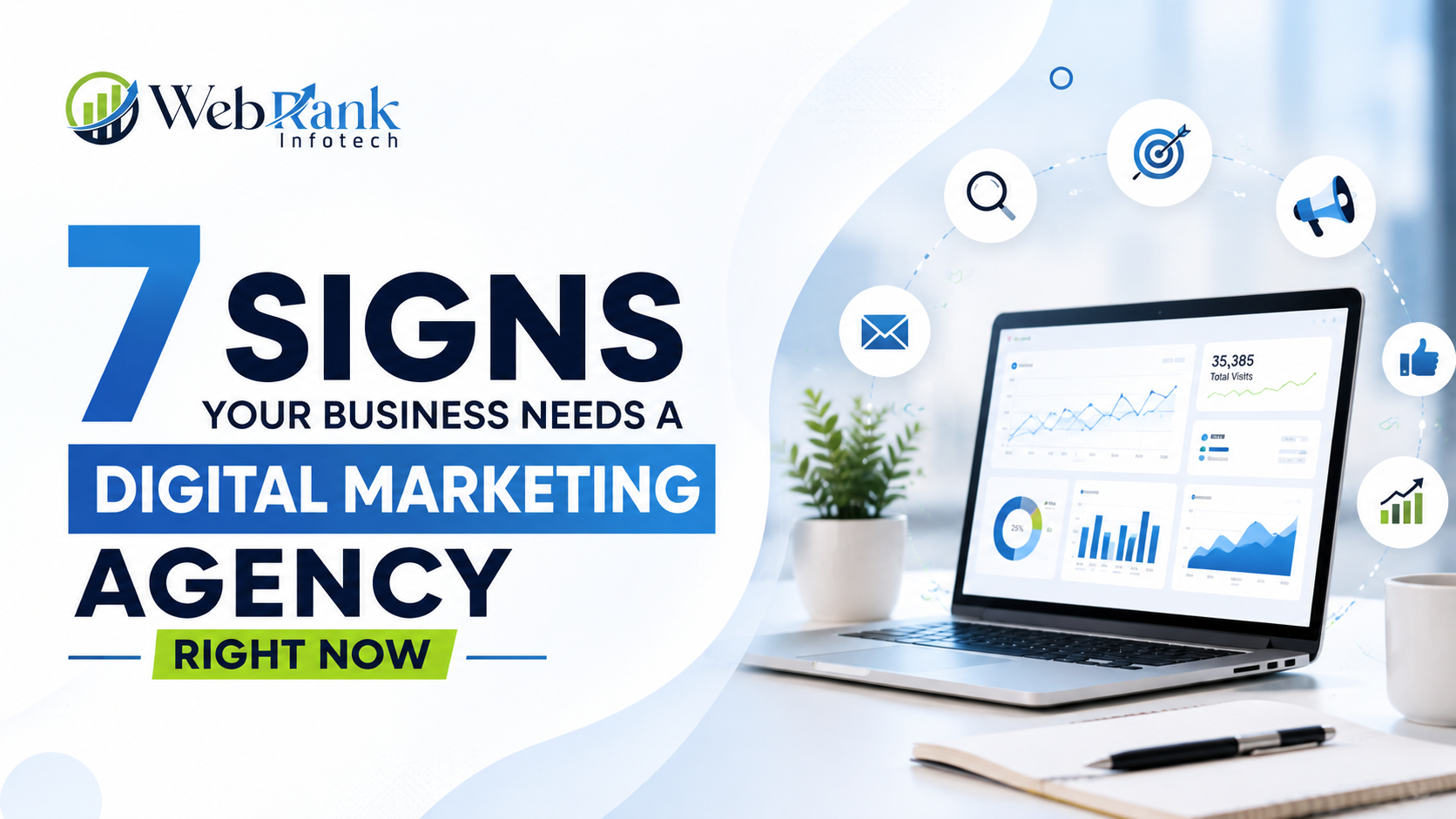
Stagnant website traffic, leads that never convert, rising ad costs, and marketing that feels like guesswork are the clearest signs a business needs a digital marketing agency. When in-house efforts stop producing measurable growth, that gap is usually not a work-ethic problem — it is a skills, tools, and bandwidth problem, and a digital marketing agency exists to close exactly that gap.
Every business owner reaches a point where marketing feels like a full-time job that nobody has time to do properly. Social media posts go out inconsistently, the website hasn’t been updated in months, and nobody can say with certainty which campaign actually brought in last month’s sales. This guide breaks down the seven clearest signs it’s time to bring in outside expertise, how a digital marketing agency actually solves each problem, and what to check before signing a contract.
What Does It Mean When a Business Needs a Digital Marketing Agency?
A business needs a digital marketing agency when internal efforts — whether run by the owner, a generalist employee, or a small in-house team — stop translating into measurable growth: more traffic, more qualified leads, and more revenue. It is rarely about effort. Most business owners are working hard on marketing; they just lack the specialized skill set, the tools, and the time to run SEO, paid ads, content, and analytics all at once, all correctly, all the time.
Skimmable summary: Needing a digital marketing agency is not a sign of failure — it’s a natural growth stage where marketing has become too complex, too time-consuming, or too specialized to run effectively without dedicated experts.
How to Spot the Signs Your Business Needs a Digital Marketing Agency
The signs rarely show up one at a time. They tend to stack — quietly — until growth plateaus. Below is a practical, step-by-step way to check for each one.
Sign 1: Website Traffic Has Stalled or Declined
Pull up Google Analytics (or Search Console) and check the last 90 days against the previous 90. If traffic is flat or falling despite the business staying active, search visibility is likely the problem. This usually points to weak on-page SEO, missing technical fixes, or thin content that search engines and AI answer engines don’t consider citable. According to Google’s own SEO starter guide, sites that don’t actively maintain technical and content quality naturally lose visibility over time as competitors improve theirs.
Sign 2: Leads Are Coming In But Not Converting
High traffic with low conversions usually means a targeting or messaging mismatch, not a traffic problem. Sales teams end up fielding unqualified leads — people with the wrong budget, wrong timing, or wrong intent — which wastes hours and lowers close rates. A digital marketing agency typically audits landing pages, ad targeting, and page intent to fix this mismatch before adding more traffic on top of a broken funnel.
Sign 3: Marketing Feels Reactive, Not Strategic
If every campaign starts with “let’s post something today” instead of a documented content calendar or quarterly plan, marketing is running on autopilot. Reactive marketing produces inconsistent branding and rushed, off-message content — a pattern that’s hard to break without a structured content marketing strategy driving the calendar.
Sign 4: Competitors Are Outranking and Outposting the Business
A five-minute Google search for the business’s core service, followed by a look at competitor social pages, usually reveals the truth quickly. If competitors consistently appear above the business in search results or post more frequently with stronger engagement, they are actively investing in visibility while the business is standing still. This is one of the fastest-moving signs your business needs a digital marketing agency, because search rankings compound — the longer the gap exists, the harder it becomes to close.
Sign 5: Ad Spend Is Rising But ROI Is Falling
Cost per lead should stay roughly flat or improve over time as campaigns get optimized. If cost per lead keeps climbing while conversion performance stays the same or drops, budget is leaking somewhere — often poor audience segmentation, weak ad creative, or a landing page that isn’t built to convert. Agencies bring the testing and bid-management discipline needed to turn ad spend into measurable results instead of guesswork.
Sign 6: No One Can Explain What’s Working and What Isn’t
Ask a simple question internally: “Which channel brought in last month’s top three customers?” If nobody has a confident, data-backed answer, reporting is broken. Effective marketing depends on knowing exactly where traffic, leads, and revenue come from — without that, budget decisions are essentially guesses.
Sign 7: Marketing Keeps Getting Pushed to the Bottom of the To-Do List
If marketing tasks routinely get bumped for “more urgent” operational work, that’s not a discipline issue — it’s a bandwidth issue. Marketing needs consistent, dedicated attention to compound over time; sporadic effort rarely builds momentum.
Skimmable summary: The seven signs — stalled traffic, poor lead quality, reactive planning, losing ground to competitors, rising cost per lead, unclear reporting, and marketing that never gets prioritized — usually appear together rather than alone, and each one compounds the others the longer they go unaddressed.
How Does a Digital Marketing Agency Fix These Problems?
A digital marketing agency solves these issues by bringing dedicated specialists, proven processes, and marketing tools that most in-house teams can’t justify owning full-time.
| Business Problem | What a Digital Marketing Agency Does |
|---|---|
| Stalled website traffic | Runs technical SEO audits, on-page optimization, and keyword-targeted content |
| Poor lead quality | Refines audience targeting, page intent, and message-to-offer fit |
| Reactive marketing | Builds a documented content calendar and quarterly strategy |
| Competitors outranking the business | Runs competitor gap analysis and closes visibility gaps |
| Rising cost per lead | Applies structured A/B testing and bid optimization across campaigns |
| Unclear reporting | Sets up dashboards tracking traffic source, lead source, and ROI by channel |
| No time for consistent marketing | Takes over execution so the owner can focus on running the business |
Skimmable summary: Every sign listed above maps to a specific, fixable process — a digital marketing agency doesn’t just “do more marketing,” it applies structured diagnosis and execution to the exact gap causing stagnation.
What Should a Business Check Before Hiring a Digital Marketing Agency?
Not every agency delivers the same value, so a quick vetting process before signing protects both budget and results.
- Ask for case studies with real numbers. A credible agency should show traffic, lead, or ROI improvements from past clients — not vague claims of “great results.”
- Check how reporting is structured. Ask exactly what a monthly report includes: traffic source breakdown, cost per lead, conversion rate, and channel-by-channel ROI.
- Confirm which channels they actually specialize in. Some agencies are strong in SEO but weak in paid ads, or vice versa — match their strength to the business’s biggest gap.
- Ask about contract flexibility. Month-to-month or quarterly terms signal confidence in results; long lock-in contracts without an exit clause are a caution flag.
- Look for industry experience, not just general experience. An agency that has worked in a similar sector understands buyer behavior faster and avoids costly trial-and-error.
Skimmable summary: Vetting an agency properly takes five checks — proof of results, reporting clarity, channel expertise, contract flexibility, and relevant industry experience — and skipping any one of them raises the risk of a mismatched partnership.
Is It Better to Hire an In-House Team or a Digital Marketing Agency?
The right choice depends on budget, scale, and how many channels need active management at once.
| Factor | In-House Team | Digital Marketing Agency |
|---|---|---|
| Cost | Higher fixed cost (salaries, benefits, tools) | Typically lower, scalable monthly investment |
| Skill range | Limited to hires made | Access to specialists across SEO, PPC, content, design |
| Tools & software | Business bears full software cost | Shared across agency’s client base, often more advanced |
| Ramp-up time | Weeks to months for hiring and training | Days to start executing with existing expertise |
| Best fit | Large businesses needing daily, hands-on brand control | SMEs and startups needing expert results without full-time overhead |
Skimmable summary: In-house teams offer tighter day-to-day control but cost more and take longer to build real expertise; agencies offer faster access to specialized skills and tools at a lower fixed cost, which is why most small and mid-sized businesses lean toward agencies first.
How Much Does a Digital Marketing Agency Cost?
Pricing varies by scope, but most agencies structure fees around three common models: a flat monthly retainer (covering ongoing SEO, content, or social management), project-based pricing (for one-off work like a website rebuild), or a percentage-of-ad-spend model (common for PPC management). Businesses should request a detailed scope breakdown before comparing quotes, since a lower monthly number sometimes hides fewer deliverables. WebRank Infotech’s SEO services and PPC management plans both work on transparent, scope-based pricing rather than vague bundled packages.
Skimmable summary: Agency pricing typically falls into retainer, project-based, or ad-spend-percentage models — the right one depends on whether the business needs ongoing growth support or a single defined deliverable.
Frequently Asked Questions
How do I know if my business really needs a digital marketing agency or just better internal effort?
Direct answer: If stagnant results persist despite consistent internal effort for 3–6 months, the gap is a skills and tools problem, not an effort problem. A local bakery, for example, might post on Instagram daily and still see zero growth — not because the owner isn’t trying, but because nobody on the team understands audience targeting, posting times, or paid boosting. That’s a specialization gap an agency closes fast.
Is a digital marketing agency worth it for a small business?
Direct answer: Yes, when the agency’s fee is smaller than the revenue lost to poor visibility, weak lead quality, or wasted ad spend. A small service business spending ₹20,000 a month on ads with no clear ROI is often better off redirecting that same budget toward an agency retainer that fixes targeting and tracking — the spend doesn’t increase, but the return does.
How long does it take to see results from a digital marketing agency?
Direct answer: Paid campaigns can show movement within 2–4 weeks; SEO and organic growth typically take 3–6 months to compound. This mirrors what most established agencies report: PPC is fast but temporary, while SEO is slower to build but keeps producing traffic long after the initial work is done — much like the difference between renting attention and owning it.
What’s the difference between a digital marketing agency and a freelancer?
Direct answer: A freelancer typically covers one channel; an agency covers multiple channels under one coordinated strategy with built-in accountability. A freelance social media manager might handle Instagram well but have no SEO or ad-management skill — leaving other growth channels untouched. An agency assigns specialists per channel, so nothing gets left out of the strategy.
Can a digital marketing agency guarantee first-page Google rankings?
Direct answer: No legitimate agency can guarantee a specific ranking position, since search engines control final placement — any agency promising a guaranteed #1 spot should be treated with caution. What a credible agency can commit to is a documented process — technical fixes, content quality, and authoritative backlinks — that reliably improves rankings over time, which is the approach outlined in resources like Google’s SEO starter guide.
What size business benefits most from hiring a digital marketing agency?
Direct answer: Startups, SMEs, and growing businesses without a full in-house marketing department benefit the most, since they get expert-level execution without the cost of a full internal team. A 10-person startup trying to run SEO, ads, and content with one generalist marketer will almost always grow faster by handing execution to a digital marketing agency and keeping strategy oversight in-house.