SEO Services

SEO and AEO Strategy: The Complete Guide to Rank on Google and Win AI Citations

SEO and AEO Strategy: The Complete Guide to Rank on Google and Win AI Citations

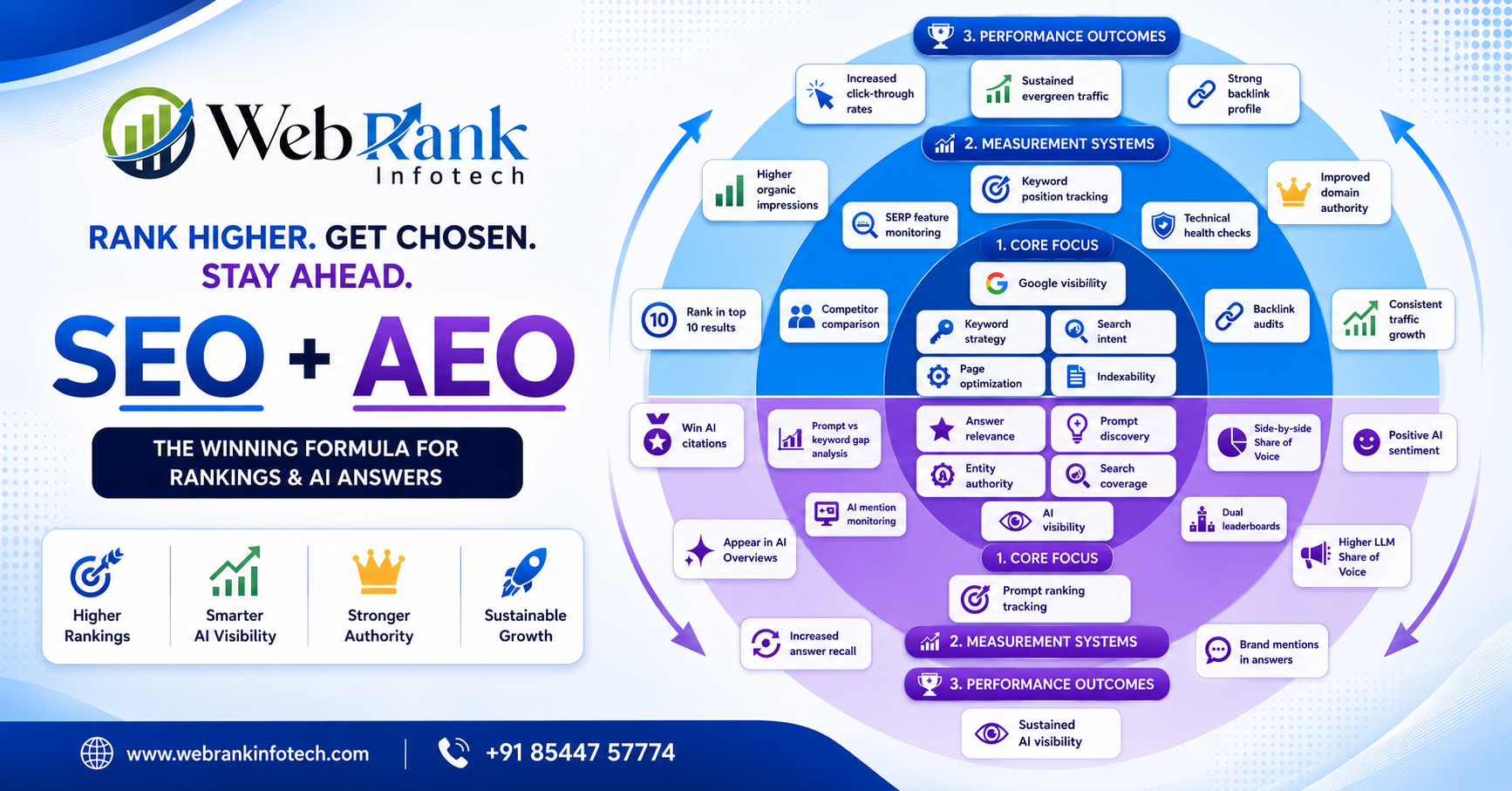
SEO and AEO strategy is no longer optional — it is the foundation of modern digital visibility. As search behaviour shifts from traditional Google results to AI-generated answers from Claude, ChatGPT, and Gemini, brands that master both Search Engine Optimization and Answer Engine Optimization will dominate every channel. This guide covers the exact framework, measurement systems, and action steps you need to rank on Google and win AI citations. What is SEO and AEO strategy and why does it matter? Most marketers are familiar with SEO — optimizing pages to rank in Google search results. But AEO, or Answer Engine Optimization, is the newer discipline focused on making your content the source that AI engines cite when answering user prompts. A combined SEO and AEO strategy ensures your brand wins in both environments simultaneously. Claude AI, ChatGPT, and Gemini all favour content that is factually authoritative, well-structured, and consistently cited across the web. Without AEO, your site may rank on Google but remain completely invisible to the growing audience that relies on AI answers. SEO core focus — building Google visibility The SEO side of the strategy rests on four pillars: keyword strategy, search intent alignment, page optimization, and indexability. Keyword strategy means identifying the exact phrases your audience searches and mapping them to dedicated pages. Prioritize long-tail, question-format keywords that overlap with AI prompts. Search intent alignment ensures every page matches what the user actually wants — informational content for research queries, transactional content for buying queries. Page optimization covers title tags, meta descriptions, heading hierarchy (H1–H4), image alt attributes containing your focus keyword, internal linking, and schema markup. Indexability means your robots.txt, sitemap, canonical tags, and Core Web Vitals are all healthy. A page that cannot be crawled cannot rank — on Google or in AI engines. AEO core focus — building AI visibility The AEO side of your SEO and AEO strategy targets four parallel pillars: answer relevance, prompt discovery, entity authority, and search coverage. Answer relevance means writing a direct, complete answer to the target question within the first 100 words of every page. AI models extract the most direct answer — burying it loses citations. Prompt discovery involves researching the exact prompts users submit to Claude and ChatGPT, not just Google keywords. These prompt-format queries reveal content opportunities invisible to traditional keyword tools. Entity authority is built by ensuring your brand is consistently mentioned across trusted third-party publications, Wikipedia, Wikidata, and industry databases. Claude AI specifically weights sources with strong entity recognition. Search coverage means covering every significant subtopic in your niche comprehensively. AI models prefer sources that can answer follow-up questions without sending users elsewhere. SEO and AEO strategy measurement systems Tracking performance across both lanes requires dedicated measurement for each. For SEO, monitor keyword position tracking weekly using Google Search Console or Ahrefs. Run SERP feature monitoring to identify featured snippet opportunities. Conduct regular competitor comparisons and monthly technical health checks to catch crawl errors early. For AEO, run prompt ranking tracking by manually testing your top 20 prompts in Claude, ChatGPT, and Gemini every week. Set up AI mention monitoring for brand citations. Maintain dual leaderboards — one for Google rankings, one for AI citation frequency — and run prompt versus keyword gap analysis to find topics missing from your AI-answer presence. Performance outcomes of a unified SEO and AEO strategy When executed correctly, a combined SEO and AEO strategy delivers outcomes across both channels. On the SEO side: sustained evergreen traffic, top 10 Google rankings, higher organic impressions, increased click-through rates, a strong backlink profile, improved domain authority, and consistent traffic growth. On the AEO side: winning AI citations from Claude, ChatGPT, and Gemini, appearing in AI Overviews, higher LLM Share of Voice, positive AI sentiment, brand mentions inside AI-generated answers, sustained AI visibility, and increased answer recall. 5 steps to implement your SEO and AEO strategy today Step 1 — Audit your entity footprint. Search your brand in Claude and ChatGPT. If the model cannot describe you accurately, fix it by earning citations in established publications and building a Wikidata presence. For external reference, visit schema.org to implement structured data correctly. Step 2 — Add direct answers to existing pages. Reformat your top traffic pages to include a clear, concise answer in the opening paragraph. Apply FAQ schema markup to make answers machine-readable. Step 3 — Build prompt-optimized content. Write pages targeting exact questions users ask AI engines. Use the question as your H1, answer in 50–100 words, then expand with supporting detail. Step 4 — Strengthen your backlink profile. One backlink from a domain authority 70+ publication does more for your SEO and AEO strategy than fifty low-quality links. Pursue guest posts, original research, and industry reports. Learn more at Ahrefs Blog for backlink building guidance. Step 5 — Run a weekly AI citation audit. Every Monday, test your 20 most important prompts across Claude, ChatGPT, and Gemini. Log citations and track trends over 90 days. Conclusion A strong SEO and AEO strategy is the single most important investment a brand can make in today’s rapidly evolving digital landscape. Google traffic remains essential — but AI-generated answers are growing faster than any other discovery channel. Brands that build both lanes now, with unified measurement and compounding content authority, will own the next decade of digital visibility. Start with your core focus areas, build measurement systems around both channels, and let the performance outcomes — rankings, citations, Share of Voice, and brand authority — compound over time.

SEO and AEO Strategy: The Complete Guide to Rank on Google and Win AI Citations Read More »

Google Killed FAQ Rich Results

Google FAQ Rich Results Removed: 5 Things Every Website Owner Must Know

Google FAQ rich results removed — and if you have not heard about this yet, you are not alone. Thousands of website owners and marketers across the world are still confused about what exactly happened, why Google made this decision, and what it means for their website rankings going forward. Let’s get straight into it and cover everything you need to know. What Were Google FAQ Rich Results Before They Were Removed? FAQ rich results were a special Google Search feature that allowed websites to display expandable questions and answers directly inside the search results page. When you added FAQ schema markup to your web pages, Google would show your questions right below your link in search results — users could expand each question without ever clicking through to your website. It was a genuinely powerful feature. Websites using FAQ schema were seeing click-through rate improvements of 20 to 30 percent compared to standard listings. Marketers loved them. SEOs built entire content strategies around them. And now — after 7 solid years of being live — Google FAQ rich results removed this feature from Search entirely. Why Were Google FAQ Rich Results Removed After 7 Years? Google has not published a lengthy explanation, but the pattern is very clear when you look at the history. When FAQ schema first launched in 2019, it genuinely helped users get quick answers to real questions. But over time — just like every other SEO feature before it — websites started abusing it. Marketers were adding 50, 60, sometimes 100 FAQs to every single page purely to claim more space in search results, even when those questions added zero real value for actual visitors. The results page was getting cluttered with walls of expanded FAQ boxes that were not actually helpful to anyone. Google’s core goal has always been to show users the most relevant and useful results possible. So Google did what it always does when a feature gets abused — it removed it entirely. This same pattern has repeated itself across 15 years of SEO history. Keyword stuffing worked until it did not. Exact-match domains worked until they did not. Low-quality backlinks worked until they did not. Google FAQ rich results removed after 7 years follows the exact same story. 5 Things Every Website Owner Must Know About Google FAQ Rich Results Removed Thing 1 — FAQ Rich Results Are Permanently Gone From Google Search From May 7 onward, these expandable FAQ boxes stopped appearing in search results entirely. It does not matter how perfectly your schema was coded or how many FAQs you added to each page — Google simply stopped displaying them across all search results worldwide. This is not a bug. This is not a glitch. This is a permanent, deliberate decision by Google. If your pages were showing those expanded question boxes before and they suddenly disappeared, now you know exactly why. Google FAQ rich results removed means they are gone for good — not temporarily paused or rolled back in certain regions. Thing 2 — Google Search Console FAQ Reporting Has Ended If you were using Google Search Console to track how your FAQ schema was performing, that data is now completely gone. The reporting section for FAQ rich results has been fully removed from Search Console. You can no longer see impressions, clicks, or performance data for FAQ schema on any of your pages. This means if you were relying on that data to make content and SEO decisions, you need to shift your attention immediately to the other rich result types that are still being actively tracked and reported inside Search Console. Thing 3 — Rich Results Test Support Is Ending Soon Google’s own testing tool — the Rich Results Test — will stop supporting FAQ schema testing very soon. You will not even be able to check whether your FAQ markup is technically valid using Google’s official tool at Google’s Rich Results Test. The 4 remaining supported schema types you can still test for are Article, Product, HowTo, and Organization. These are the schema types worth your time and investment right now. Thing 4 — Search Console API Support Is Also Being Removed For developers, agencies, and marketing teams that use the Search Console API to pull rich result data into dashboards or reporting tools — FAQ support is being removed from the API as well. You can verify your current rich result performance inside Google Search Console to see what is still active and what needs updating. If your team has automated reporting set up around FAQ rich result performance, you have a limited window to update those workflows. The sooner you act on this, the less disruption you will face on the reporting side.Thing 5 — 4 Schema Types Still Work Perfectly Right Now Here is the genuinely good news — even with Google FAQ rich results removed, structured data as a whole is absolutely not dead. There are 4 powerful schema types that Google still actively supports and displays in search results right now: 1. Article Schema Helps Google understand your blog posts and news articles at a deeper level. It contributes to stronger indexing and is actively used by Google’s AI-generated summaries to pull content from authoritative sources. Every blog post on your website should have this implemented without exception. 2. Product Schema Absolutely essential for any e-commerce or product-based business. Product schema displays price, availability, star ratings, and customer reviews directly in search results — giving potential buyers key information before they even click your link. Studies show product rich results can increase click-through rates by up to 30 percent. 3. HowTo Schema For step-by-step guides and tutorials, HowTo schema still works well. If your content walks users through a process in clearly numbered steps, HowTo schema helps Google understand the structure of your content and potentially feature it more prominently in results. 4. Organization Schema Helps establish your brand’s official identity inside Google’s knowledge graph — including

Google FAQ Rich Results Removed: 5 Things Every Website Owner Must Know Read More »

SEO, AEO, and GEO: The Three Layers of Search Visibility Every Business Needs to Understand

SEO, AEO, and GEO: The Three Layers of Search Visibility Every Business Needs to Understand

If you’ve been doing digital marketing for a while, you probably know what SEO is. But lately, two new terms have been quietly taking over the conversation — AEO and GEO. And if you’re not paying attention to all three, you’re likely leaving a lot of traffic, visibility, and customers on the table. In this blog, we’re going to break down SEO, AEO, and GEO in plain, simple language so you understand what they are, how they work, and why your business needs all three working together. Let’s get into it. First, Why Does This Even Matter? The way people search for things online has changed a lot in the last few years. Not too long ago, you typed something into Google, clicked a link, and visited a website. Simple. But now? People ask voice assistants questions. They get instant answers right inside search results without clicking anything. They ask AI tools like ChatGPT or Gemini for recommendations before they even open a browser. The search journey has moved across three very different types of engines — Search Engines, Answer Engines, and Generative Engines — and each one works in its own way. That’s exactly where SEO, AEO, and GEO come in. Each one helps you show up in a different layer of this new search world. 1. SEO — Search Engine Optimization SEO is the foundation. It’s been around the longest, and it still matters enormously. How It Works Search engines like Google work by crawling your website, reading and indexing your content, then deciding where to rank your pages when someone searches for something. The better your page is — in terms of relevance, authority, and technical quality — the higher it ranks. What SEO Focuses On The Result When your SEO is done right, your page shows up in SERPs (Search Engine Results Pages) and people click through to your website. More organic traffic, more leads, and more business — without paying for ads. Think of SEO as the engine that drives traffic to your front door. 2. AEO — Answer Engine Optimization AEO is where things start getting interesting — and where many businesses are quietly falling behind. How It Works Answer engines — think Google’s featured snippets, the “People Also Ask” boxes, and voice search results — don’t just rank pages. They pull direct answers from web pages and show them right there in the search results, without making the user click anywhere. So instead of just ranking your page, you want your content to become the answer that gets highlighted. The goal here isn’t just to rank — it’s to be so clear and concise that the search engine uses your words directly. What AEO Focuses On The Result Your content gets cited or displayed as an instant answer. Your brand name might appear in a snippet, a voice response, or a direct answer box — even if the user never clicks through to your website. That might sound a little frustrating at first, but here’s the flip side: when someone sees your brand answering their question clearly and accurately, they remember you. And when they’re finally ready to buy, they come to you — because you’re already the authority in their mind. 3. GEO — Generative Engine Optimization GEO is the newest layer — and it’s quickly becoming one of the most important things to understand. How It Works Generative AI tools like ChatGPT, Google’s AI Overviews, and Perplexity don’t work like traditional search engines at all. They don’t just find pages and rank them — they read and synthesize information from multiple trusted sources and generate a complete, conversational answer for the user. So when someone asks an AI, “What’s the best digital marketing agency in my city?” — the AI pulls together information from across the web: mentions, citations, reviews, expert content, and authoritative sources. Then it generates its own recommendation. If your brand isn’t being talked about, cited, or mentioned in trustworthy places online, the AI simply doesn’t know you exist — and it won’t recommend you. What GEO Focuses On The Result When someone asks an AI tool for a recommendation or information in your field, the AI mentions or recommends your brand by name. This is essentially word-of-mouth at a massive scale — but powered entirely by machines reading the web. A Real-World Example That Makes It Crystal Clear Let’s say someone searches for “best digital marketing agency in Ludhiana.” Here’s what happens across all three engines: Engine Type What Happens SEO Your website ranks at the top of Google’s search results page AEO Your agency appears in the featured snippet or direct answer box GEO An AI tool says “Top agencies in this space include…” and names your brand Each outcome reaches a completely different type of searcher. Some people scroll through Google results and click links. Some read the instant answer box and make a decision right there. Some ask AI tools before they even open a search engine. If you’re only doing SEO, you’re only reaching one group — and missing the rest. Why You Need All Three Working Together Here’s the honest truth most marketing blogs won’t tell you directly: you can’t afford to pick just one of these strategies. Together, these three strategies cover the entire modern search journey from start to finish. Miss one layer, and you become invisible to a whole segment of potential customers who are actively looking for exactly what you offer. The businesses that understand this now and start building all three layers will have a significant advantage over those who wait until it becomes obvious. Quick Recap Before You Go All three work at different layers of search visibility. All three matter. And the best results always come when you use all three in harmony — not just one in isolation. If you found this helpful, share it with someone who’s been asking why their SEO alone isn’t driving results like it used to. The search

SEO, AEO, and GEO: The Three Layers of Search Visibility Every Business Needs to Understand Read More »

Evolution in Link Building

Link Building in 2026: How It Strengthens Your SEO Strategy

SEO in 2026 is smarter, faster, and more competitive than ever before. With Google’s AI-driven algorithms shaping how content is ranked, one thing remains constant — link building still matters. Whether you’re handling your own website optimization or investing in SEO services, link building is the secret weapon that strengthens domain authority, drives organic traffic, and boosts credibility. However, gone are the days of spammy backlinks and link farms. Modern link building focuses on quality, context, and relationships. Let’s dive into how link building helps SEO in 2026 and how professional SEO services can elevate your strategy. What Is Link Building and Why It Matters At its core, link building is the process of getting other websites to link back to yours. These hyperlinks — known as backlinks — signal to search engines that your content is credible and worth referencing. Each link acts as a vote of confidence from one site to another. When Google sees multiple high-quality websites linking to yours, it interprets your site as authoritative — leading to higher rankings. In 2026, search engines have become much more sophisticated. They don’t just count links — they evaluate who’s linking, why they’re linking, and how relevant the link is to the topic. The Evolution of Link Building in SEO In earlier years, SEO experts focused on quantity — the more links, the better. But in 2026, Google’s AI systems prioritize relevance, authority, and natural link acquisition. Here’s what matters now: How Link Building Improves SEO in 2026 Effective link building enhances multiple aspects of SEO. Let’s explore how. 1. Boosts Domain Authority Every high-quality backlink acts as a signal of trust. When credible websites link to yours, it boosts your domain authority — helping your pages rank higher in search results. Professional SEO services focus on securing backlinks from industry-relevant websites to maximize this authority transfer. 2. Increases Organic Traffic Quality backlinks don’t just influence rankings — they also bring direct referral traffic. For instance, if a popular blog links to your post, users can click and visit your site directly. This dual benefit — SEO improvement and traffic generation — is why link building remains a core strategy in SEO services. 3. Builds Brand Credibility Being mentioned or linked on reputable websites positions your brand as a thought leader. In 2026, users are more cautious about which sources they trust. A backlink from an authority domain adds to your brand’s online credibility and reputation. 4. Enhances Indexing and Crawlability Backlinks also help Google’s crawlers discover your pages faster. Internal links improve structure within your site, while external backlinks from authoritative sources help Google find new content and rank it efficiently. Best Link Building Strategies That Work in 2026 The rules of SEO have changed, and so have link-building tactics. Below are the most effective strategies for 2026. Create Link-Worthy Content Content remains the foundation of every successful link-building campaign. When you publish high-quality blogs, guides, infographics, or research reports, others naturally want to reference and link to your material. Pro Tip: Use data, original research, or expert insights to make your content more linkable. Guest Blogging and Collaborations Guest blogging is still powerful — when done right. Instead of posting on random websites, focus on niche-relevant, high-authority domains. Collaborate with influencers, businesses, and industry experts to earn backlinks that carry real value. Leverage Digital PR In 2026, digital PR has become a core part of link building. By distributing stories, insights, or case studies to media outlets, you can secure links from top news sites and online magazines — boosting both authority and exposure. Broken Link Building This timeless strategy still works. Use tools to identify broken links on other websites, then offer your content as a replacement. It’s a win-win — the webmaster fixes a dead link, and you earn a valuable backlink. Use Professional SEO Services Outsourcing to SEO services can save time and ensure your link-building campaigns align with Google’s latest standards. Professionals use AI-driven analytics, competitor research, and outreach automation to secure the best-quality links. Common Link Building Mistakes to Avoid Even with the best intentions, many marketers fall into common traps that can hurt SEO instead of helping it. Avoid these mistakes: Professional SEO services regularly audit backlinks to maintain a clean, healthy link profile that complies with Google’s algorithms. The Future of Link Building In 2026 and beyond, link building will become even more AI-driven and data-focused. Search engines will continue emphasizing relevance, trust, and user intent, making manipulative link schemes obsolete. The future of link building lies in: Businesses that combine traditional methods with advanced SEO services will stay ahead in the competitive landscape. FAQ Section Q1: Why is link building important for SEO? Link building helps search engines understand your website’s authority and relevance, leading to higher rankings and better visibility. Q2: How do SEO services help with link building? SEO services identify relevant link opportunities, manage outreach, and ensure that all backlinks come from trusted, niche-specific sources. Q3: Are backlinks still relevant in 2026?Absolutely. Backlinks remain one of Google’s top ranking factors, though quality and context matter more than sheer quantity. Q4: How long does it take to see results from link building? Typically, results appear within 2–3 months, depending on the quality and volume of backlinks earned and your niche competition. Q5: Can bad backlinks harm my SEO? Yes. Low-quality or spammy backlinks can trigger Google penalties. Regular backlink audits and professional SEO monitoring can prevent this. Conclusion Link building in 2026 isn’t just about getting links — it’s about building trust, relevance, and authority. The internet is filled with content, but only the most credible voices rise to the top. When you combine high-quality content with strategic backlinking — especially through professional SEO services — you create a sustainable SEO foundation that keeps delivering long-term results.

Link Building in 2026: How It Strengthens Your SEO Strategy Read More »

SEO with AI: Essential Elements That Power Smarter Rankings

SEO in 2025 is smarter, faster, and more competitive than ever. With AI-driven algorithms shaping search rankings, businesses need more than traditional SEO methods to stay ahead. AI-powered SEO services optimize content, analyze user behavior, and automate technical improvements — all while helping your website rank higher on Google. From smarter keyword research to predictive trend analysis, AI is revolutionizing how search engines evaluate websites. Let’s explore the essential elements of SEO with AI and how they can help your business achieve smarter rankings. What Is SEO with AI? SEO with AI uses artificial intelligence tools to optimize websites, analyze data, and enhance search rankings. Unlike traditional SEO, AI doesn’t just follow static rules — it learns patterns, predicts trends, and helps marketers make data-driven decisions. Key Elements That Make AI SEO Smarter AI enhances several aspects of SEO, making strategies more effective and targeted. Keyword Research and Analysis AI tools identify high-potential keywords, analyze search intent, and detect trending queries faster than manual research. Predictive SEO & Trend Analysis AI predicts future trends and potential ranking opportunities by analyzing historical data. Content Optimization AI analyzes readability, keyword usage, and semantic relevance to improve existing content and guide new content creation. Technical SEO Automation AI tools automate tasks like site audits, detecting broken links, optimizing page speed, and implementing structured data. Analytics and Insights AI provides deep insights into user behavior, ranking patterns, and traffic sources. Benefits of AI SEO Services Common AI SEO Mistakes to Avoid The Future of SEO with AI AI will continue to shape SEO with: Businesses combining AI SEO services with human expertise will dominate rankings and deliver better ROI. FAQ Section Q1: How does AI improve SEO?  AI optimizes content, analyzes trends, automates technical tasks, and provides actionable insights to boost rankings. Q2: Are AI SEO tools reliable? Yes, when combined with human oversight, AI tools can significantly improve SEO efficiency and accuracy. Q3: Can AI replace traditional SEO services? AI complements human SEO experts, but it cannot fully replace strategy, creativity, and quality oversight. Q4: How long until AI SEO shows results? Results typically appear within 2–3 months, depending on strategy execution and competition. Conclusion AI is transforming SEO, making it smarter, faster, and more data-driven. From content optimization to predictive analytics, AI SEO services empower businesses to rank higher, attract more traffic, and stay ahead in a competitive landscape. Embrace AI SEO services today and elevate your digital strategy — smarter rankings are just the beginning. 

SEO with AI: Essential Elements That Power Smarter Rankings Read More »

AI SEO Services Explained: Boost Your Google Ra

AI SEO Services Explained: Boost Your Google Rankings Fast

What Is an AI SEO Service? An AI SEO service leverages artificial intelligence to automate and optimize various aspects of search engine optimization. Unlike traditional SEO methods that rely heavily on manual input, AI SEO services utilize machine learning, natural language processing, and big data analytics to enhance keyword research, content creation, technical SEO, and backlink strategies. This approach allows businesses to achieve higher rankings more efficiently and effectively. Key Functions of an AI SEO Service Keyword Research: AI-powered tools analyze vast amounts of search data to identify high-value keywords, including long-tail variations and semantic clusters. These tools can predict trends and uncover gaps in your current keyword strategy, ensuring your content aligns with user intent and search behavior. Content Optimization: AI services assess existing content to recommend improvements in structure, readability, and keyword integration. They can suggest topic clusters, optimize headings, and ensure comprehensive coverage of relevant subtopics, enhancing both user experience and search engine rankings. Technical SEO Fixes: AI tools conduct thorough site audits to identify and rectify technical issues such as broken links, slow page speeds, mobile usability problems, and crawl errors. Automation of these fixes ensures your website remains optimized without manual intervention. Competitor Analysis: AI services evaluate your backlink profile to identify quality links, potential toxic links, and opportunities for new backlinks. They can also monitor link acquisition and loss, providing insights to strengthen your site’s authority and trustworthiness. Why Traditional SEO Isn’t Enough Anymore Traditional SEO methods often involve manual processes that can be time-consuming and less adaptive to rapid changes in search engine algorithms. As search engines evolve and user behavior shifts, relying solely on traditional SEO may not yield optimal results. AI SEO services offer real-time adaptability, scalability, and data-driven insights, making them essential for staying competitive in the digital landscape. How an AI SEO Service Works: The Technology Behind It   1. Machine Learning (ML): Machine learning algorithms analyze historical data to identify patterns and make predictions about future search trends, allowing AI SEO agents to adapt strategies accordingly. 2. Natural Language Processing (NLP): NLP enables AI agents to understand and process human language, improving keyword relevance, content quality, and alignment with user search intent. 3. Big Data Analytics: AI SEO services process large datasets to uncover insights about user behavior, competitor strategies, and market trends, informing more effective SEO tactics. 4. Automation: Automation streamlines repetitive SEO tasks, such as content updates, technical audits, and backlink monitoring, freeing up resources for strategic planning and execution. Benefits of Using an AI SEO Service 1. Faster Results: AI tools can process and analyze data rapidly, implementing optimizations without delay and accelerating the path to improved rankings. 2. Data-Driven Decisions: AI services base their strategies on comprehensive data analysis, reducing reliance on assumptions and enhancing decision-making accuracy. 3. Smarter Content Optimization: By understanding user intent and search behavior, AI tools help create content that resonates with audiences and ranks well on search engines. 4. Cost-Effective: Automating SEO tasks reduces the need for extensive manual labor, lowering operational costs while maintaining high-quality optimization. 5. Scalability: AI SEO services can handle websites of varying sizes, from small blogs to large e-commerce platforms, ensuring consistent optimization across all pages. AI SEO Service Features That Boost Your Rankings 1. Keyword Research & Optimization: AI tools provide advanced keyword analysis, identifying high-value terms and optimizing content to target these keywords effectively. 2. Content Quality Improvement: AI services suggest enhancements to content structure, readability, and keyword integration, improving user engagement and search engine performance. 3. Intelligent Copywriting Support: AI-powered copywriting tools assist in generating compelling and SEO-friendly content, saving time and ensuring consistency. 4. Technical SEO Audits: Automated audits identify and address technical issues, ensuring your website meets search engine requirements and provides a seamless user experience. 5. Backlink Monitoring and Strategy: AI services analyze backlink profiles, identify opportunities for new links, and monitor existing links to maintain a healthy backlink strategy. 6. AI Image Optimization for SEO Performance: AI tools optimize images by compressing file sizes, adding alt text, and ensuring proper formatting, enhancing page load times and SEO performance. Real-Life Examples of AI SEO Services in Action Automatic Content Updates: AI services monitor content performance and automatically update underperforming pages, ensuring they remain relevant and optimized. Instant Site Audits: AI tools conduct real-time site audits, identifying and addressing issues promptly to maintain optimal website health. Competitor Monitoring: AI services analyze competitor strategies, providing insights to inform your SEO tactics and maintain a competitive edge. Tailored Campaigns for Businesses of All Sizes: Whether you’re a small business or a large enterprise, AI SEO services can customize strategies to fit your specific needs and goals. E-commerce Optimization: AI tools optimize product pages, monitor pricing changes, and adjust content dynamically to enhance visibility and sales. How to Choose the Right AI SEO Service for Your Business 1. Features & Capabilities: Ensure the AI SEO service offers comprehensive features that align with your business needs, including keyword research, content optimization, and technical SEO. 2. Ease of Use: Choose a service with an intuitive interface and user-friendly tools to facilitate seamless integration into your workflow. 3. Customization: Select a service that allows for customization to tailor strategies to your specific industry, audience, and goals. 4. Support & Updates: Opt for a provider that offers robust customer support and regular updates to keep pace with evolving SEO trends and algorithms. Why Choose WebRank Infotech for Your AI-Powered SEO Needs? Expertise & Experience: WebRank Infotech combines SEO expertise with AI technology to deliver effective and innovative solutions. AI-Driven SEO Solutions: We offer AI-powered SEO services that enhance visibility, drive traffic, and improve rankings. Comprehensive Services: Our services cover all aspects of SEO, from keyword research to technical optimization, ensuring a holistic approach. Transparent Reporting: We provide clear and detailed reports, allowing you to track progress and measure success. Global Reach, Local Focus: Our strategies are designed to cater to both global audiences and local markets, ensuring relevance and effectiveness. FAQs About AI SEO Services

AI SEO Services Explained: Boost Your Google Rankings Fast Read More »

Scroll to Top