

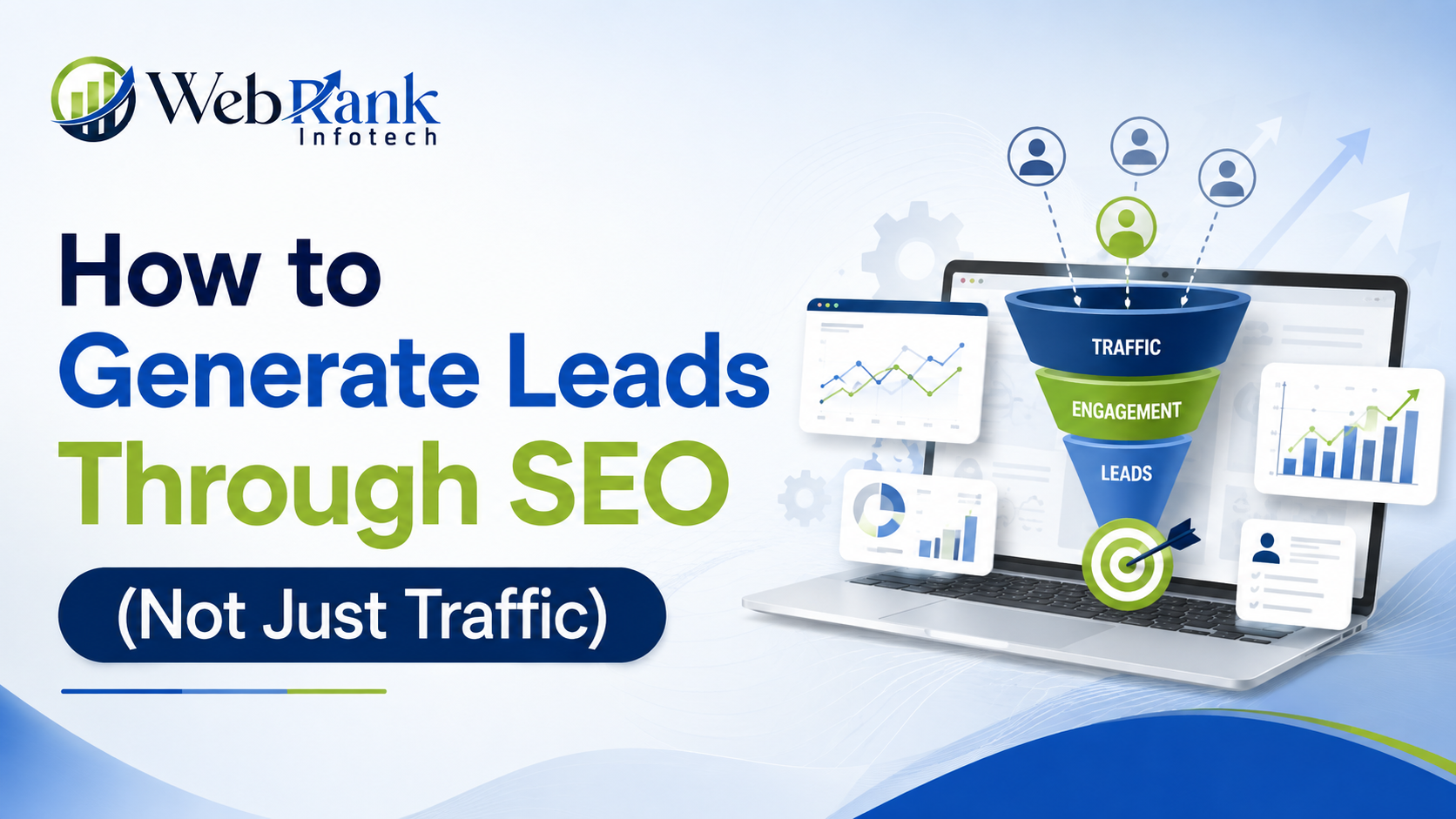
Learning how to generate leads through SEO — not just traffic — comes down to one shift: targeting buyer-intent keywords, mapping content to the funnel, and building conversion points directly into ranking pages, instead of publishing more content and hoping visitors convert on their own.
A website can double its organic traffic and still generate zero new leads. That’s not a rare edge case — it’s the default outcome when SEO gets built around search volume instead of buyer intent. This guide covers exactly how to generate leads through SEO, with a step-by-step framework for turning organic visibility into actual inquiries, form fills, and sales calls.
Table of Contents
- Why Doesn’t More SEO Traffic Always Mean More Leads?
- What Is the Real Difference Between SEO for Traffic and SEO for Leads?
- How to Generate Leads Through SEO: Step-by-Step Guide
- Which SEO Keywords Actually Generate Leads?
- What Metrics Prove SEO Is Generating Leads, Not Just Traffic?
- How Does Technical SEO Affect Lead Conversion?
- Should a Business Handle Lead-Focused SEO In-House or With a Digital Marketing Agency?
- FAQs
(In WordPress, replace this manual list with Rank Math’s native Table of Contents block — it auto-generates and satisfies the TOC checklist item automatically.)
Show Image Alt text to use: “how to generate leads through SEO funnel diagram”
Why Doesn’t More SEO Traffic Always Mean More Leads?
Traffic measures how many people visit a page. Leads measure how many of those visitors take an action that moves them toward becoming a customer. A blog post targeting “what is SEO” can pull in thousands of monthly visitors who are simply curious, while a page targeting “SEO agency pricing in Chandigarh” might get 40 visits a month and generate five real inquiries. Volume and value are two different things entirely.
The mismatch usually comes from keyword selection. Informational keywords attract people early in their research, far from a buying decision. Transactional and commercial-intent keywords attract people who are actively comparing options or ready to act. Optimizing purely for search volume — a common default in many SEO strategies — fills the top of the funnel while leaving the bottom empty.
Skimmable summary: SEO traffic and SEO leads diverge when content targets high-volume, low-intent keywords instead of buyer-ready search terms — meaning a site can see rising traffic charts in Google Search Console while inquiries and sales stay flat.
What Is the Real Difference Between SEO for Traffic and SEO for Leads?
SEO for traffic optimizes for rankings and visitor volume as the end goal. SEO for leads treats rankings and traffic as a means to an end — the real goal is a form submission, a phone call, or a booked consultation. The strategies look similar on the surface (both involve keyword research, content, and technical optimization) but diverge sharply in execution.
| Element | SEO for Traffic | SEO for Leads |
|---|---|---|
| Keyword priority | High search volume | High buyer intent |
| Content goal | Rank and attract visits | Rank, educate, and convert |
| Success metric | Sessions, impressions | Form fills, calls, qualified inquiries |
| Content type | Broad informational guides | Comparison pages, service pages, case studies |
| CTA placement | Optional or generic | Embedded strategically within high-intent content |
Skimmable summary: SEO for traffic and SEO for leads use the same core tactics but optimize for different outcomes — traffic-focused SEO chases visits and impressions, while lead-focused SEO is built around embedding conversion opportunities into content that buyer-intent searchers actually read.
How to Generate Leads Through SEO: Step-by-Step Guide
Businesses that want to know how to generate leads through SEO — rather than just chasing traffic charts — need a repeatable system, not a one-off tactic. The six steps below cover the full process, from keyword selection to reporting.
Show Image Alt text to use: “how to generate leads through SEO step by step process”
Step 1: Target Bottom-of-Funnel and Transactional Keywords First
Before writing another broad educational post, identify keywords that signal someone is close to a buying decision — phrases like “best,” “near me,” “pricing,” “services,” or “vs.” According to data published by Grow and Convert, bottom-of-funnel content converts at a dramatically higher rate than top-of-funnel content, which makes intent — not volume — the more important filter when prioritizing which pages to build first.
Step 2: Map Content to Every Stage of the Buyer Journey
Not every page should chase a sale immediately. Structure content into three tiers: awareness content that answers broad questions, consideration content that compares options, and decision content that pitches the service directly. Each tier should link toward the next, gradually moving a reader from “just researching” to “ready to talk to someone.”
Step 3: Build Topic Clusters Around Buyer Intent, Not Just Search Volume
Group content into clusters built around a core commercial topic, with one strong pillar page and several supporting articles interlinked around it. This structure signals topical authority to search engines while giving readers a clear path from a broad question to a specific, high-intent service page — for example, a cluster built around SEO services that links out to supporting posts on cost, timelines, and agency selection.
Step 4: Add Conversion Points Directly Inside High-Intent Content
A page that ranks well but has no clear next step wastes its own visibility. Every commercial-intent page needs a specific, low-friction CTA — a contact form, a callback request, or a free audit offer — placed where the reader’s intent naturally peaks, not just buried at the bottom of the page.
Step 5: Strengthen Technical SEO So Leads Don’t Leak at the Door
Slow load times, broken forms, and poor mobile experience quietly kill conversions even on well-ranked pages. Google’s own Search Central documentation outlines the technical factors that affect both rankings and user experience, and both matter equally here — a page that ranks first but takes six seconds to load will lose leads before the form ever gets seen.
Step 6: Track Leads, Not Just Rankings, Using Analytics and CRM Integration
Connect Google Analytics 4 to a CRM so form submissions and calls can be traced back to the specific keyword and page that generated them. Without this connection, it’s impossible to know which SEO efforts are actually producing revenue versus which ones are simply producing pageviews.
Skimmable summary: Generating leads through SEO follows a clear sequence — prioritize buyer-intent keywords, structure content by funnel stage, build interlinked topic clusters, embed CTAs where intent peaks, fix technical friction points, and track leads (not rankings) back to their source using analytics tied to a CRM.
Which SEO Keywords Actually Generate Leads?
| Keyword Type | Example | Typical Intent | Lead Potential |
|---|---|---|---|
| Informational | “what is SEO” | Learning | Low |
| Navigational | “WebRank Infotech reviews” | Brand research | Medium |
| Commercial investigation | “best SEO agency in India” | Comparing options | High |
| Transactional | “hire SEO agency Chandigarh” | Ready to act | Very high |
| Local intent | “SEO company near me” | Immediate need | Very high |
A page built around “SEO company near me” or a service-specific query like PPC advertising services will typically convert at a far higher rate than a broad definitional post, even with a fraction of the traffic.
Skimmable summary: Not all keywords carry equal lead value — commercial investigation and transactional keywords consistently outperform informational ones for lead generation, even when they bring in significantly less overall traffic volume.
What Metrics Prove SEO Is Generating Leads, Not Just Traffic?
Tracking the right metrics is what confirms whether a business has actually learned how to generate leads through SEO or is just watching traffic numbers rise without business impact.
Show Image Alt text to use: “SEO leads vs traffic metrics dashboard”
| Metric | What It Reveals |
|---|---|
| Organic form submissions | Direct measure of leads generated from organic search |
| Cost per lead (vs. paid channels) | Shows whether SEO is actually cheaper per lead than PPC |
| Keyword-to-conversion mapping | Identifies which specific keywords produce real inquiries |
| Landing page conversion rate | Flags high-traffic pages that fail to convert |
| Assisted conversions in GA4 | Captures leads where SEO played a supporting role, not just the final click |
Skimmable summary: Proving SEO’s lead-generation value requires tracking form submissions, cost per lead, and keyword-to-conversion mapping — not just organic sessions — since traffic dashboards alone can’t show whether visitors ever became real business inquiries.
How Does Technical SEO Affect Lead Conversion?
Technical SEO determines whether a ranking page can actually hold a visitor long enough to convert. Slow page speed increases bounce rate before a CTA is even visible. Poor mobile responsiveness breaks form fields on the device most users now browse from. Broken internal links strand visitors mid-journey through a topic cluster designed to build toward a conversion.
A page ranking on page one of Google with a five-second load time is often converting worse than a page ranking on position four that loads instantly — because half the audience never waits around to see the offer.
Skimmable summary: Technical SEO isn’t just a ranking factor — page speed, mobile usability, and clean internal linking directly determine whether a visitor sticks around long enough to actually convert into a lead once they land on a ranking page.
Should a Business Handle Lead-Focused SEO In-House or With a Digital Marketing Agency?
Lead-focused SEO requires keyword research, content strategy, technical fixes, and conversion tracking working together — a combination that’s difficult for a single in-house generalist to manage well. A digital marketing agency with dedicated SEO, content, and analytics specialists typically builds and executes this system faster, since the process (topic clusters, CTA placement, CRM integration) has already been refined across other client accounts.
Businesses without in-house SEO expertise or bandwidth to manage technical audits and CRM tracking often see faster lead results by partnering with an established SEO team rather than building the entire system from scratch internally.
Skimmable summary: Lead-focused SEO involves enough moving parts — keyword strategy, content, technical fixes, and tracking — that most businesses without a dedicated internal SEO specialist see faster, more reliable results working with a digital marketing agency that already runs this system for other clients.
FAQs: Generating Leads Through SEO
Does more website traffic always lead to more sales?
No, more traffic does not automatically produce more sales. Traffic only converts to sales when the visitors arriving are actually in a buying mindset and the page gives them a clear next step. A blog post ranking for a broad, informational keyword can pull in thousands of visitors monthly while generating zero inquiries, while a smaller, highly targeted service page can produce consistent leads with a fraction of the traffic.
How long does it take to see leads from SEO, not just traffic?
Most websites start seeing early lead activity within three to six months, with more consistent lead flow developing by month six to nine. A local business targeting a competitive commercial keyword typically sees ranking movement first, followed by a lag of several weeks before that ranking translates into actual form submissions or calls, since search engines and users both need time to build trust in newer or improved pages.
What’s the biggest mistake businesses make when trying to generate leads through SEO?
The most common mistake is prioritizing keyword search volume over buyer intent when planning content. A business chasing a high-volume informational keyword might succeed in ranking and driving traffic, only to discover the visitors were never close to a purchase decision — while a lower-volume, high-intent keyword targeting people actively comparing service providers would have produced far more actual leads.
Can local businesses generate leads through SEO without a large content budget?
Yes, local businesses can generate leads with a focused, smaller content budget by prioritizing high-intent local keywords over broad topics. A neighborhood clinic optimizing five or six pages around specific services and location-based search terms, paired with a well-optimized Google Business Profile, often outperforms a business publishing twenty generic blog posts with no local targeting.
Do blog posts actually generate leads, or only service pages?
Yes, blog posts can generate leads when they target commercial or comparison-based topics and include a clear conversion path. A blog post comparing “SEO vs PPC” or explaining “how much SEO costs” attracts readers actively evaluating a purchase decision, and when that post links directly to a service page or includes a consultation CTA, it can convert at rates close to a dedicated service page.
How does technical SEO impact lead generation specifically?
Technical SEO impacts lead generation by determining whether visitors stay on a page long enough to see and use a conversion point. A page that ranks well but loads slowly on mobile, where most local searches happen, will lose a significant share of visitors before they ever reach a contact form, regardless of how strong the ranking or content quality is.
Is it better to target one high-volume keyword or several low-volume, high-intent keywords?
Several low-volume, high-intent keywords generally produce more leads than a single high-volume, low-intent keyword. A page ranking for one broad term with 5,000 monthly searches but low buyer intent often generates fewer inquiries than five smaller pages collectively driving 500 monthly searches from people actively looking to hire a service, since intent — not volume — is what drives the conversion.
What role does a CRM play in SEO lead generation?
A CRM plays a critical role by connecting specific keywords and landing pages to actual sales outcomes. Without CRM integration, a business can see that a page is generating form submissions but has no way of knowing whether those leads are turning into paying customers, which makes it impossible to judge whether an SEO strategy is actually producing revenue or just activity.