
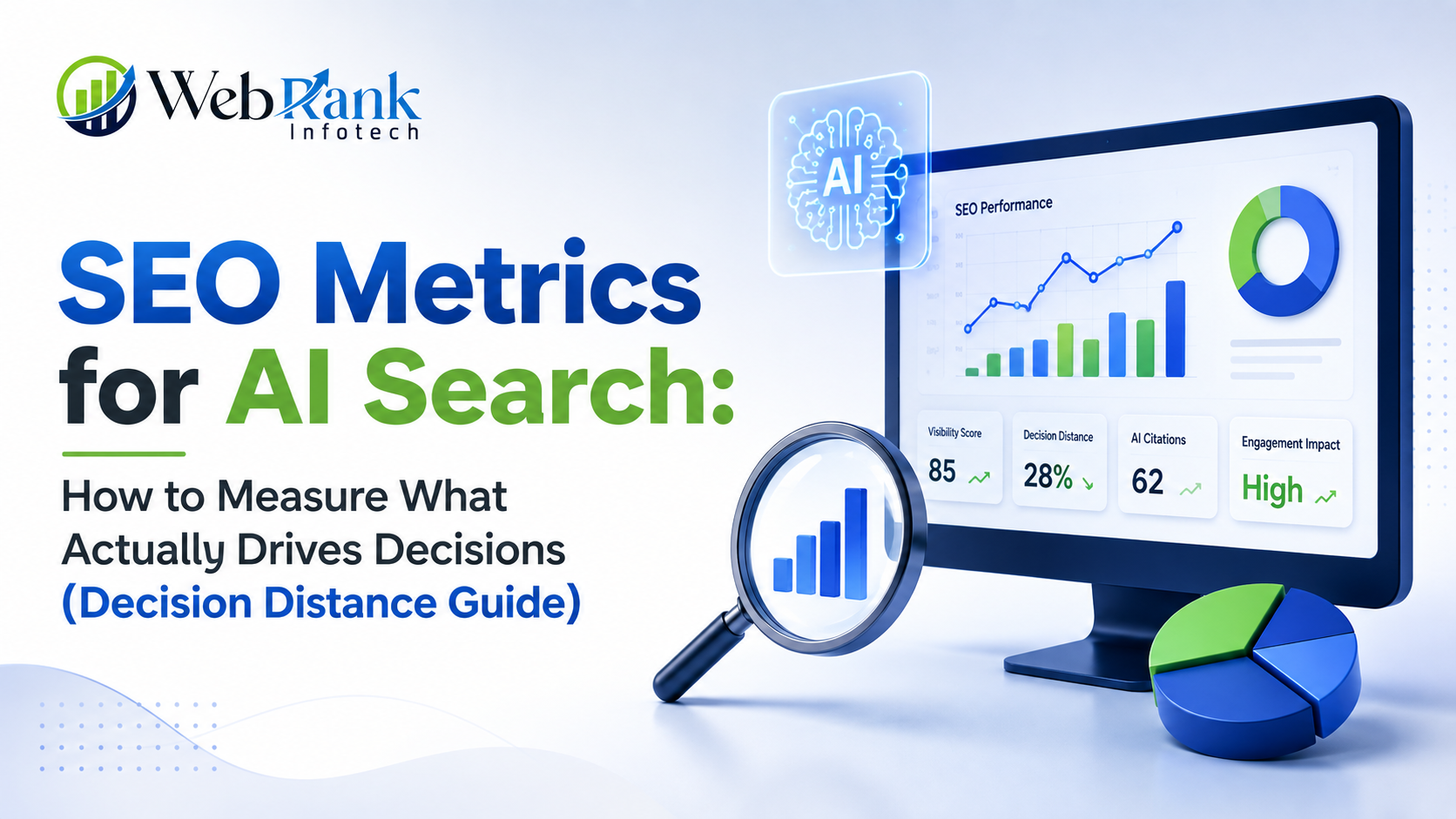
Clicks, rankings, and CTR only show what happened after someone already decided. They do not show why a brand was chosen over another, or why an AI engine mentioned a competitor instead. The metric worth tracking in 2026 is the gap between what an audience needs to hear before deciding and what a brand’s content actually says — a concept called Decision Distance. Closing that gap is what determines whether a brand gets clicked, cited, or skipped entirely.
Most teams tracking SEO metrics for AI search are still watching rankings and traffic charts while the actual decision now happens inside an AI-generated answer, before any click occurs. Search has changed shape.
On this page:
- Why Traditional SEO Metrics Fall Short in AI Search
- What Is Decision Distance in SEO
- How to Measure Decision Distance Step by Step
- AI Search Metrics to Track Alongside It
- How a Digital Marketing Agency Applies It
- Tools to Calculate It
- Framework Rating Out of 5
- Common Measurement Mistakes
- FAQs AI Overviews, ChatGPT, Perplexity, and Gemini now answer a question before a user ever opens a website, and most SEO dashboards still report on a world where clicking was the only way to get an answer. That mismatch is why so many teams see stable rankings and falling traffic at the same time. This guide breaks down what to measure instead, and how to do it — step by step.
Why Do Traditional SEO Metrics Fall Short in the Age of AI Search?
Traditional metrics — CTR, bounce rate, rankings, conversion rate — are outcome metrics. They confirm that an action was taken, but not what caused it. CTR shows that a listing was clicked; it does not show why that listing felt more trustworthy than the one above it. Bounce rate shows that a visitor left; it does not show which expectation was unmet. Rankings show visibility; they do not show whether the brand was actually the one chosen among the options an LLM or a searcher considered.
This blind spot existed before AI search, but generative answers have made it far more costly. When Google’s AI Overviews or a chatbot synthesizes a single answer from multiple sources, a large part of the decision-making process now happens inside that answer box — outside any website’s analytics, and outside a brand’s field of vision entirely.
What Each Traditional Metric Shows vs. What It Hides
| Metric | What It Confirms | What It Misses |
| CTR | A result was clicked | Why it felt more compelling than competitors |
| Bounce Rate | A visitor left the page | Which need or expectation went unmet |
| Conversion Rate | A purchase or sign-up happened | Which psychological barrier was overcome |
| Keyword Rankings | Content is visible in search | Whether the brand was actually chosen |
| AI Visibility / Citations | A brand was mentioned by an LLM | Whether that mention influenced the final decision |
Skim summary: Every legacy SEO metric measures the result of a decision that has already been made, not the reasoning that produced it. In AI search, where a synthesized answer often replaces the research phase entirely, that missing context is the single biggest reporting gap most SEO teams currently have.
What Is Decision Distance in SEO?
Decision Distance is the semantic gap between the motivations that actually drive a person’s decision (functional, emotional, and social) and the messaging a brand publishes across its customer journey — product pages, landing pages, blog content, and ad copy. The smaller that gap, the more likely a brand is to be chosen by a human or surfaced by an AI engine synthesizing an answer.
The idea comes from a framework introduced by Giulia Panozzo in a Search Engine Journal analysis on AI-era SEO measurement, and it reframes a question every SEO team should already be asking: does the content answer the query, or does it answer the reason behind the query?
A Real-World Example
Consider someone searching for payroll software. Their biggest hesitation might be trusting a third party with sensitive employee data — a trust-driven concern. If a product page spends most of its copy on feature lists, integrations, and dashboards instead of addressing data security and compliance, the Decision Distance is high. The page may match the keyword perfectly and still fail to convert, because it never addressed the actual reason the visitor was hesitant.
Skim summary: Decision Distance measures alignment, not visibility. A page can rank in position one and still lose the decision if its messaging talks about the wrong thing relative to what the audience actually needs reassurance about before moving forward.
How Can You Measure Decision Distance Step by Step?
This is a practical, four-step process that pairs semantic analysis with existing customer research. Each step builds on the one before it, so treat this as a sequence rather than a checklist to pick from.
Step 1: Identify Decision Drivers From Customer Language
Start by defining the core decision drivers relevant to the market — common ones include value for money, trust, convenience, social proof, and quality. Write a short, precise description for each driver, since these descriptions become the semantic reference points everything else gets compared against.
Then collect audience language: search queries, support tickets, CRM notes, review text, and social listening data. Map that language against each driver using sentence embeddings and semantic similarity — a technique also useful for vector-based SEO analysis. Tag each driver by customer journey stage (awareness, consideration, evaluation, purchase, loyalty) so the output tells the team not just what matters, but when it matters.
Step 2: Score How Strongly Brand Messaging Reflects Those Drivers
Run the same driver framework against owned content — product pages, landing pages, blog posts, and ad copy. This produces a brand-side profile showing which drivers are being reinforced and which are being ignored entirely. Most teams are surprised to find their content leans heavily on one or two drivers (often convenience or features) while audience language is dominated by something else entirely, like trust or quality.
Step 3: Compare the Two Profiles to Calculate the Gap
Line up the audience profile against the brand profile, driver by driver. The difference between the two is the Decision Distance score, and the individual gaps show exactly where messaging and audience motivation diverge. A large positive gap on “trust,” for instance, means the audience is asking for reassurance the content never gives.
Step 4: Close the Gaps Through Messaging and Content Changes
Use the gap data as a prioritized content roadmap. That might mean adding trust signals to a landing page, restructuring a product page around the top three unaddressed drivers, or briefing a content team to stop writing about features and start writing about outcomes. This step turns a diagnostic exercise into an action plan.
Decision Distance Measurement at a Glance
| Step | Goal | Primary Input |
| 1. Identify drivers | Understand what the audience actually cares about | Queries, reviews, CRM, support tickets |
| 2. Score messaging | Understand what the brand currently emphasizes | Website copy, ads, landing pages |
| 3. Compare profiles | Find the exact gap | Semantic similarity scoring |
| 4. Close the gap | Fix messaging where it matters most | Content and CRO roadmap |
Skim summary: Measuring Decision Distance is a four-step semantic comparison: define what drives a decision, score how the brand currently talks, compare the two, and rewrite content to close the largest gaps first. It works as a layer on top of existing SEO and CRO processes rather than a replacement for them.
Which AI Search Metrics Should Be Tracked Alongside Decision Distance?
Choosing the right SEO metrics for AI search means pairing visibility data with the Decision Distance score rather than picking one or the other. Decision Distance explains why a brand is or is not chosen. It should sit alongside — not instead of — the newer visibility metrics that show whether a brand is even part of the conversation an AI engine is having with a user.
| Metric | What It Measures | Where to Track It |
| Citation Rate | How often an AI engine cites the brand as a source | ChatGPT, Perplexity, Google AI Overviews |
| Share of Voice / Share of Model | Brand presence vs. competitors across a prompt set | GEO monitoring tools |
| Prompt Coverage | How many relevant prompts return the brand at all | Manual or automated prompt testing |
| AI Referral Conversions | Conversion rate of traffic arriving from AI tools | GA4, server logs |
| Decision Distance Score | Alignment between messaging and actual decision drivers | Custom semantic scoring |
Skim summary: Citation rate and share of voice confirm a brand is present in AI-generated answers. Decision Distance confirms the content behind that presence is actually the reason a decision leans in the brand’s favor rather than a competitor’s. Both are needed for a complete measurement picture in 2026.
How Does a Digital Marketing Agency Apply Decision Distance in Real Campaigns?
A digital marketing agency running SEO, PPC, and reputation management at the same time is in a strong position to apply this framework, because Decision Distance data touches every one of those disciplines rather than sitting inside SEO alone.
For SEO campaigns, the gap analysis directly informs which pages need messaging rewrites versus which need net-new content targeting an unaddressed driver. For PPC campaigns, driver gaps translate into ad copy testing — if trust is the dominant unaddressed driver, ad variants built around guarantees or credentials typically outperform feature-led copy. For online reputation management, Decision Distance often surfaces why negative reviews are hurting conversions more than expected — usually because the review language mirrors an unaddressed driver, like trust or quality, that the brand’s own content never speaks to.
A practical rollout looks like this: run the driver-mapping exercise once per quarter, feed the top three gaps into that quarter’s content and CRO backlog, and re-measure after the changes ship. Teams offering social media marketing services can use the same driver framework to test which content themes actually move engagement, rather than guessing based on format alone.
Skim summary: Decision Distance is not an SEO-only exercise. It is a shared diagnostic that an agency can apply across SEO, PPC, reputation management, and social content, because all four disciplines are ultimately trying to close the same gap between what a brand says and what a buyer needs to hear.
What Tools Help Calculate Decision Distance and AI Visibility?
Nothing here requires expensive enterprise software to get started. A working version of this framework can be built with tools most marketing teams already have access to, plus a few specialized options for teams ready to scale it.
For Decision Distance Calculation
- Sentence embedding models (open-source or via API) to score semantic similarity between audience language and brand messaging
- Google Colab or a similar notebook environment to run the driver-mapping script without needing a dedicated data science team
- CRM and support ticket exports as a low-cost source of authentic audience language beyond search queries alone
For AI Visibility Tracking
- Manual prompt testing across ChatGPT, Perplexity, Gemini, and Google AI Mode using a fixed prompt list, refreshed monthly
- Dedicated GEO monitoring platforms for teams tracking citation frequency at scale across dozens or hundreds of prompts
- Google Search Console and GA4 to correlate AI-referral traffic with on-site behavior once a user does click through
Skim summary: Decision Distance can be piloted with free or low-cost tools — a notebook environment, an embeddings model, and existing CRM data — before any budget is committed to a dedicated GEO platform. That makes it accessible for small and mid-sized teams, not just enterprise budgets.
Decision Distance Framework — Honest Rating Out of 5
This is an evaluation of the framework itself, judged against the criteria that matter for a team actually trying to implement it, not just read about it.
| Criteria | Score | Notes |
| Ease of Implementation | 3.5/5 | Requires basic comfort with embeddings and a notebook environment; not point-and-click |
| Data Requirement | 3/5 | Needs a reasonable volume of audience language (queries, reviews, tickets) to be reliable |
| Actionability | 4.5/5 | Output maps directly to a content and messaging roadmap, not abstract scores |
| Cost to Start | 4.5/5 | Can be piloted with free tools before any platform spend |
| Long-Term Scalability | 4/5 | Works well as a recurring quarterly process once the initial setup is done |
| Overall | 4/5 | A strong diagnostic layer for teams willing to invest a few hours in setup; not a plug-and-play dashboard metric |
Skim summary: Decision Distance rates 4 out of 5 overall. Its biggest strength is turning semantic analysis into a direct content roadmap rather than a vanity score. Its main limitation is that it requires some technical setup and a real volume of audience language before the output becomes reliable.
What Mistakes Hurt AI Search Measurement?
Most measurement failures in AI search come from applying old assumptions to a new environment rather than from a lack of data.
Treating AI Visibility as the Finish Line
Being cited by an AI engine is not the same as being chosen. A citation confirms presence; it says nothing about whether that mention actually moved someone toward a decision. Pairing citation data with Decision Distance closes that gap.
Measuring Only After the Click
Analytics tools are built to measure what happens after a visit. In 2026, a large share of the decision process happens inside the AI answer itself, before any click occurs. Waiting for click data means measuring a decision after it can no longer be influenced.
Skipping the Audience-Language Step
Some teams jump straight to scoring their own content against generic drivers without first grounding those drivers in real audience language. That produces a tidy-looking gap analysis that does not reflect what the actual audience cares about.
Skim summary: The most common measurement mistakes in AI search are stopping at visibility metrics, relying only on post-click data, and skipping the step of grounding decision drivers in real audience language before scoring brand content against them.
Conclusion
Rankings, clicks, and citations still matter, but they only confirm what already happened. Decision Distance fills the gap by showing whether messaging actually addresses the reasons someone chooses one brand over another — and that gap is exactly where most AI search visibility is being won or lost in 2026. Tracking the right SEO metrics for AI search now means combining citation data, share of voice, and Decision Distance into one report, not choosing between them. Pairing this framework with a proven SEO strategy gives a far more complete measurement picture than rankings and traffic alone ever provided.
Frequently Asked Questions
What is Decision Distance in SEO?
Decision Distance is the semantic gap between what actually drives a person’s decision — functional, emotional, or social motivations — and what a brand’s content communicates. A payroll software page that talks only about features while its buyers are worried about data security has a high Decision Distance, even if it ranks well, because the content never addresses the real hesitation standing between the visitor and a decision.
Is Decision Distance a Google ranking factor?
No, it is not a confirmed ranking factor. It is a measurement framework, not a signal Google has stated it uses directly. Its value comes from explaining behavior that ranking factors alone cannot — for example, two pages can rank in nearly identical positions for the same keyword, yet one converts and gets cited by AI engines far more often because its messaging matches audience motivation more closely.
How is Decision Distance different from an AI visibility score?
An AI visibility score measures how often a brand is mentioned inside AI-generated answers. Decision Distance measures whether the content behind that mention actually addresses what the audience needs to hear before deciding. A brand can have a high visibility score and a high Decision Distance at the same time — meaning it gets mentioned often but rarely gets chosen, similar to a salesperson who talks a lot but never actually answers the customer’s real objection.
Can a small business measure Decision Distance without a data science team?
Yes, a basic version can be built using free tools. A small team can use a Google Colab notebook with an open-source embeddings model, pull audience language from existing reviews and support tickets, and manually score a handful of key landing pages against five or six decision drivers. It will not be as polished as an enterprise setup, but it will surface the same directional gaps — similar to running a manual site audit before investing in a paid crawler tool.
How often should Decision Distance be measured?
Quarterly works well for most businesses, with a lighter check-in after any major messaging or product change. Audience language shifts slowly in most industries, so measuring monthly rarely reveals meaningful new gaps, while measuring only once a year risks missing a shift caused by a new competitor or a change in customer priorities — much like reviewing keyword rankings too infrequently to catch a competitor’s content push.
Does Decision Distance replace traditional SEO reporting?
No, it works alongside traditional SEO reporting rather than replacing it. Rankings, traffic, and conversion rate still confirm whether content is being seen and acted on. Decision Distance adds the missing layer by explaining why those numbers move the way they do, the same way a churn survey adds context to a raw churn-rate number instead of replacing it.