
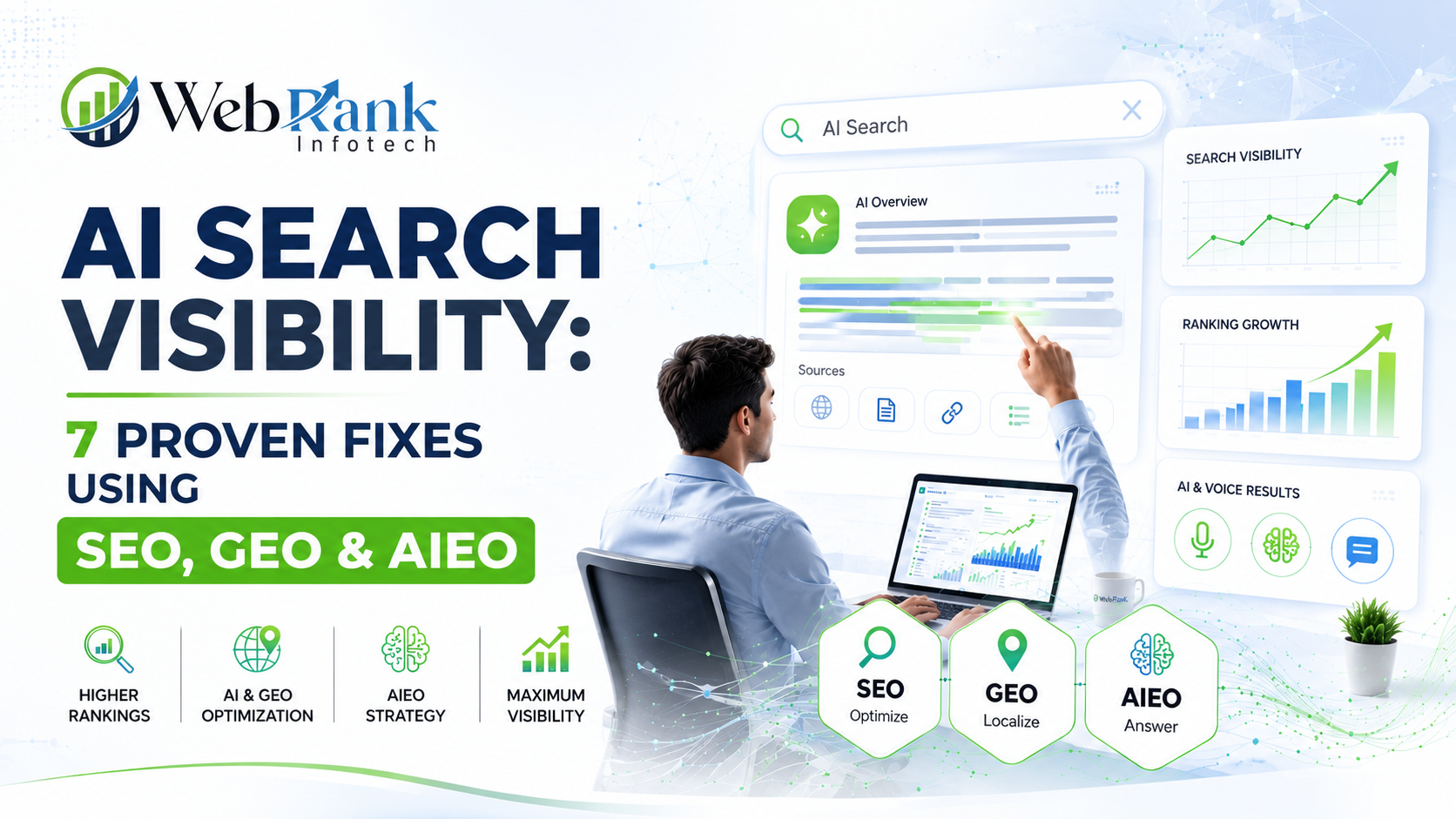
Your customers stopped scrolling through ten blue links. They started asking ChatGPT, Google AI Overviews, and Perplexity direct questions and trusting the answer they get back. If your business isn’t the answer being cited, you’re invisible — no matter how well you rank on page one. Fixing that takes three connected disciplines: SEO to earn the click, GEO to earn the citation, and AIEO to earn the AI’s trust.
Search behavior has shifted more in the last eighteen months than in the previous five years combined. We used to tell clients “get to page one and you’re done.” Not anymore. Now the message is simple: page one doesn’t matter much if the AI Overview sitting above it never mentions your name. Here’s exactly how we diagnose weak AI search visibility and fix it, step by step.
The short version, before we go deep:
- Test your brand against AI tools with real customer questions.
- Fix technical SEO first — GEO and AIEO can’t work without it.
- Restructure content into direct-answer format.
- Add schema markup so AI can parse your business correctly.
- Build E-E-A-T signals AI systems can verify.
- Earn third-party citations to strengthen trust.
- Monitor AI search visibility monthly and adjust.
What Does It Mean When Your Business Is “Invisible” on AI Search?
Invisibility on AI search doesn’t mean your website is broken or unindexed. It just means AI tools like Google AI Overviews, ChatGPT, and Perplexity never bring up your brand, your product, or your expertise when someone asks a question you could easily answer. You can rank #3 on Google and still be completely missing from the AI-generated summary sitting right above that ranking. This happens constantly — a client’s site pulls decent organic traffic, but the moment someone asks ChatGPT or Perplexity the exact question their landing page targets, their name never shows up. That’s poor AI search visibility in 2026: not a ranking problem, a recognition problem.
In short: being invisible on AI search means AI tools skip your brand entirely when generating an answer, even if your traditional SEO looks healthy.
Why Is AI Changing the Way People Search for Businesses Like Yours?
People now expect a direct answer, not a list of links to sift through, and that’s changing everything about search. A Pew Research Center analysis found users clicked on a traditional search result in just 8% of searches with an AI summary present, compared to nearly double that rate on searches without one. We’ve watched this play out in client analytics too — click-through rates on informational queries have dropped even while rankings held steady or improved. The traffic isn’t going to a competitor anymore; the AI answer is simply absorbing it. That’s why success today gets measured less by rank position and more by how often a brand gets cited inside the AI answer itself.
Simply put: AI answers are replacing the click. If your content isn’t structured to be quoted by AI, you lose visibility even while ranking well.
What Is the Difference Between SEO, GEO, and AIEO?
These three disciplines solve different problems, and it helps to think of it this way: SEO gets you found, GEO gets you quoted, and AIEO gets you trusted at scale.
| Discipline | What It Optimizes For | Primary Goal | Where It Shows Up |
|---|---|---|---|
| SEO (Search Engine Optimization) | Traditional search engine rankings | Rank on page one of Google/Bing | Organic search results |
| GEO (Generative Engine Optimization) | Being cited inside AI-generated answers | Get quoted or summarized by AI | Google AI Overviews, Perplexity, AI Mode |
| AIEO (AI Engine Optimization) | How AI systems judge your overall trust and authority | Long-term credibility across every AI platform | ChatGPT, Claude, Gemini, voice assistants |
Show Image
Technical health, on-page structure, and backlinks still matter, which is why SEO Services remain the foundation for every client we work with. GEO builds on top of that by shaping how content gets pulled into AI summaries. AIEO sits above both, since it’s less about a single page and more about whether AI systems, over time, decide your brand is worth referencing at all. Strong AI search visibility almost always comes from running all three together, not picking just one. For a closer look at how the technical and on-page side comes together, check out our SEO services page.
Quick summary: SEO ranks you, GEO gets you quoted by AI, and AIEO builds the long-term trust that keeps you visible everywhere. They work together, not as substitutes for each other.
How Do You Check Your AI Search Visibility Today?
You find out by testing, not guessing. Here’s the checklist we run through with every client before touching a single page.
Run the Direct-Question Test
Ask ChatGPT, Perplexity, and Google AI Mode the exact question your ideal customer would type — not your brand name, the actual problem they’re trying to solve. If your business doesn’t show up in the answer, that’s a visibility gap.
Check Your AI Overview Presence
Search your top five money keywords on Google and note whether an AI Overview appears, and whether your domain gets cited inside it. Keeping a simple monthly spreadsheet for this per client makes patterns easy to spot.
Audit Your Structured Data
Missing or broken schema markup is one of the most common reasons AI systems can’t parse a site correctly. Google’s own structured data documentation is worth bookmarking for every audit.
Review Your Off-Site Trust Signals
AI systems weigh reviews, mentions, and third-party citations heavily. If your brand rarely shows up outside your own website, that’s a trust gap AIEO needs to close — which is exactly why AIEO work often goes hand in hand with online reputation management for clients with a thin review footprint.
In one line: test your visibility with real questions across three AI tools, check schema, and audit off-site trust — that combination tells you exactly where you’re invisible and why.
How to Fix Weak AI Search Visibility: A Step-by-Step Process
This is the sequence we follow with clients, and skipping a step usually means redoing it later.
Step 1: Audit Current AI and Search Visibility
Start by documenting where things currently stand — rankings, AI Overview appearances, and citation frequency across ChatGPT and Perplexity. Without this baseline, there’s no way to prove improvement later.
Step 2: Fix the Technical and On-Page SEO Foundation
GEO and AIEO can’t fix a site with broken crawlability, slow load times, or missing metadata. This groundwork comes first, always, before any AI-specific work begins.
Step 3: Restructure Content Into Direct-Answer Format
AI systems favor content that answers a question in the first two sentences, then expands from there. Rewriting key pages so the direct answer sits at the top — the same structure used in this article — makes a real difference.
Step 4: Add Structured Data and Entity Markup
Schema.org markup — FAQ schema, Organization schema, Product schema where relevant — helps AI crawlers understand exactly what a business does and who it serves.
Step 5: Build E-E-A-T Signals That AI Systems Can Verify
Author bios, credentials, case studies, and original data all need to be visible and consistent across the site. AI models weigh demonstrated experience heavily when deciding what to cite.
Step 6: Earn Third-Party Citations and Mentions
Digital PR, guest contributions, and directory listings that reference the brand by name all add up. AI systems cross-reference multiple sources before trusting a brand — one polished website alone is never enough.
Step 7: Monitor and Iterate Monthly
Re-running the direct-question test every month, and tracking whether citation frequency is climbing, keeps the strategy honest. AI models update constantly, so this isn’t a one-time fix.
Skimmable takeaway: fixing AI invisibility means auditing first, strengthening technical SEO, restructuring content for direct answers, adding schema, proving expertise, earning outside citations, then monitoring monthly — in that exact order.
Which Tools Actually Show You Your AI Search Visibility?
A mix of manual testing and dedicated platforms works best, because no single tool tells the whole story yet.
| Tool | Best For | Limitation |
|---|---|---|
| Manual prompts in ChatGPT, Perplexity, Gemini | Real citation testing | Time-consuming, not scalable alone |
| Google Search Console | Traditional ranking and impression data | Doesn’t separate AI Overview clicks |
| Schema markup validators (Google’s Rich Results Test) | Confirming structured data works | Doesn’t measure AI citations |
| AI-visibility tracking platforms (emerging category) | Tracking brand mentions across AI tools at scale | Still maturing, coverage varies by tool |
Manual testing paired with Search Console data covers most clients well, since the newer AI-tracking platforms are useful but not yet complete on their own.
Bottom line: no single dashboard covers AI visibility fully yet — the reliable method today is combining manual AI testing with your existing Search Console data.
Should You Hire an SEO Services Expert or Handle GEO and AIEO Yourself?
Handling basic GEO and AIEO steps yourself is realistic if there’s time to test AI tools weekly and keep rewriting content consistently. In practice, though, most business owners simply don’t have the bandwidth to run technical audits, implement schema, and track AI citations every month on top of actually running their business. When a client comes to us after months of DIY effort with flat results, it’s almost always because content got fixed but the technical or trust layer underneath it never did. That’s exactly why all three disciplines get run together here rather than treated as separate services — see how that comes together on the about page, or reach out through the contact page for a visibility audit.
Short version: DIY works for small, consistent tweaks, but hiring an expert makes sense once you need technical audits, schema, and monthly AI monitoring running together.
How Long Does It Take to Become Visible on AI Search?
The first measurable movement — an AI tool mentioning a brand where it didn’t before — usually shows up within 6 to 10 weeks of consistent work. Full, stable AI search visibility across multiple AI platforms typically takes 3 to 6 months, since AI systems need repeated, consistent signals before they’ll trust a source enough to cite it regularly. Sites with strong existing SEO and some off-site authority move faster. Brand-new sites with no history take longer, the same way they always have with traditional SEO.
In brief: expect early signs in 6-10 weeks and stable AI visibility in 3-6 months, depending on how much existing authority the site already has.
Our Honest Review — SEO vs GEO vs AIEO, Rated Out of 5
Each discipline gets judged here on three factors: speed of results, effort required, and durability once achieved.
| Discipline | Speed | Effort Required | Durability | Rating |
|---|---|---|---|---|
| SEO | Moderate (3-6 months) | Moderate | High — compounds over years | 4.5 / 5 |
| GEO | Fast (weeks) | Low-Moderate | Medium — depends on AI model updates | 4 / 5 |
| AIEO | Slow (3-6+ months) | High | Very High — builds lasting trust | 4.5 / 5 |
The honest take: SEO remains the most reliable long-term investment, since it compounds and rarely disappears overnight. GEO delivers the fastest visible wins, which is great for a quick proof of concept, but it’s also the most exposed to sudden shifts since AI models retrain often. AIEO takes the most work and patience, but it’s the one that protects a brand across every AI platform at once, not just Google. If a client asks where to put the first dollar, the answer is still SEO — everything else builds on top of it.
Quick verdict: SEO scores highest for durability, GEO wins on speed, and AIEO takes the most effort but pays off hardest over time — none of the three should be skipped entirely.
Conclusion
Weak AI search visibility isn’t a niche problem anymore — it’s the default state for any business that hasn’t adapted its content and technical foundation for how AI actually reads the web. This guide covered exactly how to diagnose it, fix it, and track progress, using SEO as the foundation, GEO to earn AI citations, and AIEO to build the trust that keeps a brand visible everywhere, not just on Google. Start with the direct-question test today — ask ChatGPT or Perplexity the question your best customer would ask, and see what comes back.
FAQs
What is AIEO in simple terms?
AIEO stands for AI Engine Optimization — the practice of building trust and authority signals that AI systems use to decide whether a brand is worth citing. Think of it like reputation-building, but for machines: the more consistently AI tools find a brand mentioned, credentialed, and cited elsewhere, the more they trust it as a source. In one case, building out consistent author bios and case studies for a client’s site got ChatGPT referencing them by name within two months — something that had never happened before.
Is GEO the same as SEO?
No, GEO and SEO are related but different. SEO optimizes for ranking in traditional search results, while GEO optimizes specifically for getting cited or summarized inside AI-generated answers. Plenty of pages rank on page one of Google and still never appear in an AI Overview — that gap is exactly what GEO closes.
Can small businesses compete for AI search visibility?
Yes, small businesses can absolutely compete, sometimes faster than larger competitors. AI systems reward clear, well-structured, trustworthy content regardless of company size. One local service business even outranked a national brand in an AI Overview simply because their content answered the exact question more directly and had cleaner schema markup.
Does AI SEO replace traditional SEO Services?
No, AI SEO builds on traditional SEO rather than replacing it. Technical health, site speed, and quality backlinks still form the foundation every AI-focused strategy sits on top of. A GEO or AIEO campaign rarely succeeds on a site with weak technical SEO underneath it.
How do I check if ChatGPT knows about my business?
Ask ChatGPT the exact question your ideal customer would ask, without mentioning your brand name, and see if your business comes up naturally in the answer. Running this test monthly, using three or four different phrasings of the same core question, gives the clearest picture, since AI answers can vary depending on exact wording.
What’s the biggest mistake businesses make with AI search optimization?
The biggest mistake is treating GEO as a quick content trick instead of pairing it with real technical SEO and trust-building. Businesses rewrite a few pages to sound more “AI-friendly,” expect citations within days, then get discouraged when nothing changes — because the underlying schema, site structure, and off-site authority never got addressed.