
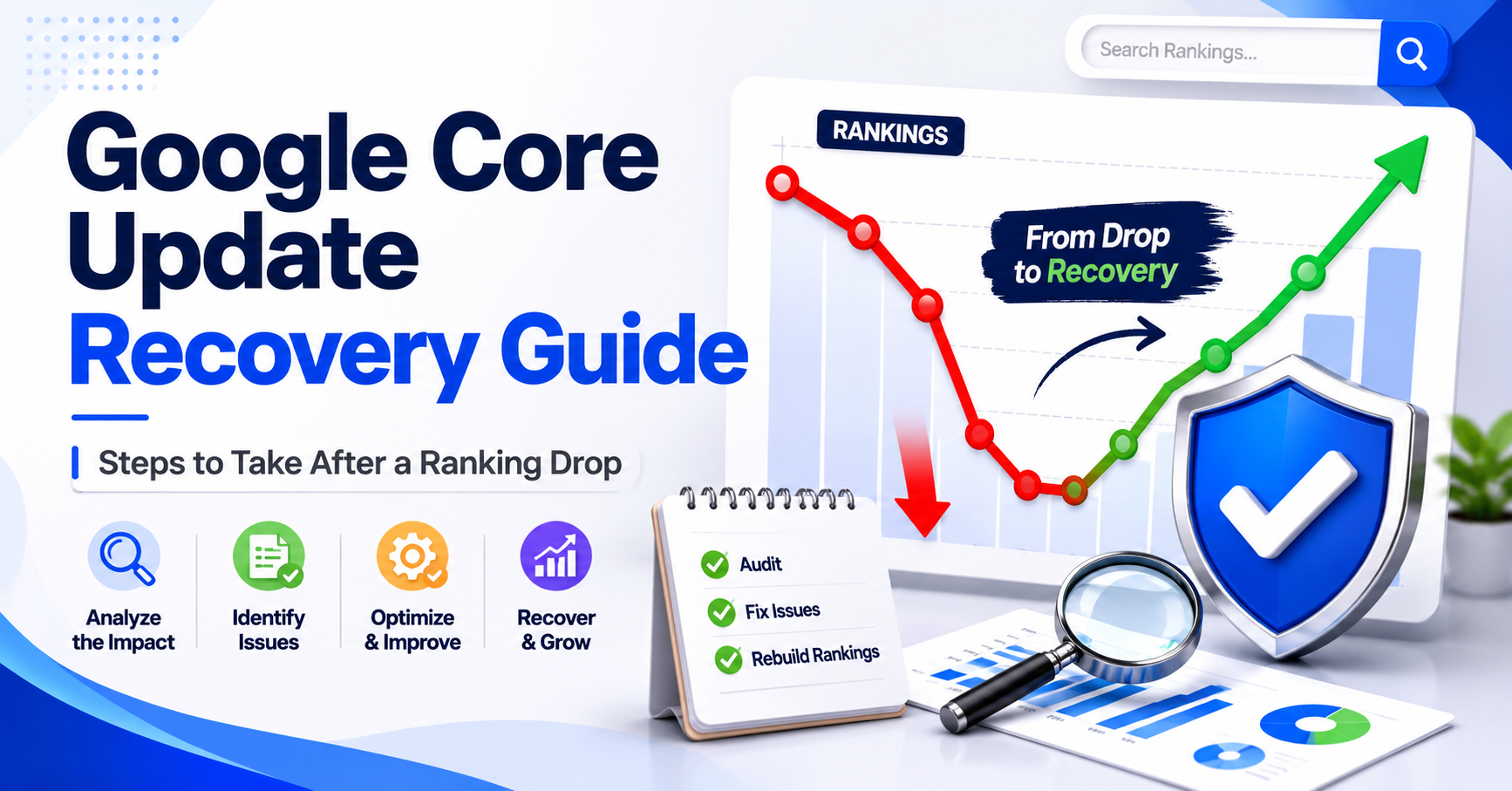
So your rankings dropped overnight. You opened Google Search Console and the traffic graph looked like it fell off a cliff. If this happened to you after the Google May 2026 core update, you are not alone.
Thousands of websites saw major ranking shifts starting May 21, 2026. At WebRank Infotech, we have been tracking this update since day one and helping businesses in Chandigarh and across India bounce back. This is your complete Google core update recovery plan — honest, practical, and easy to follow.
What Is a Google Core Update and Why Did Your Rankings Drop?
A Google core update is a broad change to Google’s main ranking systems. It is not a penalty — it is Google reassessing which pages deserve to rank higher based on quality, relevance, and trust.
The May 2026 Google core update is the second core update of this year after March 2026. It uses Gemini-based AI quality models to evaluate content, making it significantly smarter at detecting thin, unhelpful, or AI-spun pages.
A ranking drop after a core update means one thing: competing pages are currently scoring higher on Google’s quality signals than yours. That is fixable.
Step 1: Wait for the Rollout to Complete Before Panicking
The May 2026 core update started on May 21 and completes around June 4, 2026. Rankings are extremely volatile during this window.
Do not do this while the update is rolling:
- Rewrite or delete content in a panic
- Change your URL structure
- Disavow backlinks randomly
- Make major design changes
Do this instead:
- Open Google Search Console daily
- Track impressions and average position — not just traffic
- Separate branded vs non-branded keyword performance
- Wait at least one full week after June 4 before drawing conclusions
Patience is not weakness here. It is strategy.
Step 2: Identify Exactly Which Pages Were Hit
Go to Google Search Console → Performance Report. Compare the two weeks before May 21 against the current period.
Look for:
- Pages that lost the most impressions (Google showing them less)
- Pages where average position dropped from page 1 to page 2 or 3
- Specific queries that lost clicks — informational drops suggest content depth issues, commercial drops suggest trust issues
Group pages by type: blog posts, service pages, homepage. Each group needs a different fix.
For further analysis, check tools like Google Search Console and Ahrefs to compare ranking changes before and after the update.
Step 3: Run a Content Quality Audit on Every Dropped Page
This is where most Google core update recovery work happens. The May 2026 update specifically targets:
- Thin pages covering a topic in 300–500 words when the query deserves depth
- Content that repeats what is already everywhere online with no original value
- Pages with no first-hand experience or real expertise signals
- Articles written for search engines, not actual people
For every page that dropped, ask honestly:
Is this genuinely helpful? Not just accurate — useful to someone with a real problem.
Does it answer the query completely? Partial answers cause bounces. Google notices.
Does it show real expertise? Specific examples, original insights, practical detail that goes beyond generic information.
Is it up to date? Outdated content on fast-moving topics like SEO loses trust signals fast.
Rewrite weak sections. Add specific examples. Update statistics. Do not just add words — add value.
Step 4: Strengthen Your E-E-A-T Signals
E-E-A-T — Experience, Expertise, Authoritativeness, Trustworthiness — is central to the May 2026 update. Here is what to fix:
Author bios on every blog post. “Posted by Admin” tells Google nothing. Add a proper author page with name, photo, credentials, experience, and LinkedIn link.
Show business credentials clearly. Team experience, Google certifications, industries served, and client results should be visible on your homepage and About page — not buried in a footer.
Get third-party validation. Google Business Profile reviews, Clutch profiles, and GoodFirms listings build the off-site authority signals that Google cross-references with your on-site claims.
Add trust elements. Privacy policy, real address, phone number, and a clear About page all contribute to trustworthiness scores.
Step 5: Fix Technical SEO Issues Amplifying the Drop
Core updates amplify existing technical problems. Run your site through Google PageSpeed Insights and fix:
- LCP under 2.5 seconds — slow load time tanks rankings post-update
- CLS under 0.1 — layout shifts from unoptimised images or popups hurt UX
- INP under 200ms — Google’s newest Core Web Vital, now a ranking signal
Also check:
- Broken internal links going to 404 pages
- Missing or duplicate meta descriptions
- Pages accidentally blocked in robots.txt
- XML sitemap not submitted in Search Console
- Thin pages under 300 words — merge or expand them
Step 6: Add Schema Markup to Every Page
Zero schema markup means zero eligibility for rich results or Google AI Overviews. For a digital marketing agency, add:
- LocalBusiness schema — name, address, phone, service area
- Service schema — describes each service precisely
- FAQPage schema — Q&As that appear in People Also Ask and AI Overview
- Article schema — author, publish date, article details for blog posts
- BreadcrumbList schema — helps Google understand your site structure
Schema markup is one of the top signals for appearing in Google AI Overviews — the most visible real estate in search results right now.
Step 7: Build Off-Page Authority
Strong content on a weak domain will still struggle after a core update. Fix your off-page signals:
List your business on Clutch and GoodFirms. These are the platforms Google and AI engines like ChatGPT and Perplexity cite when recommending service providers. A complete profile with real reviews makes you citable.
Earn backlinks through original content. Research posts, data studies, and comprehensive guides attract natural links. Guest posts on reputable Indian digital marketing blogs build relevant authority fast.
Fix NAP consistency. Your Name, Address, and Phone number must match exactly across your website, Google Business Profile, Justdial, Sulekha, and every directory. One mismatch breaks local trust signals.
Step 8: Monitor Recovery and Stay Consistent
Google core update recovery follows a predictable timeline:
- Now (May 21 – June 4): Update rolling out. Monitor only. Do not make reactive changes.
- June 4 onwards: Analyse data. Begin content improvements on priority pages.
- Month 2: Technical fixes, schema, and E-E-A-T improvements take effect.
- Month 3–4: Recovery signals appear in Search Console for improved pages.
- Next core update: The biggest ranking jumps typically happen when Google re-crawls improved pages during the following core update.
Consistency between updates is what separates websites that recover from those that stay stuck.
The Bottom Line
A Google core update recovery is not about tricks or shortcuts. It is about building a website that genuinely deserves to rank — helpful content, real expertise, solid technical foundation, and trusted brand signals.
The May 2026 Google core update is not the end for your website. For businesses willing to do the work, it is the starting point of a stronger, more sustainable search presence.
At WebRank Infotech, we offer hands-on core update recovery audits for businesses in Chandigarh, Mohali, and across India. Contact us today to find out exactly what your website needs to recover and grow.
Frequently Asked Questions on Google Core Update Recovery
What is Google core update recovery?
Google core update recovery is the process of identifying why your website lost rankings after a broad Google algorithm update and systematically improving content quality, technical SEO, and authority signals to regain and improve those rankings.
How long does Google core update recovery take?
Recovery typically takes 1 to 3 months of consistent improvement. The biggest gains usually happen after the next core update when Google re-evaluates your improved pages.
Did the May 2026 Google core update penalise my website?
No. Core updates are not penalties. A ranking drop means competing pages scored higher on Google’s quality assessment. There is no manual action and no disavow process needed — only content and trust improvements.
Which pages should I fix first for Google core update recovery?
Start with pages that lost the most impressions and were closest to page one rankings. These pages have the highest recovery potential and the fastest impact on traffic.
Does schema markup help with Google core update recovery?
Yes. Schema markup like FAQPage and Article schema helps Google understand your content better and makes your pages eligible for rich results and AI Overviews — both of which increase visibility even during volatile ranking periods.