
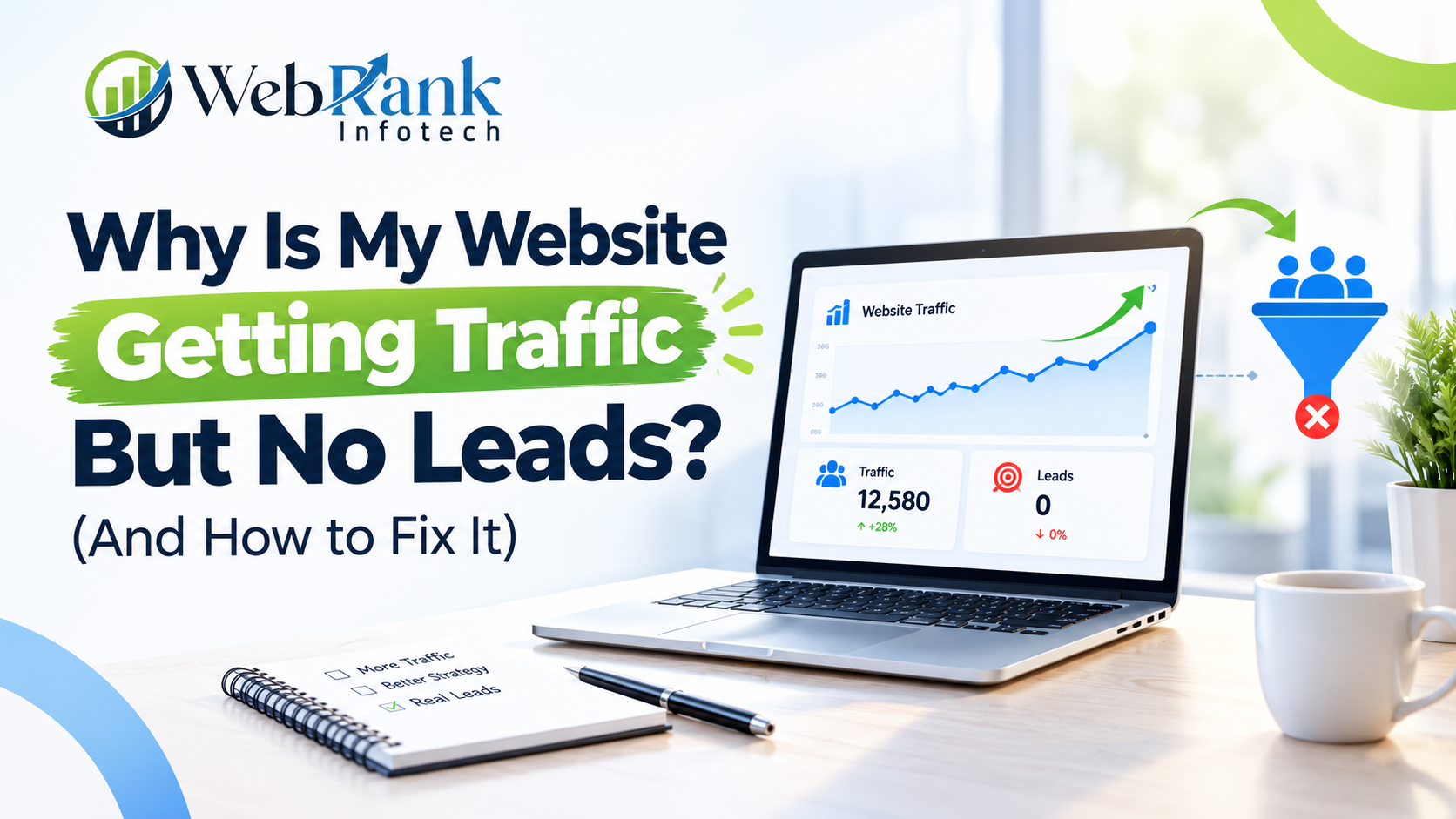
A website can get thousands of visitors and still generate zero leads. Traffic is not the same as demand — a website converts leads only when the right visitors arrive, trust the brand within seconds, and find a clear, easy next step. Fixing this gap does not require more traffic; it requires fixing what happens after someone lands on the page.
Analytics show a steady stream of visitors. Rankings look solid. Ads are driving clicks. Yet the inbox stays empty and the phone does not ring. This is one of the most common problems a digital marketing agency gets asked to solve, and it almost never has one single cause. Below is a complete, practical breakdown of why this happens and exactly how to fix it.
What Does It Mean When a Website Gets Traffic But No Leads?
Getting traffic but no leads means visitors are reaching the website, but almost none of them are taking a meaningful action — filling a form, calling, booking a consultation, or requesting a quote. This is a conversion problem, not a traffic problem. A site can rank on page one, run high-performing ads, and still fail to generate business if the pages, messaging, or follow-up process are not built to turn visitors into inquiries.
In short: the traffic numbers look healthy, but the conversion numbers behind them tell the real story. Before adding more visitors, the existing traffic needs to be checked for quality, trust, and a clear path to action.
Why Do Visitors Land on a Website but Never Convert?
Visitors leave without converting for a small number of repeatable reasons: they are not the right audience, they do not trust the business yet, the next step is unclear, or something on the page (speed, design, forms) creates friction. Most websites lose leads at one of these four stages rather than a mysterious, unfixable issue.
| Stage | Common Failure | Effect |
|---|---|---|
| Attraction | Wrong keywords or ad targeting | Wrong audience arrives |
| Trust | No proof, reviews, or credibility signals | Visitors doubt the business |
| Action | Weak or missing CTA | Visitors don’t know what to do next |
| Follow-up | Slow or no response to inquiries | Interested leads go cold |
In short: conversion loss almost always happens in one of four predictable stages — attraction, trust, action, or follow-up — and each stage needs a different fix.
Is the Traffic Even the Right Audience?
Not all traffic carries buying intent. Ranking for broad, informational keywords brings in readers who are researching, not ready to hire or buy. This is one of the most overlooked reasons a website shows strong numbers but weak conversions.
Low-Intent vs High-Intent Keywords
| Low-Intent (Informational) | High-Intent (Commercial/Transactional) |
|---|---|
| “What is SEO” | “SEO services near me” |
| “Digital marketing tips” | “Digital marketing agency for small business” |
| “How does PPC work” | “PPC company pricing” |
| “Types of online reputation issues” | “Online reputation management services” |
A blog ranking for “what is SEO” will pull in students and curious readers. A page ranking for “SEO services” in a specific city pulls in business owners ready to talk. Search behavior itself is shifting too — McKinsey’s research on AI-powered search shows discovery moving toward AI-generated answers, meaning keyword strategy now needs to account for both traditional rankings and how content gets surfaced in AI Overviews and chat-based search.
In short: traffic volume is meaningless without intent. Prioritizing commercial and transactional keywords over broad informational ones brings in visitors who are closer to a buying decision.
Does the Website Build Enough Trust in the First Few Seconds?
Visitors decide whether to trust a business within seconds of landing on a page. Outdated design, no reviews, no clear proof of results, or a missing “About” story all cause immediate drop-off, regardless of how good the offer actually is.
Trust Signals That Matter Most
- Real client testimonials with names, photos, or company details
- Case studies showing measurable results
- Visible certifications, years in business, or client count
- Clear, easy-to-find contact information
- Consistent, professional design across every page
A useful reference point on this is the Nielsen Norman Group’s research on website credibility, which shows how quickly users scan and judge a page before deciding to stay or leave.
In short: without visible trust signals in the first few seconds, even well-targeted, high-intent visitors will leave before considering a purchase.
Are Weak CTAs and Complicated Forms Losing Leads?
A call-to-action (CTA) tells a visitor exactly what to do next. Without one clear, visible CTA per page, most visitors simply leave. The same applies to forms — every additional field reduces the chance someone completes it.
CTA and Form Checklist
- One primary CTA per page (not five competing options)
- Action-based wording: “Book a Free Consultation,” “Get a Free Quote”
- Forms limited to name, phone, and email — nothing more upfront
- CTA visible without scrolling on both desktop and mobile
- Click-to-call buttons for mobile visitors
In short: one clear CTA and a short form consistently outperform cluttered pages with multiple vague actions and long forms.
Is Site Speed or Mobile Experience Killing Conversions?
A slow website or a broken mobile layout quietly kills leads before a visitor ever reads the offer. Since most traffic today comes from mobile devices, a page that loads slowly or displays incorrectly on a phone loses the majority of potential leads immediately.
Google’s own Core Web Vitals guidelines outline the speed and stability benchmarks that directly affect both user experience and search rankings — a page failing these benchmarks is losing leads on two fronts at once.
In short: page speed and mobile usability are not just SEO ranking factors; they are direct lead-generation factors, since most visitors abandon slow or broken mobile pages within seconds.
How to Fix a Website That Gets Traffic But No Leads (Step-by-Step Guide)
Fixing this problem requires a structured audit rather than guesswork. The steps below follow the order that produces the fastest, most measurable improvement.
Step 1: Audit Traffic Sources and Keyword Intent
Check Google Search Console and analytics to see which keywords and channels bring the most traffic. Separate informational keywords from commercial ones, and note which pages get views but zero conversions.
Step 2: Add Trust Signals to Every Key Page
Add testimonials, case studies, and credibility markers to the homepage, service pages, and contact page — not just a dedicated “testimonials” page most visitors never visit.
Step 3: Simplify CTAs and Shorten Forms
Reduce every page to one primary CTA. Cut forms down to the essentials — name and phone or email — and add more fields only after the first response.
Step 4: Fix Site Speed and Mobile Layout
Compress images, remove unnecessary scripts and plugins, and test every page on an actual mobile device, not just a browser resize.
Step 5: Verify That Lead Tracking Actually Works
Submit a test form, click every CTA, and confirm that thank-you pages, email notifications, and CRM entries all fire correctly. A broken form can silently erase leads for months without anyone noticing.
Step 6: Build a Fast Follow-Up System
Set up automated email or WhatsApp follow-up so no inquiry waits more than a few hours for a response. Speed of follow-up is often the single biggest factor in whether a lead converts into a client.
In short: fixing traffic-to-lead problems follows a specific sequence — audit intent, build trust, simplify action, fix technical friction, confirm tracking, then tighten follow-up. Skipping the sequence usually means fixing the wrong thing first.
What Happens After a Lead Comes In — Is Follow-Up the Real Problem?
Sometimes the issue is not the website at all — it’s what happens after someone submits a form. Slow responses, missed calls, or leads sitting unread in an inbox quietly waste every conversion the website worked hard to earn.
Common Follow-Up Failures
- No automated confirmation or acknowledgment sent to the lead
- Sales team checking inquiries only once a day
- No WhatsApp or call-based follow-up for time-sensitive inquiries
- Leads not logged anywhere trackable, so they get forgotten
In short: a website can do everything right and still show “no leads” in reporting if the follow-up process loses the leads after they arrive.
When Is It Time for a Professional Website and SEO Audit?
A professional audit is worth getting when traffic has grown for several months but leads have stayed flat, when paid ads generate clicks without inquiries, or when it’s unclear which part of the funnel — traffic, trust, UX, or follow-up — is actually broken. Self-diagnosis works for small fixes, but a full technical and conversion audit finds problems that are difficult to see from the inside.
This is exactly where a combined approach — proper SEO services paired with conversion and trust fixes — tends to outperform tackling each piece separately. A website audit that only checks rankings misses the conversion side, and a conversion audit that ignores keyword intent misses why the wrong visitors are showing up in the first place.
In short: when traffic keeps growing but leads don’t follow, a full-funnel audit — not more traffic — is the right next step.
FAQs on Website Traffic and Lead Generation
Why does my website get traffic but no sales?
Direct answer: Traffic without sales usually means the visitors are not the right audience, or the website fails to build trust and provide a clear next step. For example, a page ranking for “types of digital marketing” will pull in students and researchers — informative traffic that was never going to buy — while a page targeting “digital marketing agency for startups” pulls in visitors who are actually evaluating vendors.
How long does it take to fix a website that isn’t converting?
Direct answer: Basic fixes like CTA placement, form simplification, and speed improvements can show results within two to four weeks. Deeper issues like keyword intent mismatch or trust-building content usually take one to three months to fully show impact, since they involve content and ranking changes rather than a single page edit.
Is it better to get more traffic or fix conversions first?
Direct answer: Fixing conversions first almost always delivers faster, cheaper results than adding more traffic. Sending more visitors to a page that already leaks leads simply wastes ad spend or SEO effort faster — the leak needs patching before scaling the flow.
Can SEO alone fix a low-conversion website?
Direct answer: SEO can fix the “wrong audience” problem by targeting better-intent keywords, but it cannot fix trust, CTA, or follow-up issues on its own. SEO Services bring in more qualified visitors, but conversion elements on the website still need to do their job once those visitors arrive.
Why do my Google Ads bring clicks but not leads?
Direct answer: This usually means the ad’s promise and the landing page’s message don’t match, or the landing page has weak trust signals and unclear CTAs. A high click-through rate with low conversions almost always points to a landing page problem, not a targeting problem.
Does removing negative reviews help increase leads?
Direct answer: Yes — negative reviews are one of the biggest trust-killers for new visitors, since most people check reviews before contacting a business. Managing this is where reputation management services make a measurable difference, particularly for local, service-based businesses where reviews are often the deciding factor.
Final Thought
A website generating traffic but no leads is not broken — it’s incomplete. The traffic is doing its job. The missing piece is usually intent-matched keywords, visible trust, a clear CTA, fast technical performance, or a follow-up system that actually responds. Fixing these in sequence turns existing traffic into a working lead-generation channel without spending a single extra rupee on new visitors.
Ready to find out exactly where leads are leaking on a specific website? Get in touch for a complete traffic-to-lead audit.