Digital Marketing Strategy

7 Signs Your Business Needs a Digital Marketing Agency Right Now

7 Signs Your Business Needs a Digital Marketing Agency Right Now

Stagnant website traffic, leads that never convert, rising ad costs, and marketing that feels like guesswork are the clearest signs a business needs a digital marketing agency. When in-house efforts stop producing measurable growth, that gap is usually not a work-ethic problem — it is a skills, tools, and bandwidth problem, and a digital marketing agency exists to close exactly that gap. Every business owner reaches a point where marketing feels like a full-time job that nobody has time to do properly. Social media posts go out inconsistently, the website hasn’t been updated in months, and nobody can say with certainty which campaign actually brought in last month’s sales. This guide breaks down the seven clearest signs it’s time to bring in outside expertise, how a digital marketing agency actually solves each problem, and what to check before signing a contract. What Does It Mean When a Business Needs a Digital Marketing Agency? A business needs a digital marketing agency when internal efforts — whether run by the owner, a generalist employee, or a small in-house team — stop translating into measurable growth: more traffic, more qualified leads, and more revenue. It is rarely about effort. Most business owners are working hard on marketing; they just lack the specialized skill set, the tools, and the time to run SEO, paid ads, content, and analytics all at once, all correctly, all the time. Skimmable summary: Needing a digital marketing agency is not a sign of failure — it’s a natural growth stage where marketing has become too complex, too time-consuming, or too specialized to run effectively without dedicated experts. How to Spot the Signs Your Business Needs a Digital Marketing Agency The signs rarely show up one at a time. They tend to stack — quietly — until growth plateaus. Below is a practical, step-by-step way to check for each one. Sign 1: Website Traffic Has Stalled or Declined Pull up Google Analytics (or Search Console) and check the last 90 days against the previous 90. If traffic is flat or falling despite the business staying active, search visibility is likely the problem. This usually points to weak on-page SEO, missing technical fixes, or thin content that search engines and AI answer engines don’t consider citable. According to Google’s own SEO starter guide, sites that don’t actively maintain technical and content quality naturally lose visibility over time as competitors improve theirs. Sign 2: Leads Are Coming In But Not Converting High traffic with low conversions usually means a targeting or messaging mismatch, not a traffic problem. Sales teams end up fielding unqualified leads — people with the wrong budget, wrong timing, or wrong intent — which wastes hours and lowers close rates. A digital marketing agency typically audits landing pages, ad targeting, and page intent to fix this mismatch before adding more traffic on top of a broken funnel. Sign 3: Marketing Feels Reactive, Not Strategic If every campaign starts with “let’s post something today” instead of a documented content calendar or quarterly plan, marketing is running on autopilot. Reactive marketing produces inconsistent branding and rushed, off-message content — a pattern that’s hard to break without a structured content marketing strategy driving the calendar. Sign 4: Competitors Are Outranking and Outposting the Business A five-minute Google search for the business’s core service, followed by a look at competitor social pages, usually reveals the truth quickly. If competitors consistently appear above the business in search results or post more frequently with stronger engagement, they are actively investing in visibility while the business is standing still. This is one of the fastest-moving signs your business needs a digital marketing agency, because search rankings compound — the longer the gap exists, the harder it becomes to close. Sign 5: Ad Spend Is Rising But ROI Is Falling Cost per lead should stay roughly flat or improve over time as campaigns get optimized. If cost per lead keeps climbing while conversion performance stays the same or drops, budget is leaking somewhere — often poor audience segmentation, weak ad creative, or a landing page that isn’t built to convert. Agencies bring the testing and bid-management discipline needed to turn ad spend into measurable results instead of guesswork. Sign 6: No One Can Explain What’s Working and What Isn’t Ask a simple question internally: “Which channel brought in last month’s top three customers?” If nobody has a confident, data-backed answer, reporting is broken. Effective marketing depends on knowing exactly where traffic, leads, and revenue come from — without that, budget decisions are essentially guesses. Sign 7: Marketing Keeps Getting Pushed to the Bottom of the To-Do List If marketing tasks routinely get bumped for “more urgent” operational work, that’s not a discipline issue — it’s a bandwidth issue. Marketing needs consistent, dedicated attention to compound over time; sporadic effort rarely builds momentum. Skimmable summary: The seven signs — stalled traffic, poor lead quality, reactive planning, losing ground to competitors, rising cost per lead, unclear reporting, and marketing that never gets prioritized — usually appear together rather than alone, and each one compounds the others the longer they go unaddressed. How Does a Digital Marketing Agency Fix These Problems? A digital marketing agency solves these issues by bringing dedicated specialists, proven processes, and marketing tools that most in-house teams can’t justify owning full-time. Business Problem What a Digital Marketing Agency Does Stalled website traffic Runs technical SEO audits, on-page optimization, and keyword-targeted content Poor lead quality Refines audience targeting, page intent, and message-to-offer fit Reactive marketing Builds a documented content calendar and quarterly strategy Competitors outranking the business Runs competitor gap analysis and closes visibility gaps Rising cost per lead Applies structured A/B testing and bid optimization across campaigns Unclear reporting Sets up dashboards tracking traffic source, lead source, and ROI by channel No time for consistent marketing Takes over execution so the owner can focus on running the business Skimmable summary: Every sign listed above maps to a specific, fixable process — a digital marketing agency

7 Signs Your Business Needs a Digital Marketing Agency Right Now Read More »

seo-metrics-ai-search

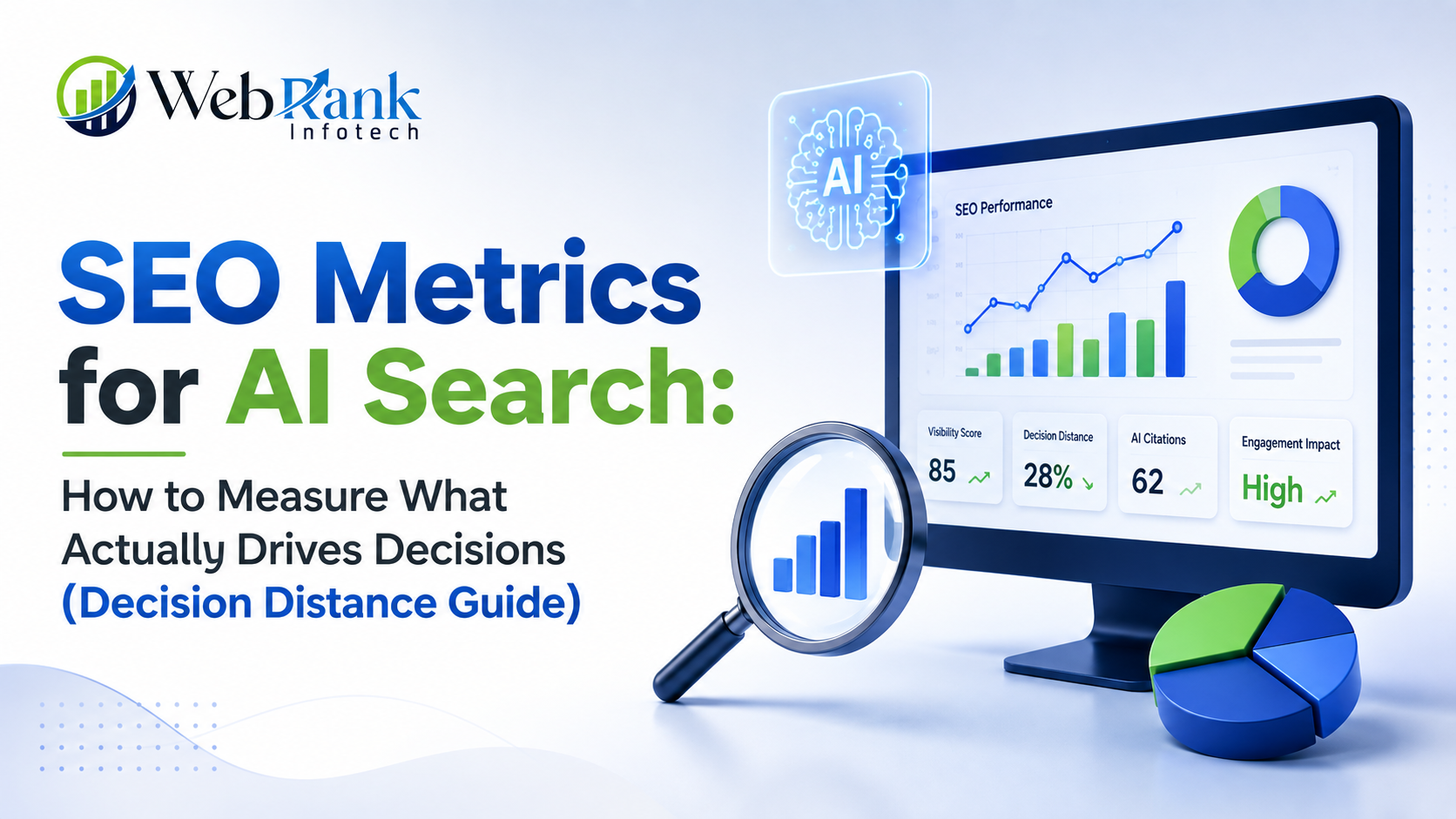
SEO Metrics for AI Search: How to Measure What Actually Drives Decisions (Decision Distance Guide)

Clicks, rankings, and CTR only show what happened after someone already decided. They do not show why a brand was chosen over another, or why an AI engine mentioned a competitor instead. The metric worth tracking in 2026 is the gap between what an audience needs to hear before deciding and what a brand’s content actually says — a concept called Decision Distance. Closing that gap is what determines whether a brand gets clicked, cited, or skipped entirely. Most teams tracking SEO metrics for AI search are still watching rankings and traffic charts while the actual decision now happens inside an AI-generated answer, before any click occurs. Search has changed shape. On this page: Why Do Traditional SEO Metrics Fall Short in the Age of AI Search? Traditional metrics — CTR, bounce rate, rankings, conversion rate — are outcome metrics. They confirm that an action was taken, but not what caused it. CTR shows that a listing was clicked; it does not show why that listing felt more trustworthy than the one above it. Bounce rate shows that a visitor left; it does not show which expectation was unmet. Rankings show visibility; they do not show whether the brand was actually the one chosen among the options an LLM or a searcher considered. This blind spot existed before AI search, but generative answers have made it far more costly. When Google’s AI Overviews or a chatbot synthesizes a single answer from multiple sources, a large part of the decision-making process now happens inside that answer box — outside any website’s analytics, and outside a brand’s field of vision entirely. What Each Traditional Metric Shows vs. What It Hides Metric What It Confirms What It Misses CTR A result was clicked Why it felt more compelling than competitors Bounce Rate A visitor left the page Which need or expectation went unmet Conversion Rate A purchase or sign-up happened Which psychological barrier was overcome Keyword Rankings Content is visible in search Whether the brand was actually chosen AI Visibility / Citations A brand was mentioned by an LLM Whether that mention influenced the final decision Skim summary: Every legacy SEO metric measures the result of a decision that has already been made, not the reasoning that produced it. In AI search, where a synthesized answer often replaces the research phase entirely, that missing context is the single biggest reporting gap most SEO teams currently have. What Is Decision Distance in SEO? Decision Distance is the semantic gap between the motivations that actually drive a person’s decision (functional, emotional, and social) and the messaging a brand publishes across its customer journey — product pages, landing pages, blog content, and ad copy. The smaller that gap, the more likely a brand is to be chosen by a human or surfaced by an AI engine synthesizing an answer. The idea comes from a framework introduced by Giulia Panozzo in a Search Engine Journal analysis on AI-era SEO measurement, and it reframes a question every SEO team should already be asking: does the content answer the query, or does it answer the reason behind the query? A Real-World Example Consider someone searching for payroll software. Their biggest hesitation might be trusting a third party with sensitive employee data — a trust-driven concern. If a product page spends most of its copy on feature lists, integrations, and dashboards instead of addressing data security and compliance, the Decision Distance is high. The page may match the keyword perfectly and still fail to convert, because it never addressed the actual reason the visitor was hesitant. Skim summary: Decision Distance measures alignment, not visibility. A page can rank in position one and still lose the decision if its messaging talks about the wrong thing relative to what the audience actually needs reassurance about before moving forward. How Can You Measure Decision Distance Step by Step? This is a practical, four-step process that pairs semantic analysis with existing customer research. Each step builds on the one before it, so treat this as a sequence rather than a checklist to pick from. Step 1: Identify Decision Drivers From Customer Language Start by defining the core decision drivers relevant to the market — common ones include value for money, trust, convenience, social proof, and quality. Write a short, precise description for each driver, since these descriptions become the semantic reference points everything else gets compared against. Then collect audience language: search queries, support tickets, CRM notes, review text, and social listening data. Map that language against each driver using sentence embeddings and semantic similarity — a technique also useful for vector-based SEO analysis. Tag each driver by customer journey stage (awareness, consideration, evaluation, purchase, loyalty) so the output tells the team not just what matters, but when it matters. Step 2: Score How Strongly Brand Messaging Reflects Those Drivers Run the same driver framework against owned content — product pages, landing pages, blog posts, and ad copy. This produces a brand-side profile showing which drivers are being reinforced and which are being ignored entirely. Most teams are surprised to find their content leans heavily on one or two drivers (often convenience or features) while audience language is dominated by something else entirely, like trust or quality. Step 3: Compare the Two Profiles to Calculate the Gap Line up the audience profile against the brand profile, driver by driver. The difference between the two is the Decision Distance score, and the individual gaps show exactly where messaging and audience motivation diverge. A large positive gap on “trust,” for instance, means the audience is asking for reassurance the content never gives. Step 4: Close the Gaps Through Messaging and Content Changes Use the gap data as a prioritized content roadmap. That might mean adding trust signals to a landing page, restructuring a product page around the top three unaddressed drivers, or briefing a content team to stop writing about features and start writing about outcomes. This step turns a diagnostic exercise into an action

SEO Metrics for AI Search: How to Measure What Actually Drives Decisions (Decision Distance Guide) Read More »

in-house-marketing-team-vs-digital-marketing-agency

In-House Marketing Team vs Digital Marketing Agency: Pros and Cons

Choosing between an in-house marketing team vs digital marketing agency comes down to budget, growth stage, and control – an in-house team wins on brand alignment and long-term ownership, while a digital marketing agency wins on cost efficiency, specialist access, and speed to results. Every growing business eventually hits this fork in the road: build a marketing team from scratch, or hand the work to a digital marketing agency. Both paths can work. Both can also waste six figures if chosen for the wrong reasons. This guide breaks down the in-house marketing team vs digital marketing agency decision in full – real pros, cons, costs, and a step-by-step framework so the choice stops feeling like a guess. Table of Contents What Is the Real Difference Between an In-House Marketing Team and a Digital Marketing Agency? An in-house marketing team consists of full-time employees who work exclusively for one company, embedded in its culture, product, and daily operations. A digital marketing agency is an external company hired on contract to handle marketing execution – SEO, PPC, social media, content, or all of the above – often serving multiple clients across different industries at the same time. The core difference isn’t just “internal vs external.” It’s ownership vs access. An in-house team is owned entirely by one business, with slower ramp-up but total brand alignment. A digital marketing agency gives access to a ready-made team of specialists without the overhead of hiring, training, or retaining them – but that expertise is shared across other client accounts too. Skimmable summary: In-house marketing means hiring full-time staff dedicated to one brand; a digital marketing agency means outsourcing execution to an external specialist team serving multiple clients. The trade-off is control and brand immersion (in-house) versus speed, cost-efficiency, and breadth of expertise (agency). How Does an In-House Marketing Team Actually Work? An in-house team typically starts with one marketing generalist or manager and expands into specialists – SEO, content, paid ads, design – as the budget allows. They report directly to leadership, sit in on product meetings, and build marketing strategy around firsthand knowledge of the business. Pros of an In-House Marketing Team Advantage Why It Matters Deep brand knowledge The team lives and breathes the product daily, so messaging stays consistent Faster internal communication No client-agency lag – decisions happen in the same Slack channel as the rest of the company Full control over priorities Marketing sprints can be reshuffled instantly around business needs Long-term institutional memory Campaign history, customer insights, and lessons learned stay in-house Cons of an In-House Marketing Team Drawback Why It Matters High fixed cost Salaries, benefits, software licenses, and training add up even in slow months Narrower skill coverage A 2-3 person team rarely covers SEO, PPC, design, and analytics equally well Slower to scale Ramping up for a big campaign means hiring, which takes weeks or months Risk of stagnant ideas Teams immersed in one brand for years can lose exposure to fresh industry trends Skimmable summary: An in-house marketing team offers unmatched brand alignment and internal speed of communication, but it comes with fixed overhead, narrower specialist coverage, and slower scalability – all real constraints for a business trying to grow fast on a lean budget. How Does a Digital Marketing Agency Actually Work? A digital marketing agency operates as an external partner. After an onboarding phase – where the agency studies the business, competitors, and target audience – it builds and executes a marketing strategy using a team of specialists who already have tools, processes, and experience across dozens of similar campaigns. Pros of Hiring a Digital Marketing Agency Advantage Why It Matters Access to a full specialist team SEO, PPC, content, and design experts work together without separate hiring Lower fixed cost Businesses pay for output, not salaries, insurance, or paid leave Faster results from proven playbooks Agencies reuse strategies validated across multiple clients and industries Easy to scale up or down Campaigns can expand for a product launch and shrink again without layoffs Access to premium tools Enterprise-grade SEO, ad, and analytics tools are already part of the agency’s stack Cons of Hiring a Digital Marketing Agency Drawback Why It Matters Shared attention Agencies manage multiple clients, so response time can be slower than an internal team Onboarding lag New agencies need weeks to fully understand a brand before hitting full stride Less day-to-day control Strategy execution happens outside the building, on the agency’s workflow Quality varies by agency Results depend heavily on which agency gets chosen, making due diligence essential Skimmable summary: A digital marketing agency delivers specialist expertise, proven strategies, and flexible scaling at a lower fixed cost than hiring internally – the trade-off is shared attention and a shorter onboarding period before full alignment kicks in. In-House Team vs Digital Marketing Agency: Which Costs More in India? Cost is usually the deciding factor in the in-house marketing team vs digital marketing agency decision, so here’s a realistic breakdown for a small-to-mid-sized Indian business trying to run SEO, PPC, and social media together. Cost Component In-House Team (Monthly) Digital Marketing Agency (Monthly) SEO specialist ₹35,000 – ₹60,000 Included in package PPC specialist ₹30,000 – ₹55,000 Included in package Social media manager ₹25,000 – ₹45,000 Included in package Tools & software (SEO, ads, analytics) ₹15,000 – ₹30,000 Included in package Recruitment & training cost One-time, ₹20,000+ None Typical total ₹1,05,000 – ₹1,90,000+ ₹25,000 – ₹80,000 (varies by scope) A detailed breakdown of what full-service SEO packages typically include — audits, on-page work, technical fixes, and link building — is covered in WebRank Infotech’s SEO services in India, which is a useful benchmark for comparing agency pricing against in-house salary costs. Skimmable summary: For most small and mid-sized businesses in India, an in-house team costs roughly 2-3x more per month than an agency once salaries, tools, and training are factored in — though the gap narrows for larger companies that need dedicated, full-time attention. How to Decide Between an In-House Team and a

In-House Marketing Team vs Digital Marketing Agency: Pros and Cons Read More »

Scroll to Top