
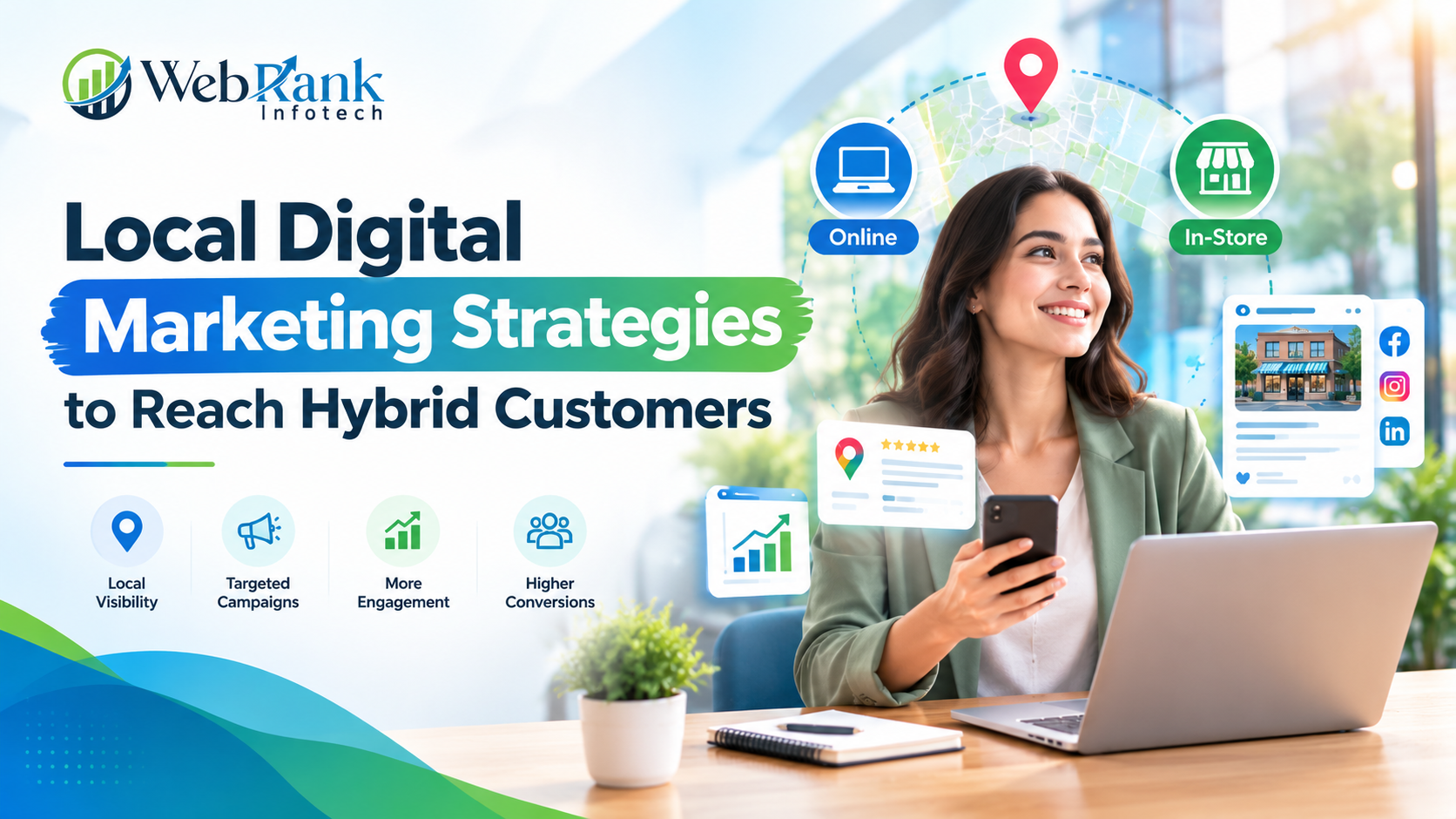
Hybrid customers are no longer a niche segment – they are the majority of local shoppers today. They research a product on their phone, check reviews before leaving the house, and still walk into a physical store to buy it. Reaching hybrid customers requires a local digital marketing strategy that connects online discovery with offline action – Google Business Profile, local SEO, content, reviews, and paid ads all working together instead of in isolation – and this guide breaks down exactly how to build that strategy, step by step.
Who Are Hybrid Customers and Why Do They Matter for Local Businesses?
A hybrid customer is someone who blends online research with offline purchasing behavior, or the reverse – browsing in-store and then buying online later. This behavior shows up in two well-documented patterns: ROPO (Research Online, Purchase Offline) and webrooming, alongside its opposite, showrooming, where a customer checks a product in-store before buying it online for a better price. According to Think with Google’s research on local search behavior, a large share of smartphone searches with local intent result in a store visit within a day, which confirms that online research directly drives offline footfall for local businesses.
Hybrid customers matter because they represent the biggest share of local buyers, and they judge a business on both its digital presence and its physical experience. A business with a polished website but no updated local listing loses this customer just as fast as a business with a great store but no online visibility.
Quick summary: Hybrid customers research online and buy offline, or the reverse, and they now make up the majority of local buyers. Winning them requires a business to perform well both digitally and physically, since a gap in either area causes a lost sale.
How to Build a Local Digital Marketing Strategy That Reaches Hybrid Customers?
Reaching hybrid customers is not about picking one channel – it is about connecting several channels around a single local customer journey.
Step 1: Map the Hybrid Customer’s Journey
Identify where a typical customer starts (a Google search, a social media ad, a friend’s recommendation) and where they end (a store visit, a phone call, an online order for pickup). This map determines which channels need attention first.
Step 2: Build a Complete Local Digital Footprint
This includes a Google Business Profile, consistent NAP (Name, Address, Phone) data across directories, an optimized website, and active social profiles. Each of these acts as a touchpoint a hybrid customer might land on before deciding to visit.
Step 3: Align Online Content With Offline Reality
In-store promotions, stock availability, and operating hours should match exactly what is shown online. A mismatch here is one of the fastest ways to lose a hybrid customer’s trust before they even walk in.
Step 4: Use Local SEO and Paid Ads Together
Local SEO builds sustained visibility for people actively searching, while local paid ads capture demand faster during promotions or new location launches. Used together, they cover both immediate and long-term hybrid customer behavior.
Step 5: Track Both Online and In-Store Outcomes
Set up tracking for calls, direction requests, and – where possible – in-store redemptions of online offers, so the strategy can be measured against real hybrid behavior, not just website traffic.
Quick summary: A local digital marketing strategy for hybrid customers works by mapping the full customer journey, building a consistent digital footprint, matching online content to in-store reality, combining SEO with paid ads, and tracking both online and offline outcomes together.
How to Optimize Google Business Profile for Both Online Discovery and In-Store Visits?
Google Business Profile (GBP) is the single most important touchpoint for a hybrid customer because it appears at the exact moment someone is deciding whether to visit.
Keep Real-Time Information Accurate
Store hours, holiday closures, and temporary changes need to be updated immediately. A hybrid customer who shows up to a closed store because of outdated hours rarely gives that business a second chance.
Add Products, Services, and In-Store Offers
GBP allows listing specific products and current offers directly on the profile, which lets a hybrid customer confirm availability before making the trip – reducing the friction that causes cart abandonment or a canceled visit.
Enable Messaging and Booking Where Relevant
Direct messaging or appointment booking through GBP shortens the gap between online interest and an in-store or in-person action, which is exactly the bridge a hybrid customer strategy needs to close.
Quick summary: Google Business Profile works as the bridge between online discovery and offline visits for hybrid customers, so accurate real-time information, visible product listings, and direct booking or messaging options directly reduce the friction that causes a lost visit.
What Role Does Local SEO Play in Reaching Hybrid Customers?
Local SEO ensures a business shows up when a hybrid customer is actively researching before making an offline decision. Since hybrid behavior often starts with a search like “[product] near me” or “[service] open now,” ranking in local search results and the map pack directly determines whether a business gets considered at all.
Long-tail, intent-specific keywords tend to convert hybrid customers better than broad terms, because they reflect a decision already narrowing toward a visit.
| Search Intent | Example Query | What It Signals |
| Immediate visit intent | “furniture store open now near me” | High likelihood of same-day visit |
| Comparison research | “best furniture store [city] reviews” | Still deciding, reviews matter most |
| Availability check | “does [store] have [product] in stock” | Close to purchase, needs confirmation |
| Pickup preference | “furniture store curbside pickup [city]” | Wants hybrid buy-online-pickup-in-store option |
A business without professional SEO services handling these intent-specific keywords typically loses hybrid customers to competitors who rank higher for these exact, high-intent searches.
Quick summary: Local SEO determines whether a business even appears when a hybrid customer searches before visiting, and targeting intent-specific, long-tail local keywords converts far better than competing for broad, generic search terms.
How to Use Local Content to Bridge Online Research and Offline Purchases?
Content plays a specific role for hybrid customers: it needs to answer the exact questions someone asks before deciding to leave the house.
Publish Stock and Availability Updates
Content confirming what is currently in stock or available removes one of the biggest hesitations a hybrid customer has before visiting.
Create Location-Specific Buying Guides
A guide like “how to choose a mattress for [city]’s climate” or “best home heating options for [region]’s winter” earns relevance a generic national article cannot match, while also nudging the reader toward an in-store consultation.
Show Real In-Store Experience Through Video and Photos
Hybrid customers who research online but plan to visit in person respond strongly to real photos and short videos of the actual store, staff, or product in use – this reduces the uncertainty that stops a webrooming customer from converting.
Quick summary: Content built for hybrid customers should answer pre-visit questions directly – stock availability, location-specific buying advice, and real visuals of the physical location – since this content removes the hesitation that stops online research from turning into an offline visit.
How to Use Social Media and Local Ads to Reach Hybrid Customers?
Social media and local paid ads work best for hybrid customers when they are used to trigger a specific, nearby action rather than general brand awareness.
Run Geo-Targeted Ads Tied to Local Events or Weather
A geo-targeted ad announcing an in-store offer during a local event or specific weather condition captures hybrid customers at a moment when visiting is genuinely convenient for them.
Promote Buy-Online-Pickup-In-Store (BOPIS) Options
Ads and posts highlighting a BOPIS option directly serve hybrid customers who prefer ordering ahead and picking up locally, a behavior pattern that has grown significantly since the shift toward hybrid shopping.
Retarget Website Visitors With Location-Specific Offers
A customer who browsed a product page but did not purchase online is a strong candidate for a retargeting ad offering an in-store incentive, which converts research into a visit rather than losing the lead entirely.
A digital marketing agency that manages both local SEO and paid campaigns together typically captures more hybrid customers than running these channels separately, since the two amplify each other rather than compete for the same customer’s attention.
Quick summary: Social media and local ads work best for hybrid customers when tied to a specific, time-sensitive local trigger – geo-targeted offers, BOPIS promotion, or retargeting – rather than broad brand awareness campaigns that do not prompt an immediate local action.
Why Do Reviews Influence Hybrid Customers More Than Ads Do?
Reviews carry more weight than paid advertising for hybrid customers because they answer the exact question a hybrid customer is asking before visiting: is this business actually reliable in person, not just online?
A hybrid customer who has already seen an ad or found a listing typically checks reviews as the final confirmation step before deciding to visit. A steady stream of recent, specific reviews mentioning in-store experience, staff behavior, or product availability directly reduces the uncertainty that stops research from becoming a visit. Businesses struggling with inconsistent or negative reviews should look into professional online reputation management services to rebuild this trust signal systematically rather than letting it erode hybrid conversions silently.
Quick summary: Reviews function as the final trust check for hybrid customers before an offline visit, often outweighing paid ads at that decision stage, which makes active review management a direct driver of in-store conversions, not just an online reputation exercise.
How to Track a Hybrid Customer’s Journey Across Online and Offline Touchpoints?
Measuring hybrid customer behavior requires connecting online signals to offline outcomes, not treating them as separate funnels.
Use Call and Direction Tracking
Google Business Profile insights and call tracking numbers show how many online interactions convert into calls or direction requests – a strong proxy for in-store visits.
Track Online-to-Offline Redemptions
Unique promo codes or QR codes used only in online ads, redeemable in-store, give a direct, measurable link between a digital campaign and an offline purchase.
Cross-Reference Website Analytics With POS Data
Comparing spikes in website traffic or ad campaigns against point-of-sale data during the same period reveals whether digital efforts are actually driving offline sales, even without perfect individual-level tracking.
Quick summary: Tracking hybrid customer behavior means connecting online signals like calls, direction requests, and campaign-specific promo codes to offline outcomes like store visits and POS data, rather than measuring digital and physical performance as two disconnected metrics.
Which Local Digital Marketing Tools Help Track Hybrid Customer Behavior?
Judged on accuracy, ease of use, and actual usefulness for hybrid tracking, here is an honest breakdown:
| Tool | Best For | Free/Paid | Rating (out of 5) |
| Google Business Profile Insights | Search-to-visit behavior tracking | Free | 5/5 – essential, highest relevance for hybrid tracking |
| Google Search Console | Understanding which queries drive local traffic | Free | 4.5/5 – strong diagnostic, needs manual cross-referencing |
| Call tracking software (e.g., CallRail) | Linking ads/SEO to phone-based conversions | Paid | 4/5 – accurate, adds a recurring cost |
| Meta Ads Manager (Local Ads) | Geo-targeted social campaigns | Free with ad spend | 4/5 – strong targeting, needs active management |
| Google Analytics 4 | Cross-channel traffic and campaign performance | Free | 3.5/5 – powerful but has a learning curve for local-specific tracking |
For most small businesses, combining Google Business Profile Insights with basic call tracking covers the majority of hybrid customer visibility needed before investing in more advanced tools.
Quick summary: Google’s own free tools cover most hybrid customer tracking needs, while call tracking software adds the missing link between digital campaigns and phone-based conversions – a combination that gives small businesses reliable hybrid visibility without a large tool budget.
Should a Small Business Handle Hybrid Local Marketing In-House or Hire an Agency?
Both routes can work – the right choice depends on how many channels need to be managed together and how much time the owner actually has.
| Criteria | DIY (In-House) | Hiring an Agency |
| Cost | Lower upfront (4/5) | Higher upfront (3/5) |
| Ability to coordinate SEO + ads + content together | Difficult without a dedicated team (2/5) | Built for cross-channel coordination (4.5/5) |
| Speed of measurable results | Slower, trial and error (2.5/5) | Faster, established process (4.5/5) |
| Risk of disconnected campaigns | Higher – channels often run in isolation (2/5) | Lower – managed as one strategy (4.5/5) |
| Time investment from owner | Very high (2/5) | Low, mostly oversight (4.5/5) |
A single-location business with simple hybrid behavior (mostly search-to-visit) can often manage GBP and basic local SEO in-house. A business running SEO, social ads, and reputation management simultaneously to capture hybrid customers across multiple touchpoints generally gets faster, more coordinated results by partnering with a specialized digital marketing agency, since disconnected channels are the most common reason hybrid strategies underperform.
Quick summary: DIY works for simple, single-channel hybrid behavior, but agencies consistently outperform on cross-channel coordination and speed, which matters most for hybrid customers since they interact with multiple touchpoints before making a final offline decision.
Conclusion: Building a Local Digital Marketing Roadmap for Hybrid Customers
Hybrid customers do not separate their online and offline experience, so a local digital marketing strategy cannot treat them separately either. A business that keeps its Google Business Profile accurate, ranks for intent-specific local searches, publishes content that answers pre-visit questions, manages reviews actively, and connects online campaigns to offline outcomes builds the exact trust and convenience a hybrid customer is looking for. The businesses that win this customer are not the ones present on the most channels – they are the ones whose channels actually work together.
Frequently Asked Questions
What is a hybrid customer in digital marketing?
A hybrid customer is someone who combines online research with offline purchasing, or the reverse – browsing in a store and buying online later. For example, a customer might compare furniture options and read reviews on a phone at home, then visit the store in person to check the actual texture and size before buying.
How is local digital marketing different from regular digital marketing?
Local digital marketing focuses on visibility within a specific geographic area and on driving real-world actions like store visits and calls, while regular digital marketing often targets broader, national or global visibility. A regional bakery investing in local SEO to rank for “custom cakes in [city]” is practicing local digital marketing, while a national bakery brand competing for “custom cakes online” nationwide is not.
Do hybrid customers convert better than purely online or offline customers?
Yes, hybrid customers often convert at a higher rate because they arrive at a decision point already informed and interested, needing only a final trust confirmation. A customer who has already read reviews and checked stock online typically completes a purchase faster in-store than someone browsing with no prior research.
How much should a local business invest in digital marketing to reach hybrid customers?
Investment should scale with market competition rather than following a fixed number, though a reasonable starting range for small businesses is close to what general marketing budget guidelines recommend, adjusted for how competitive the local market is. A business in a low-competition town may need a modest, mostly organic effort, while a business competing against several similar stores in the same neighborhood typically needs a combined SEO and paid ad budget to stay visible.
Can small businesses compete with big brands for hybrid customers?
Yes, because hybrid customers value proximity, accurate real-time information, and genuine reviews – all areas where a well-managed small business often outperforms a large brand’s generic, less personalized local presence. A neighborhood electronics repair shop with fast Google Business Profile responses and detailed reviews frequently wins the hybrid customer over a big-box store with an outdated, generic listing.
How long does it take to see results from a local hybrid marketing strategy?
Initial improvements in visibility and engagement typically appear within 4 to 8 weeks, while measurable increases in in-store visits driven by digital efforts usually build over 3 to 6 months. A retail store that starts tracking calls and direction requests alongside an optimized GBP profile often sees a noticeable uptick in foot traffic within the first two months.
Should a small business use SEO or paid ads first to reach hybrid customers?
Local SEO builds the sustainable foundation hybrid customers rely on for ongoing searches, while paid ads work best layered on top for immediate visibility during launches or promotions. A new store opening in a neighborhood typically benefits from starting with local SEO and Google Business Profile setup, then adding paid ads for the opening week to accelerate initial foot traffic.