
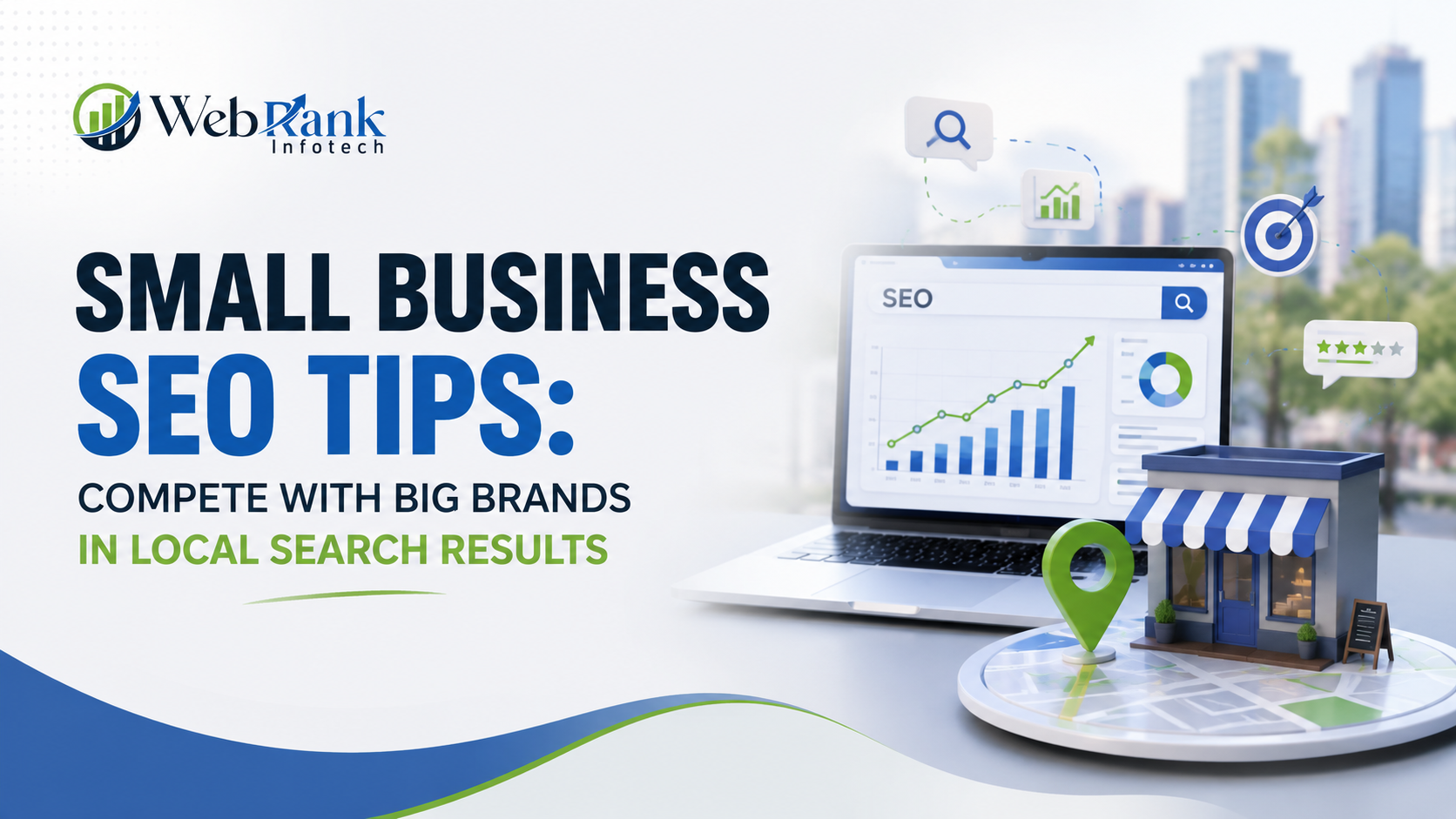
Ranking above a national brand in local search is not about outspending them. It is about outmaneuvering them. Big brands win on domain authority and budget, but they consistently lose on proximity, specificity, and genuine local trust — three ranking signals that Google rewards heavily in local search, and that a well-run small business can win almost every time.
Most small business owners assume local SEO is a budget war they cannot win. That assumption is wrong, and it costs businesses real customers every month. Google’s local algorithm does not rank the biggest advertiser first. It ranks the business that proves it is the most relevant, most trusted, and most active option near the searcher. This guide breaks down exactly how to build that proof, step by step, without a national marketing budget.
What Is Local SEO and Why Does It Matter for Small Businesses?
Local SEO is the process of optimizing a business’s online presence so it appears in location-based searches — think “plumber near me” or “best bakery in Chandigarh.” Unlike traditional SEO, which competes for broad national visibility, local SEO competes for the map pack, local organic results, and “near me” queries where intent to buy is already high.
This matters more for small businesses than almost any other digital marketing lever because local search traffic converts faster. A person searching “emergency electrician near me” is not researching — they are ready to call. Local SEO puts a small business directly in front of that decision-making moment, and it does it without competing against national brands on their turf.
Skim summary: Local SEO targets location-based, high-intent searches, and it is the fastest, most cost-effective way small businesses generate qualified leads without competing against big brands on broad national keywords.
Why Do Big Brands Struggle to Dominate Local Search?
Big brands are built for scale, not specificity. Their content teams manage thousands of pages across hundreds of locations, which means they cannot produce the hyper-local, neighborhood-level content that ranks for long-tail searches. According to Ahrefs’ keyword research, the majority of all search queries are long-tail — specific, multi-word phrases — and this is exactly where big brands underperform and small businesses win.
| Ranking Factor | Big Brand Advantage | Small Business Advantage |
| Domain Authority | Very high | Low to moderate |
| Content Budget | Very high | Low |
| Proximity to Searcher | Weak (one location per city) | Strong (deeply embedded) |
| Review Volume & Authenticity | Diluted across locations | Concentrated, personal |
| Local Citation Accuracy | Often inconsistent | Easy to control |
| Hyperlocal Content Depth | Rarely produced | Highly achievable |
| Community/Local Backlinks | Minimal | Naturally accessible |
Skim summary: Big brands dominate on domain authority and budget, but local SEO ranking factors like proximity, review authenticity, and hyperlocal content favor small, focused businesses — a genuine structural advantage that doesn’t require a big spend to use.
How Can a Small Business Beat Big Brands in Local Search? (Step-by-Step Guide)
This is the practical part. Each step below builds on the last, and skipping steps is the most common reason local SEO efforts stall. We recommend working through this in order rather than cherry-picking tactics.
Step 1: Optimize Your Google Business Profile Completely
Google Business Profile (GBP) is the single most influential local ranking factor because it feeds directly into the map pack. An incomplete or inactive profile is invisible no matter how good the website is.
What a complete profile includes
- Accurate business category (primary + secondary)
- Full service area and business hours, including holiday hours
- Weekly photo uploads and Google Posts
- Complete product/service listings with descriptions
- Q&A section actively monitored and answered
Why this works
Google prioritizes profiles that show consistent activity and completeness because it signals a real, currently operating business — something a national brand’s local listing often fails to maintain across every branch.
Step 2: Fix NAP Consistency Across Directories
NAP stands for Name, Address, Phone number. If these details differ even slightly across Google, Yelp, Bing Places, and Facebook, Google treats it as a trust signal problem.
| Directory | Common NAP Error | Fix |
| Google Business Profile | Old phone number | Update directly in GBP dashboard |
| Yelp | Abbreviated address | Match exact GBP formatting |
| Missing suite/unit number | Standardize across all platforms | |
| Bing Places | Duplicate listing | Merge or remove duplicates |
Skim summary: Consistent NAP data across every directory builds the trust signal Google needs to confidently rank a business in local results — inconsistency is one of the most common, and most fixable, local SEO mistakes.
Step 3: Target Long-Tail, Hyperlocal Keywords
Instead of chasing “restaurant Chandigarh,” a small business should target “best butter chicken restaurant Sector 34 Chandigarh.” Lower volume, dramatically lower competition, and far higher purchase intent.
How to find these keywords
- Use Google’s autocomplete and “People also ask” for local phrasing
- Check Google Business Profile Insights for actual search terms used
- Layer in neighborhood names, landmarks, and hyperlocal modifiers
Step 4: Build Local Backlinks and Citations
Backlinks from local news sites, community blogs, local business associations, and event sponsorships carry more local ranking weight than generic high-authority links from unrelated industries.
Practical ways to earn them
- Sponsor a local event and request a link from the organizer’s site
- Get listed in local business directories and chambers of commerce
- Pitch a local reporter a genuinely newsworthy story about the business
Step 5: Generate and Respond to Reviews Strategically
Review volume, recency, and response rate all factor into local ranking. A small business with 50 recent, responded-to reviews often outranks a big brand location with 200 old, unanswered ones.
A simple review system
- Ask for a review immediately after a positive interaction, not days later
- Send a direct Google review link via SMS or email
- Respond to every review — positive and negative — within 48 hours
Step 6: Publish Locally-Relevant Content
Neighborhood guides, local event coverage, and location-specific service pages let a small business own searches that no national content calendar has time for.
Step 7: Add Local Business Schema Markup
Schema markup is structured code that tells Google exactly what a business does, where it operates, and what it offers. Most competitor content skips the technical detail here, but this is a genuine ranking lever.
What to mark up
- LocalBusiness schema with NAP, hours, and geo-coordinates
- Review/aggregate rating schema
- FAQ schema on service pages (also boosts AI Overview eligibility)
Step 8: Optimize for Mobile and Page Speed
Most “near me” searches happen on mobile, often while someone is walking or driving. A slow-loading site loses that visitor before it ever explains what the business offers.
Skim summary: Winning local search is a sequence, not a single tactic — GBP optimization, NAP consistency, hyperlocal keywords, local backlinks, review management, location content, schema markup, and mobile speed all compound together to outrank bigger, less specific competitors.
How Long Does It Take to Rank in Local Search?
| Business Situation | Typical Timeline |
| New GBP, no prior optimization | 8–12 weeks for initial movement |
| Existing profile, inconsistent NAP fixed | 4–8 weeks |
| Competitive urban market | 3–6 months for map pack top 3 |
| Low-competition suburban/local niche | 4–10 weeks |
Local SEO compounds. The businesses that stay consistent for 90+ days see results that businesses giving up after three weeks never do.
What Mistakes Stop Small Businesses From Ranking Locally?
- Targeting broad national keywords instead of hyperlocal, high-intent phrases
- Letting the Google Business Profile go stale — no new photos, posts, or updates
- Inconsistent NAP data across directories, which erodes trust signals
- Ignoring negative reviews instead of responding professionally
- Treating local SEO as a one-time project rather than an ongoing process
Skim summary: Most local ranking failures come from inconsistency and misplaced keyword targeting, not lack of effort — fixing these two issues alone resolves the majority of local visibility problems we see.
Is It Worth Hiring Local SEO Services or Doing It Yourself?
This depends on time, technical comfort, and how competitive the local market is. Here’s an honest breakdown, scored out of 5 on the factors that actually matter.
| Criteria | DIY Local SEO | Professional Local SEO Services |
| Cost efficiency (short term) | 4/5 | 3/5 |
| Speed to results | 2/5 | 4/5 |
| Technical execution (schema, audits) | 2/5 | 5/5 |
| Time investment required from owner | 2/5 | 5/5 |
| Long-term scalability | 2/5 | 4/5 |
| Overall | 2.4/5 | 4.2/5 |
Our honest take: DIY works for a single-location business with time to spare and a low-competition market. Once the market gets competitive, or the business runs multiple locations, professional local SEO services close the gap faster and avoid costly technical mistakes like duplicate GBP listings or incorrect schema markup, which can take months to undo.
Conclusion
Beating a big brand in local search does not require a bigger budget — it requires better local relevance. A complete Google Business Profile, consistent NAP data, hyperlocal keyword targeting, genuine reviews, and locally-relevant content together create a local ranking profile that big brands structurally cannot replicate at scale. Start with the Google Business Profile, fix NAP consistency next, and build from there. For businesses that want this executed correctly and faster, WebRank Infotech’s SEO services are built specifically around this local-first strategy — get in touch for a free local SEO audit.
Frequently Asked Questions
Can a small business really outrank a big brand in local search?
Yes, particularly in local search and for long-tail, location-specific queries. Big brands dominate broad national keywords, but a small business with a fully optimized Google Business Profile, consistent NAP data, and genuine local reviews can outrank a national chain’s local listing. We’ve seen this happen most often in the map pack, where proximity and review recency outweigh domain authority.
How much does local SEO cost for a small business?
Costs vary by market competitiveness and scope, typically ranging from a few thousand rupees monthly for basic GBP management to a comprehensive strategy involving content, citations, and link building for competitive urban markets. The better way to think about it: local SEO is an investment that compounds, unlike ad spend that stops producing results the moment the budget runs out.
What’s the difference between local SEO and regular SEO?
Regular SEO targets broad, often national or global search intent, while local SEO specifically targets location-based searches like “near me” or “in [city]” queries. A regular SEO strategy might target “digital marketing tips,” while a local SEO strategy targets “digital marketing agency in Chandigarh” — the second version converts faster because the searcher already wants a local provider.
Does Google Business Profile really impact rankings that much?
Yes — it’s one of the top three local ranking factors, alongside proximity and review signals. A complete, active GBP with recent photos, posts, and accurate categories consistently outperforms a stale or incomplete one, even against competitors with stronger overall domain authority.
How many reviews does a small business need to rank well locally?
There’s no fixed number, but recency and response rate matter more than raw volume. A business with 50 recent, responded-to reviews often outranks one with 200 old, unanswered reviews, because Google reads response behavior as a signal of an actively managed business.
Should a small business hire local SEO services or do it themselves?
It depends on market competitiveness and available time. DIY can work well for a single-location business in a low-competition area, but competitive urban markets and multi-location businesses typically see faster, more reliable results with professional local SEO services, particularly for technical work like schema markup and citation audits.