
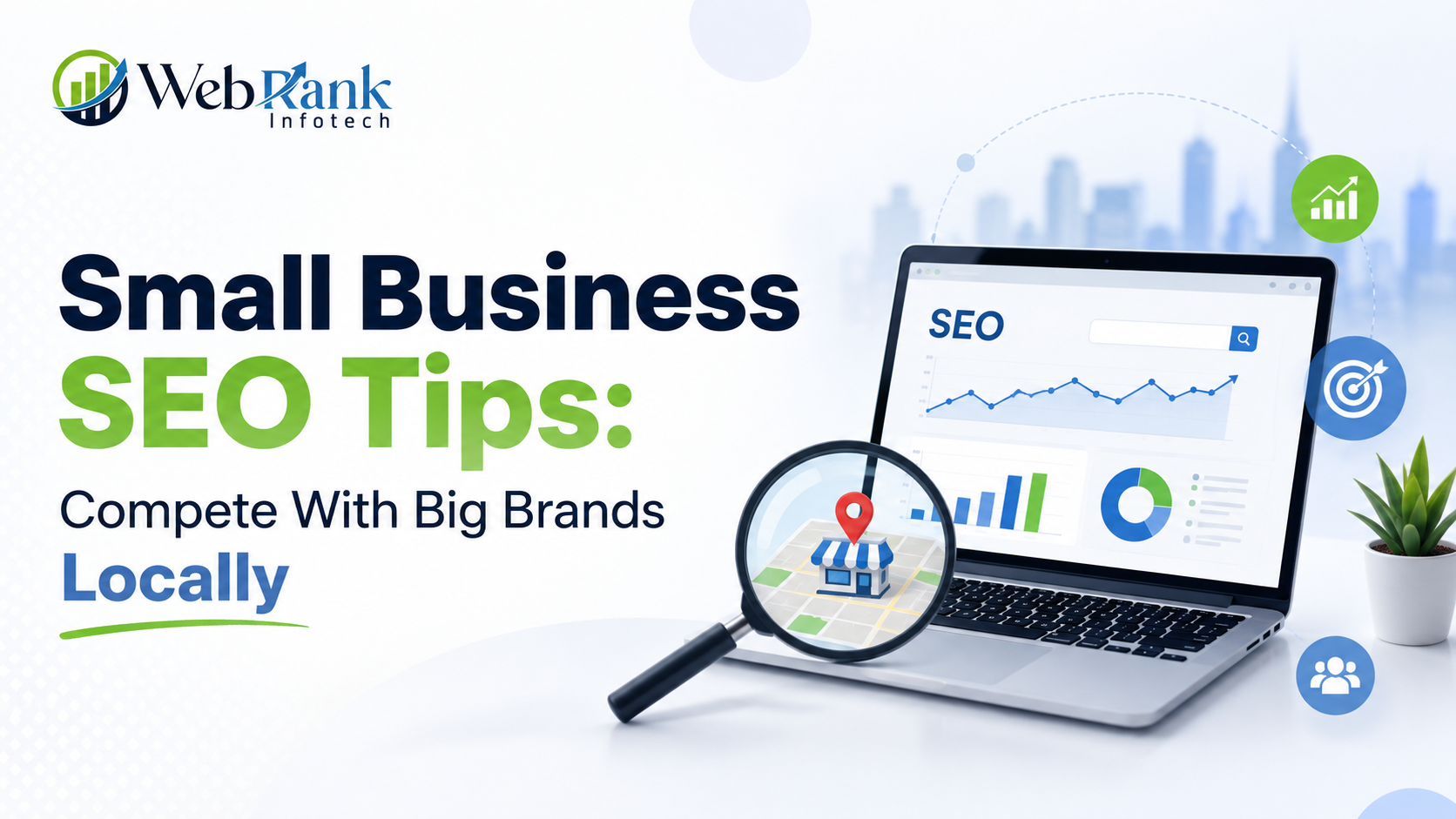
Big brands do not outrank small businesses in local search because of budget. They outrank them when small businesses skip the basics that actually decide local rankings — a complete Google Business Profile, consistent local content, real reviews, and clean technical SEO. Local search rewards relevance, proximity, and trust — three signals a small, focused business can build faster than any national brand — and this guide breaks down exactly how to do that, step by step.
Why Do Big Brands Still Lose to Small Businesses in Local Search?
Google’s local ranking system does not run on domain size. It runs on three factors published directly by Google: relevance, distance, and prominence. A national brand’s website might carry more backlinks and more domain authority overall, but none of that guarantees a strong position in the local pack — the map results that show up for searches with local intent. Distance to the searcher and relevance to the exact query often outweigh raw authority in these results. A big brand with one generic listing serving an entire city cannot match a local business with a fully optimized profile, hyperlocal content, and steady reviews from real nearby customers. This is why a two-person plumbing business regularly outranks a national franchise for “plumber near me” searches in its own neighborhood.
Big brands also tend to under-invest in local signals because their marketing teams are built for scale, not for street-level precision. They rarely respond to reviews individually, rarely publish location-specific content, and often have inconsistent business listings across directories. Every one of those gaps is an opening.
Quick summary: Local search ranks on relevance, distance, and prominence — not domain size. Big brands often neglect location-specific signals like review responses and NAP consistency, which gives small businesses with a focused, well-maintained local presence a genuine structural advantage over national competitors.
How to Set Up a Google Business Profile That Outranks National Competitors?
Google Business Profile (GBP) is the single highest-leverage asset for local rankings. Most small businesses claim it and stop there. Winning it requires ongoing management.
Step 1: Claim and Verify the Correct Category
Choose the most specific primary category available, not the broadest one. A “family-owned Italian restaurant” should select “Italian Restaurant,” not just “Restaurant.” Specific categories match specific search intent more precisely, which improves relevance scoring.
Step 2: Keep NAP Data 100% Consistent
Name, Address, and Phone number (NAP) must match exactly across the GBP listing, the website, and every directory listing. Inconsistent NAP data confuses Google’s trust signals and can quietly suppress rankings even when everything else is optimized.
Step 3: Add Location-Specific Attributes and Services
List every service or product category the business offers, using the exact terms customers search for. A bakery should list “custom birthday cakes,” “eggless cakes,” and “same-day delivery” as separate service entries rather than one vague “bakery items” line.
Step 4: Post Weekly Updates and Real Photos
Businesses that post GBP updates weekly and upload fresh, geotagged photos regularly signal ongoing activity, which correlates with stronger local pack visibility. Stock photos and stale listings signal the opposite.
Step 5: Respond to Every Review Within 48 Hours
Response rate and response speed are both measurable engagement signals. A fast, personalized response to a three-star review often does more for trust than five generic five-star reviews with no reply.
Quick summary: A fully optimized Google Business Profile — correct category, consistent NAP, detailed service listings, fresh photos, and fast review responses — is the fastest path to outranking a big brand’s generic, under-managed listing in local map results.
What Local Keywords Should a Small Business Target Instead of Broad Terms?
Big brands compete for broad, high-volume keywords like “digital marketing agency” or “best pizza.” Small businesses win by targeting long-tail, geo-specific, and intent-rich variations that broad brand campaigns ignore entirely.
| Keyword Type | Example (Broad) | Example (Local, High-Intent) |
|---|---|---|
| Service + Location | SEO services | SEO services in Chandigarh |
| Service + Modifier | Digital marketing agency | Affordable digital marketing agency for small business |
| Near-Me Intent | Marketing agency | Digital marketing agency near me |
| Problem-Based | SEO help | Why is my local business not showing on Google Maps |
| Neighborhood-Specific | Bakery | Eggless cake shop in Sector 34 Chandigarh |
Long-tail, location-based keywords convert at a higher rate because the searcher has already narrowed their intent to something specific and nearby. Tools like Google’s own “People also search for” section, Google Search Console’s query report, and free keyword tools can surface these patterns directly from real search behavior in a target area.
Quick summary: Broad keywords favor big brands with bigger ad budgets and domain authority. Long-tail, location-modified, and problem-based keywords favor small businesses because they match narrower, higher-converting search intent with far less competition.
How to Create Local Content That Big Brands Cannot Copy?
National brands publish generic content because it has to work everywhere. That is precisely the gap a local business can exploit.
Publish Neighborhood and Community Content
Content tied to local events, local news, or community involvement builds relevance signals a corporate content team will never replicate at scale. A landscaping business writing about “best plants for Chandigarh’s summer heat” earns relevance a national chain’s generic “top 10 plants” post cannot match locally.
Build Location Pages for Every Service Area
A business serving multiple nearby towns should build a dedicated page per location rather than one page trying to rank for all of them. Each page should include unique content — not duplicated text with only the city name swapped — covering local landmarks, service specifics, and testimonials from that area.
Answer Hyperlocal Questions Directly
Content that answers questions like “which areas does this business deliver to” or “is parking available near this store” satisfies real searcher intent that big brand content almost never addresses. This kind of specificity is also what AI-driven search overviews increasingly pull from directly.
Quick summary: Big brand content is built for scale, not specificity. Small businesses win by publishing neighborhood-relevant content, unique per-location service pages, and direct answers to hyperlocal questions — content a corporate content calendar simply won’t produce.
How to Earn Local Backlinks Without a PR Budget?
Backlinks still influence prominence, one of Google’s three core local ranking factors, but earning them locally does not require a national PR budget.
- Local directories and chambers of commerce — Listings on city business directories, local chambers of commerce, and industry associations are often free or low-cost and carry real local relevance.
- Local news and community sites — Sponsoring a local event or being featured in community coverage generates a natural, relevant backlink.
- Supplier and partner cross-links — Businesses that supply or collaborate with other local businesses can exchange genuine, relevant links (a caterer linking to a wedding venue partner, for example).
- Guest content on local blogs — Contributing genuinely useful content to a local lifestyle or industry blog earns both a backlink and direct local audience exposure.
Each of these earns a backlink from a source that is itself locally relevant — which matters more for local rankings than a high-authority link from an unrelated national site.
Quick summary: Local backlinks from directories, chambers of commerce, community sites, and partner businesses carry more local ranking weight than generic national backlinks, and none of them require a large PR budget to acquire.
Why Do Reviews Matter More Than Domain Authority in Local Search?
Reviews function as a real-time trust and prominence signal that Google can verify continuously, unlike domain authority, which changes slowly. According to BrightLocal’s annual local search ranking factors research, review signals — including review quantity, velocity, and diversity — consistently rank among the top local pack ranking factors, alongside Google Business Profile signals.
Review Volume Alone Isn’t Enough
What matters more than the total count is review velocity — a steady stream of new reviews over time — and review diversity across multiple platforms, not just Google.
Responding Builds Prominence
Every response is public content that signals active management. It also gives a natural opportunity to reinforce location and service keywords in a way that reads authentically rather than as keyword stuffing.
Negative Reviews Are Not a Loss
A calm, professional response to a negative review often builds more trust with prospective customers than a page of unanswered five-star reviews. Businesses considering how to handle a damaged reputation or a cluster of negative reviews should look into structured online reputation management services rather than trying to have reviews removed, which rarely works and can look evasive to searchers.
Quick summary: Review volume, velocity, diversity, and response rate act as continuous trust signals that Google can verify in real time — something a big brand’s static domain authority cannot replicate at the local level, and something a well-managed small business can win consistently.
How to Fix the Technical SEO Issues Costing Local Rankings?
Content and reviews mean little if the website itself is slow, broken on mobile, or missing structured data.
Step 1: Fix Core Web Vitals
Page speed, load stability, and interactivity are ranking factors Google measures directly. Tools like Google’s own PageSpeed Insights and Search Console’s Core Web Vitals report identify exactly which pages are underperforming.
Step 2: Add LocalBusiness Schema Markup
Structured data using schema.org’s LocalBusiness markup helps search engines and AI-driven overviews understand the business name, address, hours, and service area with certainty — reducing the chance of being misrepresented in search results.
Step 3: Make the Site Mobile-First
The majority of local searches happen on mobile devices, often with immediate intent (“open now,” “near me”). A site that is slow or awkward on mobile loses both rankings and conversions.
Step 4: Fix Duplicate or Thin Location Pages
Multiple location pages with near-identical content can suppress rankings for all of them. Each page needs genuinely unique, useful content specific to that location.
A small business without in-house development resources can get a full technical audit and fix through professional SEO services rather than attempting piecemeal fixes that miss the underlying issues.
Quick summary: Slow load times, missing schema markup, poor mobile experience, and duplicate location pages quietly suppress local rankings regardless of how good the content or reviews are — fixing these technical foundations is non-negotiable, not optional.
Which Local SEO Tools Are Worth Using on a Small Budget?
Judged on cost-effectiveness, ease of use, and actual impact on local rankings, here is an honest breakdown:
| Tool | Best For | Free/Paid | Rating (out of 5) |
|---|---|---|---|
| Google Business Profile | Core local listing management | Free | 5/5 — non-negotiable, highest ROI |
| Google Search Console | Tracking search queries and technical errors | Free | 5/5 — essential diagnostic tool |
| Google PageSpeed Insights | Core Web Vitals and speed diagnostics | Free | 4.5/5 — accurate but requires technical follow-through |
| BrightLocal | Local rank tracking and citation management | Paid | 4/5 — strong for agencies, pricier for solo owners |
| Whitespark | Local citation building | Paid | 4/5 — effective, narrow use case |
| Ubersuggest | Basic keyword research on a budget | Freemium | 3.5/5 — decent starting point, less precise than premium tools |
For a small business with limited time, the free stack of Google Business Profile, Search Console, and PageSpeed Insights covers roughly 80% of what matters before any paid tool becomes necessary.
Quick summary: Google’s own free tools — Business Profile, Search Console, and PageSpeed Insights — deliver the highest return for the lowest cost, while paid tools like BrightLocal and Whitespark are worth adding only once a business needs rank tracking or citation building at scale.
Should a Small Business Handle Local SEO In-House or Hire an Agency?
Both routes work — the right choice depends on time, existing skill, and how fast results are needed. Here is an honest, scored comparison:
| Criteria | DIY (In-House) | Hiring an Agency |
|---|---|---|
| Cost | Lower upfront (4/5) | Higher upfront (3/5) |
| Speed of results | Slower — learning curve (2.5/5) | Faster — established process (4.5/5) |
| Expertise required | High, must self-teach (2/5) | Provided by the agency (5/5) |
| Time investment from owner | Very high (2/5) | Low, mostly oversight (4.5/5) |
| Risk of costly mistakes | Higher, especially technical SEO (2.5/5) | Lower, assuming a reputable agency (4/5) |
A business owner with time to learn and a genuinely small local footprint (single location, low competition) can realistically manage GBP optimization and basic content in-house. A business competing in a crowded local market, or juggling technical SEO, content, and review management alongside actually running the business, generally sees faster and more reliable results by partnering with a digital marketing agency that specializes in local SEO. Learning the fundamentals through a structured digital marketing course is also a middle path worth considering for owners who want to stay hands-on long-term.
Quick summary: DIY local SEO works for low-competition, single-location businesses with time to learn, but agencies consistently win on speed, expertise, and reduced risk of costly technical mistakes — the right choice depends on how much owner time is actually available.
How to Measure Whether Local SEO Is Actually Working?
Local SEO without measurement is guesswork. Three metrics matter most:
Local Pack Rankings for Target Keywords
Tracking position in the map pack for core service + location keywords, checked weekly or monthly, shows direct ranking movement over time.
Google Business Profile Insights
GBP’s built-in insights show how many people found the listing through search versus maps, how many requested directions, called, or visited the website — direct behavioral data tied to local intent.
Conversion Actions, Not Just Traffic
Calls, direction requests, form submissions, and booking clicks matter more than raw impressions. A small business with fewer visitors but a higher call rate is outperforming a business with more traffic and no conversions.
Google Search Console’s performance report, cross-referenced with GBP insights monthly, gives a complete, free picture of whether local SEO effort is translating into real customer actions.
Quick summary: Local SEO success should be measured through local pack rankings, Google Business Profile engagement data, and actual conversion actions like calls and direction requests — not vanity metrics like total site traffic alone.
Conclusion: Building a Local SEO Roadmap That Beats Big Brands
Local SEO is not a spending contest — it is an intent-matching contest, and that favors small businesses structurally. A big brand’s national domain authority cannot fake proximity, cannot personally respond to a review, and cannot publish genuinely local content at scale. A small business that consistently optimizes its Google Business Profile, targets long-tail local keywords, builds hyperlocal content, earns local backlinks, manages reviews actively, and keeps its technical SEO clean will consistently outrank far larger competitors in the results that actually drive foot traffic and phone calls. The businesses that win locally are not the biggest — they are the most consistent.
Frequently Asked Questions
Can a small business really outrank big brands on Google?
Yes, especially in local search results. Google’s local ranking system weighs relevance, proximity, and prominence over raw domain size, so a well-optimized small business listing regularly outranks a national brand’s generic one. For example, a single-location coffee shop with an actively managed Google Business Profile and consistent reviews often beats a national chain’s nearest branch for “coffee shop near me” searches in that exact neighborhood.
How long does local SEO take to show results?
Most small businesses see initial local pack movement within 4 to 8 weeks, with more substantial ranking gains building over 3 to 6 months. A restaurant that starts posting weekly GBP updates and actively collecting reviews often sees a noticeable increase in map visibility within the first month, while ranking for competitive long-tail keywords typically takes longer to stabilize.
Is local SEO better than paid ads for a small business?
Local SEO delivers more sustainable, lower-cost-per-lead results over time, while paid ads deliver faster but temporary visibility. A retail store running both often finds paid ads useful for a product launch or seasonal push, while local SEO builds the steady, ongoing visibility that keeps generating customers even after ad spend stops.
Should a small business hire an SEO agency or do it themselves?
It depends on available time and market competition. A business in a low-competition area with an owner who has time to learn can manage the basics in-house, while a business in a crowded market usually gets faster, more reliable results from a specialized agency. A boutique clinic competing against five other clinics within a two-kilometer radius, for instance, typically needs professional support to keep pace with faster-moving competitors.
How many Google reviews does a small business need to rank locally?
There is no fixed number, but review velocity and response rate matter more than total count. A business with 40 reviews added steadily over a year, each with a thoughtful response, often outranks a competitor with 200 old reviews and no engagement. Consistency beats raw volume.
What is the difference between local SEO and regular SEO?
Regular SEO focuses on ranking for broad, often national or global search intent, while local SEO focuses on location-specific visibility, particularly in Google’s map pack and “near me” searches. A national e-commerce brand invests in regular SEO to rank for “running shoes,” while a local sporting goods store invests in local SEO to rank for “running shoes store in [city].”
How much does local SEO cost for a small business?
Costs vary widely, from free (using owner time and Google’s own tools) to a few hundred dollars per month for a managed service, depending on market competition and how much work is needed. A single-location business in a low-competition town might manage everything using free tools, while a business in a competitive metro area typically needs an ongoing paid strategy to stay ahead of similarly invested competitors.