
If you’ve been doing digital marketing for a while, you probably know what SEO is. But lately, two new terms have been quietly taking over the conversation — AEO and GEO. And if you’re not paying attention to all three, you’re likely leaving a lot of traffic, visibility, and customers on the table.
In this blog, we’re going to break down SEO, AEO, and GEO in plain, simple language so you understand what they are, how they work, and why your business needs all three working together.
Let’s get into it.
First, Why Does This Even Matter?
The way people search for things online has changed a lot in the last few years. Not too long ago, you typed something into Google, clicked a link, and visited a website. Simple.
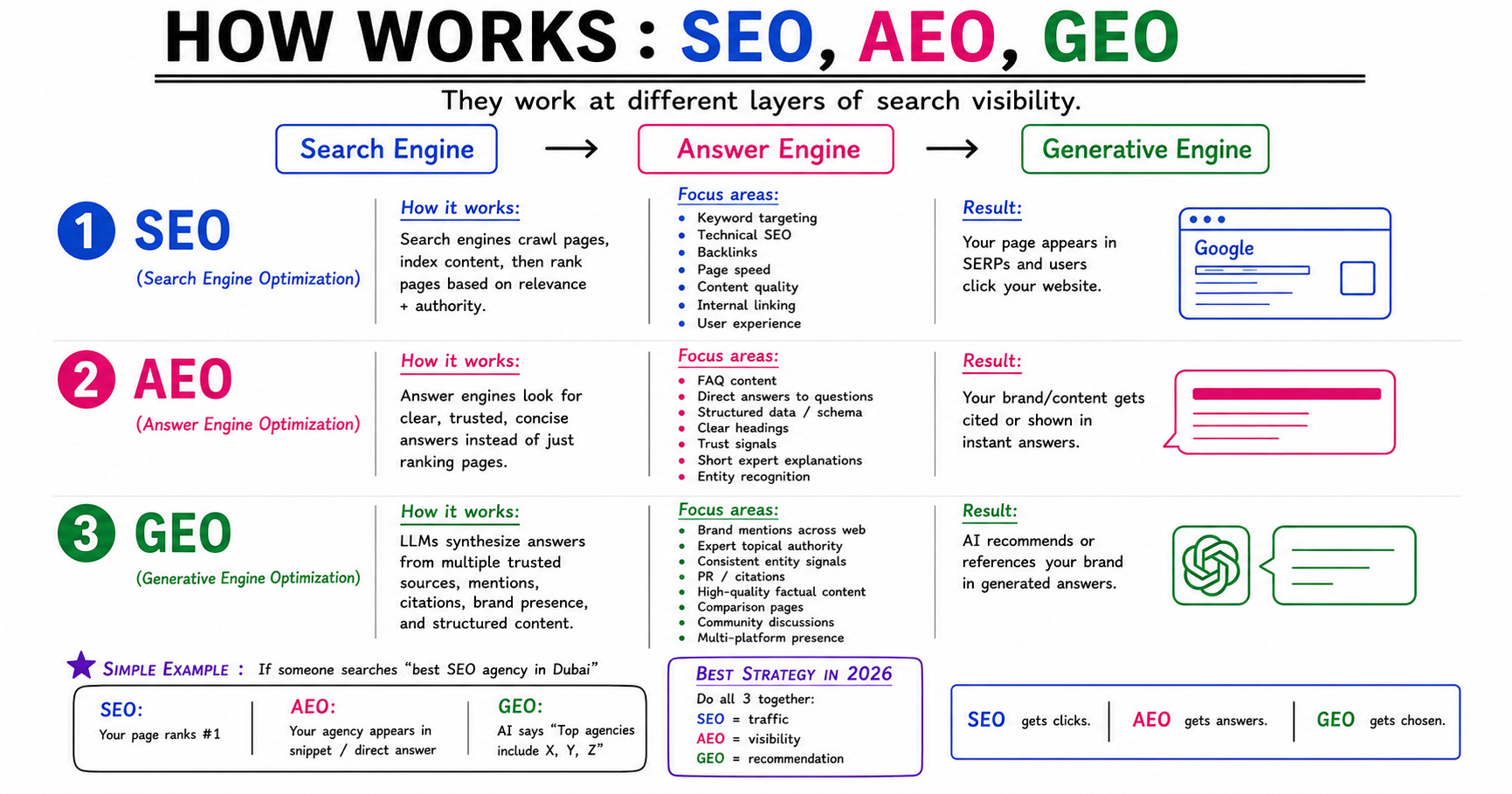
But now? People ask voice assistants questions. They get instant answers right inside search results without clicking anything. They ask AI tools like ChatGPT or Gemini for recommendations before they even open a browser. The search journey has moved across three very different types of engines — Search Engines, Answer Engines, and Generative Engines — and each one works in its own way.
That’s exactly where SEO, AEO, and GEO come in. Each one helps you show up in a different layer of this new search world.
1. SEO — Search Engine Optimization
SEO is the foundation. It’s been around the longest, and it still matters enormously.
How It Works
Search engines like Google work by crawling your website, reading and indexing your content, then deciding where to rank your pages when someone searches for something. The better your page is — in terms of relevance, authority, and technical quality — the higher it ranks.
What SEO Focuses On
- Keyword targeting — making sure your content matches what people are actually searching for
- Technical SEO — making sure your site is fast, mobile-friendly, and easy for search bots to crawl
- Backlinks — getting other reputable websites to link to yours, which builds your authority
- Page speed — slow websites rank lower, and users leave faster
- Content quality — helpful, well-written content that genuinely answers what people are looking for
- Internal linking — connecting your pages together so both users and search bots can navigate your site easily
- User experience — if visitors bounce from your page quickly, search engines notice and it hurts your ranking
The Result
When your SEO is done right, your page shows up in SERPs (Search Engine Results Pages) and people click through to your website. More organic traffic, more leads, and more business — without paying for ads.
Think of SEO as the engine that drives traffic to your front door.
2. AEO — Answer Engine Optimization
AEO is where things start getting interesting — and where many businesses are quietly falling behind.
How It Works
Answer engines — think Google’s featured snippets, the “People Also Ask” boxes, and voice search results — don’t just rank pages. They pull direct answers from web pages and show them right there in the search results, without making the user click anywhere.
So instead of just ranking your page, you want your content to become the answer that gets highlighted. The goal here isn’t just to rank — it’s to be so clear and concise that the search engine uses your words directly.
What AEO Focuses On
- FAQ-style content — writing questions and clear answers that a search engine can pull directly
- Direct, concise answers — no fluff, no long introductions; get to the point immediately
- Structured data and schema markup — a type of code that helps search engines understand exactly what your content is about
- Clear headings — using proper H2s and H3s to organize content so it’s easy to scan
- Trust signals — showing that your brand is credible, established, and authoritative
- Short expert explanations — proving you know your subject without overwhelming the reader with jargon
- Entity recognition — helping search engines associate your brand name with specific topics and industries
The Result
Your content gets cited or displayed as an instant answer. Your brand name might appear in a snippet, a voice response, or a direct answer box — even if the user never clicks through to your website.
That might sound a little frustrating at first, but here’s the flip side: when someone sees your brand answering their question clearly and accurately, they remember you. And when they’re finally ready to buy, they come to you — because you’re already the authority in their mind.
3. GEO — Generative Engine Optimization
GEO is the newest layer — and it’s quickly becoming one of the most important things to understand.
How It Works
Generative AI tools like ChatGPT, Google’s AI Overviews, and Perplexity don’t work like traditional search engines at all. They don’t just find pages and rank them — they read and synthesize information from multiple trusted sources and generate a complete, conversational answer for the user.
So when someone asks an AI, “What’s the best digital marketing agency in my city?” — the AI pulls together information from across the web: mentions, citations, reviews, expert content, and authoritative sources. Then it generates its own recommendation.
If your brand isn’t being talked about, cited, or mentioned in trustworthy places online, the AI simply doesn’t know you exist — and it won’t recommend you.
What GEO Focuses On
- Brand mentions across the web — being talked about on reputable sites, blogs, news outlets, and forums
- Expert topical authority — consistently publishing high-quality, accurate content in your niche
- Consistent entity signals — your brand name, services, and area of expertise appearing consistently everywhere online
- PR and citations — getting mentioned in news articles, industry publications, and trusted sources
- High-quality factual content — AI tools are built to favor accurate, well-sourced information over vague or thin content
- Comparison pages — content that compares products, services, or approaches (AI tools often reference these when answering user questions)
- Community discussions — actively being part of conversations on platforms like Reddit, Quora, and LinkedIn
- Multi-platform presence — not just your website, but also YouTube, podcasts, social media, and business directories
The Result
When someone asks an AI tool for a recommendation or information in your field, the AI mentions or recommends your brand by name. This is essentially word-of-mouth at a massive scale — but powered entirely by machines reading the web.
A Real-World Example That Makes It Crystal Clear
Let’s say someone searches for “best digital marketing agency in Ludhiana.”
Here’s what happens across all three engines:
| Engine Type | What Happens |
|---|---|
| SEO | Your website ranks at the top of Google’s search results page |
| AEO | Your agency appears in the featured snippet or direct answer box |
| GEO | An AI tool says “Top agencies in this space include…” and names your brand |
Each outcome reaches a completely different type of searcher. Some people scroll through Google results and click links. Some read the instant answer box and make a decision right there. Some ask AI tools before they even open a search engine. If you’re only doing SEO, you’re only reaching one group — and missing the rest.
Why You Need All Three Working Together
Here’s the honest truth most marketing blogs won’t tell you directly: you can’t afford to pick just one of these strategies.
- SEO gets you clicks — people visit your site, read your content, and convert into customers
- AEO gets you visibility — your brand appears as a trusted answer, building recognition even without a click
- GEO gets you chosen — AI tools actively recommend your brand when people are in decision-making mode
Together, these three strategies cover the entire modern search journey from start to finish. Miss one layer, and you become invisible to a whole segment of potential customers who are actively looking for exactly what you offer.
The businesses that understand this now and start building all three layers will have a significant advantage over those who wait until it becomes obvious.
Quick Recap Before You Go
- SEO = Getting your pages ranked on search engines so people find and click your website
- AEO = Getting your content pulled as direct, instant answers in snippets and voice search
- GEO = Getting your brand mentioned and recommended by AI-powered tools
All three work at different layers of search visibility. All three matter. And the best results always come when you use all three in harmony — not just one in isolation.
If you found this helpful, share it with someone who’s been asking why their SEO alone isn’t driving results like it used to. The search landscape has changed — and now you know exactly how to navigate it.
Web Rank Infotech helps businesses build complete search visibility strategies that cover all three layers — SEO, AEO, and GEO — so your brand gets found no matter where your customers are searching.