

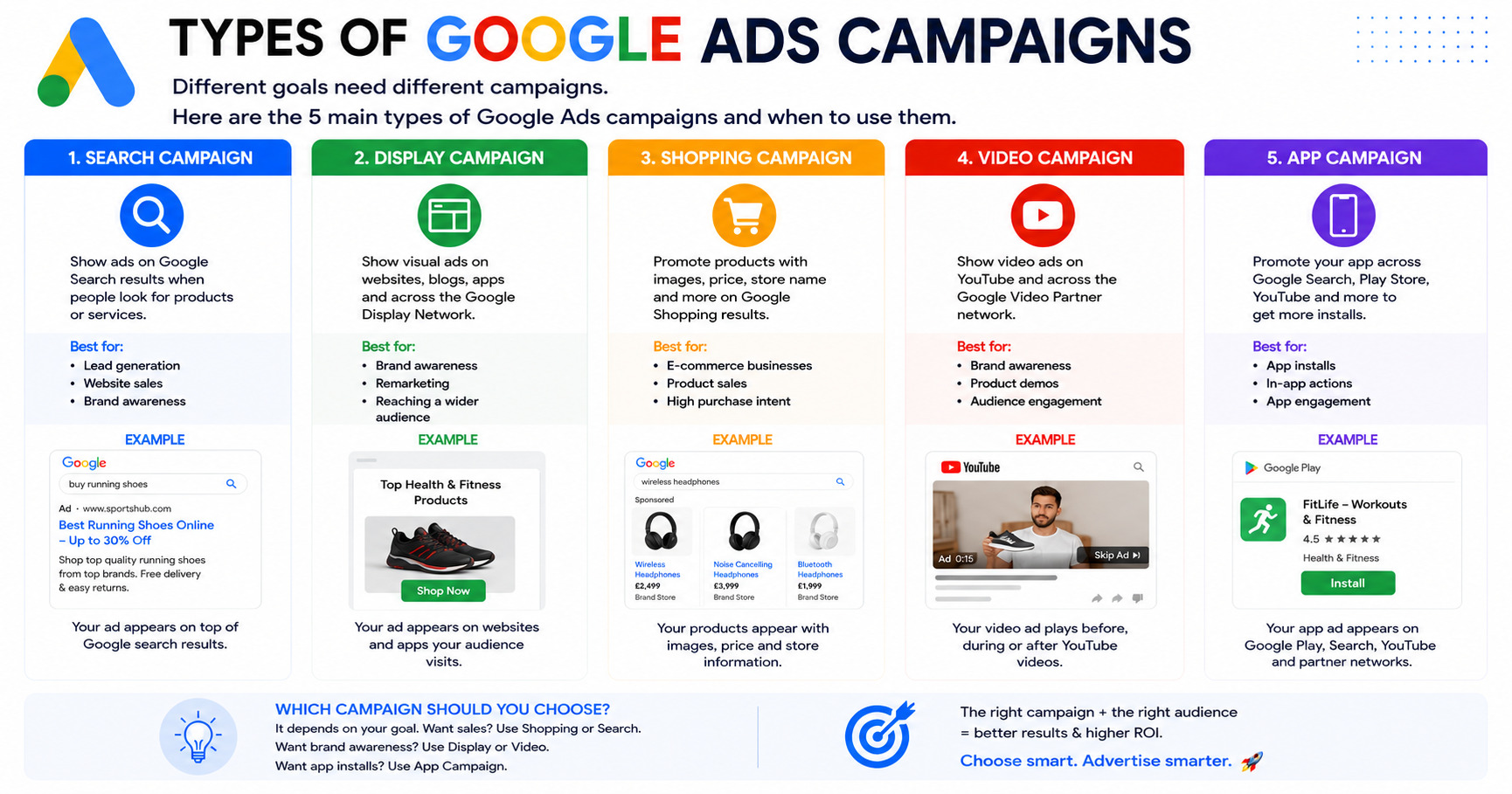
If you’ve ever logged into Google Ads and felt completely lost staring at all the campaign options — you’re not alone. Most business owners and even some marketers feel the same way. The good news? Once you understand what each campaign type does and when to use it, the whole thing becomes much less overwhelming.
In this guide, we’re breaking down all 5 types of Google Ads campaigns in plain, simple language. No jargon. No fluff. Just honest, practical advice to help you spend your ad budget where it actually counts.
Let’s get into it.
Why Choosing the Right Campaign Type Matters
Here’s something Google won’t tell you upfront — running the wrong type of campaign for your goal is one of the biggest reasons businesses waste money on ads.
A clothing brand running Search ads when they should be running Shopping ads. A mobile app company pouring money into Display when they need App campaigns. It happens all the time. And the result is always the same — poor results, frustration, and the belief that “Google Ads doesn’t work.”
Google Ads absolutely works. You just need to match the right campaign to the right goal. That’s exactly what this guide is here to help you do.
1. Search Campaign — Show Up When People Are Ready to Buy
Best for: Lead generation, website sales, brand awareness
What It Is
Search campaigns are the most common type of Google Ads — and for good reason. These are the text ads that appear at the top of Google search results when someone types in a keyword related to your business.
For example, if someone searches “buy running shoes online,” a Search ad from a shoe retailer appears right at the top — before any organic results.
How It Works
You choose keywords you want to target, write compelling ad copy, set your budget, and Google shows your ad to people actively searching for those terms. You only pay when someone clicks — which is why it’s called Pay Per Click (PPC).
Why It’s Powerful
The biggest advantage of Search campaigns is intent. The person searching already wants what you’re offering. They’re not casually browsing — they’re actively looking. That makes Search ads one of the highest-converting campaign types available.
When to Use It
Use Search campaigns when you want immediate leads or sales, when you have a specific service or product to promote, or when you know exactly what your customers are typing into Google.
2. Display Campaign — Stay Visible Everywhere Your Audience Goes
Best for: Brand awareness, remarketing, reaching a wider audience
What It Is
Display campaigns show visual banner ads — images, graphics, and sometimes animations — across millions of websites, blogs, and apps that are part of the Google Display Network. This network reaches over 90% of internet users worldwide.
How It Works
Instead of targeting people by what they search, Display campaigns target people based on their interests, demographics, browsing behaviour, or whether they’ve previously visited your website (remarketing).
Why It’s Powerful
Think about it — someone visits your website, doesn’t buy anything, and leaves. With a Display remarketing campaign, your ad follows them across the web, reminding them about your brand until they’re ready to come back and convert. It’s one of the most effective ways to stay top-of-mind.
When to Use It
Use Display campaigns when you want to build brand awareness at scale, when you want to remarket to people who’ve already shown interest in your business, or when you want to reach a broad audience at a lower cost per impression.
3. Shopping Campaign — Perfect for Products That Sell Themselves
Best for: E-commerce businesses, product sales, high purchase intent
What It Is
Shopping campaigns are designed specifically for businesses that sell physical products. When someone searches for a product on Google, Shopping ads appear with an image, price, store name, and sometimes reviews — right at the top of the page.
How It Works
Instead of bidding on keywords, Shopping campaigns pull product information directly from your Google Merchant Center feed — your product catalogue. Google then matches your products to relevant searches automatically.
Why It’s Powerful
Shopping ads are incredibly effective because they show the user exactly what they’re getting — the product image and price — before they even click. This means the people who do click are already interested and more likely to buy, giving you a much higher conversion rate.
When to Use It
Use Shopping campaigns if you run an online store and want to drive direct product sales. If someone is searching “wireless headphones under ₹3,000,” a Shopping ad with your product, price, and brand puts you right in front of a buyer who is ready to purchase.
4. Video Campaign — Tell Your Story Where Attention Lives
Best for: Brand awareness, product demos, audience engagement
What It Is
Video campaigns run ads on YouTube and across Google’s Video Partner Network. These can appear before videos (skippable or non-skippable), during videos, or as standalone ads in YouTube search results.
How It Works
You create a video ad — anything from a 15-second brand clip to a longer product demo — and target it based on audience demographics, interests, keywords, or specific YouTube channels. You typically only pay when someone watches a significant portion of your ad.
Why It’s Powerful
Video is the most engaging content format on the internet. A well-made video ad can communicate your brand story, showcase your product in action, or build an emotional connection with your audience far more effectively than any text or image ad.
For businesses launching new products or trying to explain a complex service, Video campaigns are unmatched.
When to Use It
Use Video campaigns when you want to build brand recognition at scale, when you have a product that benefits from a visual demonstration, or when you want to engage a younger, highly active online audience.
5. App Campaign — Get Your App in Front of the Right Users
Best for: App installs, in-app actions, app engagement
What It Is
App campaigns are built specifically for businesses that have a mobile app and want to drive downloads or in-app activity. These ads appear across Google Search, Google Play Store, YouTube, and partner networks — all from a single campaign setup.
How It Works
You provide your app details, some ad text, images, and videos, and Google’s machine learning takes over — automatically optimizing your ads across all placements to get you the most installs or in-app actions at the lowest cost.
Why It’s Powerful
App campaigns are incredibly efficient because Google does the heavy lifting for you. Instead of managing multiple campaigns across different platforms, one App campaign covers everything — and it keeps getting smarter over time as it learns what works.
When to Use It
Use App campaigns if you’ve built a mobile app and want to grow your user base quickly, re-engage existing users who’ve gone inactive, or drive specific in-app actions like purchases or sign-ups.
Which Google Ads Campaign Should You Choose?
Here’s the honest answer — it depends entirely on your goal.
| Your Goal | Best Campaign Type |
|---|---|
| Generate leads or website sales | Search Campaign |
| Build brand awareness | Display or Video Campaign |
| Sell products online | Shopping Campaign |
| Reach people who visited your site | Display (Remarketing) |
| Grow your mobile app | App Campaign |
| Launch a new product with visual impact | Video Campaign |
The right campaign type matched with the right audience always leads to better results and a higher return on investment. The mistake most businesses make is choosing a campaign based on what looks familiar rather than what actually fits their goal.
Can You Run Multiple Campaign Types Together?
Absolutely — and in most cases, you should.
A smart Google Ads strategy often combines multiple campaign types working together. For example, a Search campaign captures people actively looking for your service. A Display remarketing campaign re-engages people who visited but didn’t convert. A Video campaign builds awareness with a cold audience who’s never heard of you. Together, they cover every stage of your customer’s journey.
This is exactly the kind of multi-layered approach that separates businesses getting strong ROI from Google Ads and those constantly burning budget with nothing to show for it.
Final Thoughts
Google Ads is one of the most powerful advertising platforms available to businesses today — but only when you use it correctly. Understanding the difference between Search, Display, Shopping, Video, and App campaigns is the foundation of any successful paid advertising strategy.
The formula is simple: the right campaign type + the right audience = better results and higher ROI.
Whether you’re a local service business trying to generate leads, an e-commerce store looking to boost product sales, or a brand wanting to build awareness — there’s a Google Ads campaign type built for exactly what you need.
Choose smart. Advertise smarter.
WebRank Infotech helps businesses build and manage high-performance Google Ads campaigns tailored to their goals — so every rupee of your ad budget works harder.