SEO

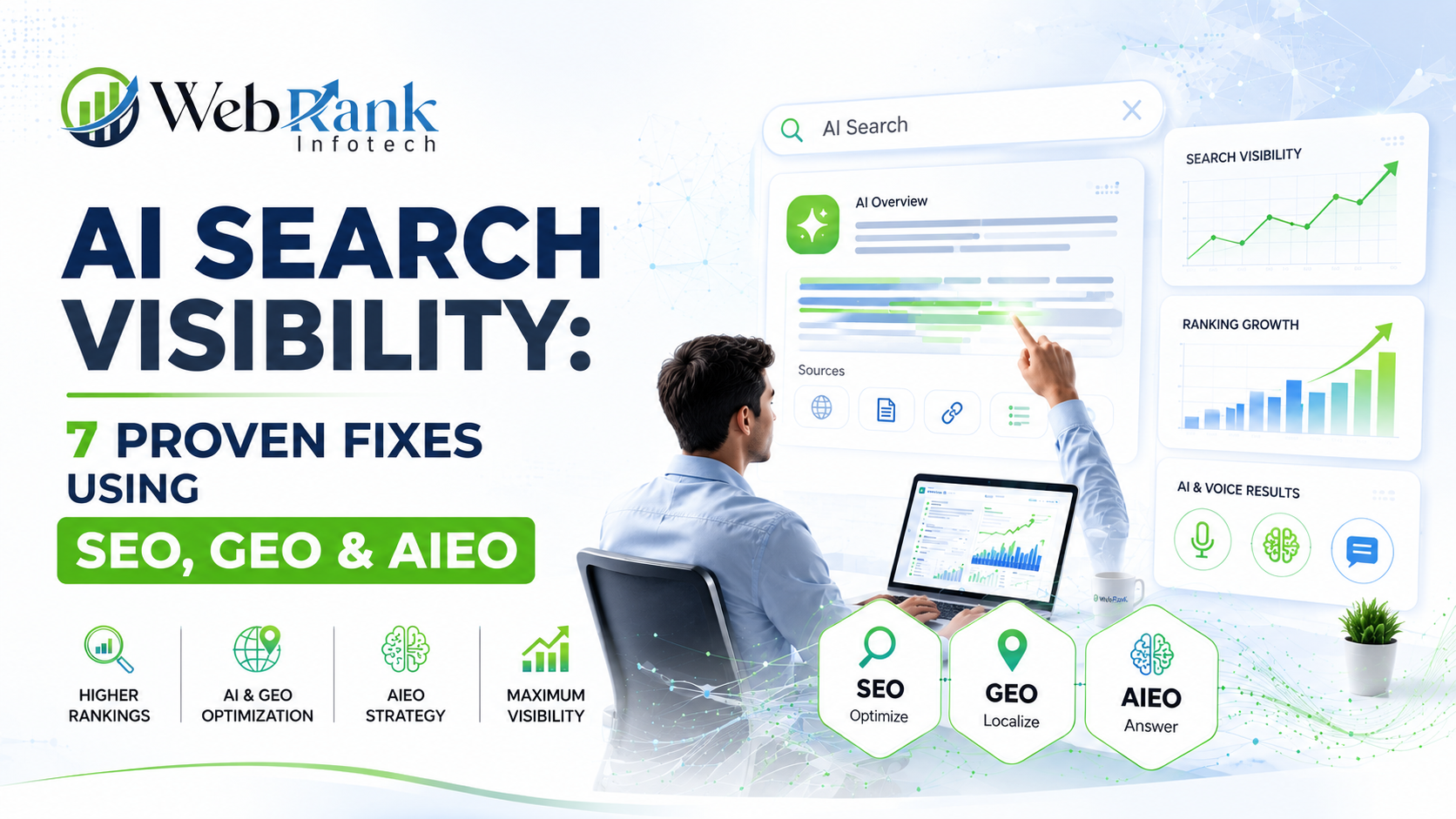
AI Search Visibility: 7 Proven Fixes Using SEO, GEO & AIEO

AI Search Visibility: 7 Proven Fixes Using SEO, GEO & AIEO

Your customers stopped scrolling through ten blue links. They started asking ChatGPT, Google AI Overviews, and Perplexity direct questions and trusting the answer they get back. If your business isn’t the answer being cited, you’re invisible — no matter how well you rank on page one. Fixing that takes three connected disciplines: SEO to earn the click, GEO to earn the citation, and AIEO to earn the AI’s trust. Search behavior has shifted more in the last eighteen months than in the previous five years combined. We used to tell clients “get to page one and you’re done.” Not anymore. Now the message is simple: page one doesn’t matter much if the AI Overview sitting above it never mentions your name. Here’s exactly how we diagnose weak AI search visibility and fix it, step by step. The short version, before we go deep: What Does It Mean When Your Business Is “Invisible” on AI Search? Invisibility on AI search doesn’t mean your website is broken or unindexed. It just means AI tools like Google AI Overviews, ChatGPT, and Perplexity never bring up your brand, your product, or your expertise when someone asks a question you could easily answer. You can rank #3 on Google and still be completely missing from the AI-generated summary sitting right above that ranking. This happens constantly — a client’s site pulls decent organic traffic, but the moment someone asks ChatGPT or Perplexity the exact question their landing page targets, their name never shows up. That’s poor AI search visibility in 2026: not a ranking problem, a recognition problem. In short: being invisible on AI search means AI tools skip your brand entirely when generating an answer, even if your traditional SEO looks healthy. Why Is AI Changing the Way People Search for Businesses Like Yours? People now expect a direct answer, not a list of links to sift through, and that’s changing everything about search. A Pew Research Center analysis found users clicked on a traditional search result in just 8% of searches with an AI summary present, compared to nearly double that rate on searches without one. We’ve watched this play out in client analytics too — click-through rates on informational queries have dropped even while rankings held steady or improved. The traffic isn’t going to a competitor anymore; the AI answer is simply absorbing it. That’s why success today gets measured less by rank position and more by how often a brand gets cited inside the AI answer itself. Simply put: AI answers are replacing the click. If your content isn’t structured to be quoted by AI, you lose visibility even while ranking well. What Is the Difference Between SEO, GEO, and AIEO? These three disciplines solve different problems, and it helps to think of it this way: SEO gets you found, GEO gets you quoted, and AIEO gets you trusted at scale. Discipline What It Optimizes For Primary Goal Where It Shows Up SEO (Search Engine Optimization) Traditional search engine rankings Rank on page one of Google/Bing Organic search results GEO (Generative Engine Optimization) Being cited inside AI-generated answers Get quoted or summarized by AI Google AI Overviews, Perplexity, AI Mode AIEO (AI Engine Optimization) How AI systems judge your overall trust and authority Long-term credibility across every AI platform ChatGPT, Claude, Gemini, voice assistants Show Image Technical health, on-page structure, and backlinks still matter, which is why SEO Services remain the foundation for every client we work with. GEO builds on top of that by shaping how content gets pulled into AI summaries. AIEO sits above both, since it’s less about a single page and more about whether AI systems, over time, decide your brand is worth referencing at all. Strong AI search visibility almost always comes from running all three together, not picking just one. For a closer look at how the technical and on-page side comes together, check out our SEO services page. Quick summary: SEO ranks you, GEO gets you quoted by AI, and AIEO builds the long-term trust that keeps you visible everywhere. They work together, not as substitutes for each other. How Do You Check Your AI Search Visibility Today? You find out by testing, not guessing. Here’s the checklist we run through with every client before touching a single page. Run the Direct-Question Test Ask ChatGPT, Perplexity, and Google AI Mode the exact question your ideal customer would type — not your brand name, the actual problem they’re trying to solve. If your business doesn’t show up in the answer, that’s a visibility gap. Check Your AI Overview Presence Search your top five money keywords on Google and note whether an AI Overview appears, and whether your domain gets cited inside it. Keeping a simple monthly spreadsheet for this per client makes patterns easy to spot. Audit Your Structured Data Missing or broken schema markup is one of the most common reasons AI systems can’t parse a site correctly. Google’s own structured data documentation is worth bookmarking for every audit. Review Your Off-Site Trust Signals AI systems weigh reviews, mentions, and third-party citations heavily. If your brand rarely shows up outside your own website, that’s a trust gap AIEO needs to close — which is exactly why AIEO work often goes hand in hand with online reputation management for clients with a thin review footprint. In one line: test your visibility with real questions across three AI tools, check schema, and audit off-site trust — that combination tells you exactly where you’re invisible and why. How to Fix Weak AI Search Visibility: A Step-by-Step Process This is the sequence we follow with clients, and skipping a step usually means redoing it later. Step 1: Audit Current AI and Search Visibility Start by documenting where things currently stand — rankings, AI Overview appearances, and citation frequency across ChatGPT and Perplexity. Without this baseline, there’s no way to prove improvement later. Step 2: Fix the Technical and On-Page SEO Foundation GEO and AIEO can’t fix a

AI Search Visibility: 7 Proven Fixes Using SEO, GEO & AIEO Read More »
AI SEO: Rank on ChatGPT, Gemini, Claude & Perplexity

AI SEO: Rank on ChatGPT, Gemini, Claude & Perplexity

If you’re ranking #1 on Google and still invisible in ChatGPT, Gemini, or Perplexity, you’re not failing at SEO — you’re solving the wrong problem. AI search engines don’t rank pages the way Google does; they retrieve, filter, and cite them through an entirely different pipeline. I’ve spent the last two years watching this shift happen in real client data, and the businesses winning right now aren’t the ones with the highest domain authority. They’re the ones who understood, early, that AI SEO is a separate discipline from traditional SEO — related, but not the same game. Search is splitting in two. One half still looks like ten blue links. The other half is a single generated answer, and your brand either gets named in it or it doesn’t exist for that searcher. This is why AI SEO — sometimes called GEO (Generative Engine Optimization) or AEO (Answer Engine Optimization) — has stopped being a “nice to have” for forward-thinking marketers and become the single highest-leverage channel most businesses are underinvesting in. Here’s why this matters right now. Google’s AI Overviews now appear on a large share of informational searches, and Google AI Mode has its own separate retrieval logic. ChatGPT has hundreds of millions of weekly users asking product and buying questions directly. Perplexity cites sources in nearly every answer it gives. Claude increasingly gets used for research and comparison tasks by people who never touch Google at all. None of these systems reward the same signals Google’s classic algorithm rewards, and I want to walk you through exactly what does work with AI SEO, platform by platform, with the mechanics, not the hype. I write this from direct, hands-on testing — running the same prompts across ChatGPT, Gemini, Claude, and Perplexity repeatedly, watching which of my own and my clients’ pages get pulled in and which get ignored. What follows is the clearest picture I can give you of how each of these systems actually decides what to trust, and how a deliberate AI SEO strategy should account for each one. Table of Contents What Is AI SEO? AI SEO is the practice of optimizing your website, content, and brand presence so that AI-powered search and chat systems — ChatGPT, Google Gemini/AI Overviews, Claude, Perplexity, and Bing Copilot — retrieve, reference, and recommend you in their generated answers. It sits at the intersection of three older disciplines: I think of AI SEO as the umbrella term a business owner actually searches for, while GEO and AEO are the technical sub-disciplines underneath it. If you’re building an AI SEO strategy, you need all three working together: you can’t get cited in an AI answer if your site isn’t even indexed, and you can’t win an AI Overview if your content doesn’t answer the question directly in the first few sentences. The core shift AI SEO asks you to make: stop optimizing purely for rank position, and start optimizing for extractability and trust. An AI model doesn’t scroll through your page and give you credit for keyword placement. It pulls a chunk of your content, decides if it can attribute a claim to you confidently, and either includes you or moves to the next candidate. Quick Summary: AI SEO is the umbrella strategy for getting cited and recommended inside AI-generated answers across ChatGPT, Gemini, Claude, and Perplexity. It combines classic SEO fundamentals with GEO (making content citable) and AEO (making content answer-first), and it succeeds or fails based on whether your content is extractable, trustworthy, and specific enough for an AI system to confidently attribute a claim to you. Why Is AI Search Changing the Rules of SEO? AI search is changing the rules of SEO because it removes the click. In classic search, Google shows you ten options and you choose. In AI search, the system chooses for the user and hands them one synthesized answer with a handful of citations. If you’re not one of those citations, you don’t just rank lower — you don’t exist in that interaction at all. Three structural shifts are driving this: I’ve watched this play out with clients who were previously obsessed with page-one Google rankings, only to discover competitors dominating the exact same buyer questions inside ChatGPT and Perplexity — competitors who, in some cases, don’t even rank in Google’s top 10 for that keyword. Traditional SEO alone no longer guarantees discovery. It’s necessary infrastructure for AI SEO, but it isn’t sufficient on its own. Quick Summary: AI search replaces a ranked list of links with a single synthesized answer and a small set of citations, so classic rank position matters less than it used to. Data shows AI Overview citations increasingly come from outside Google’s top 10, and AI chat platforms are becoming a primary research step before a purchase — meaning traditional SEO is necessary but no longer sufficient on its own. How Is AI SEO Different From GEO and AEO? Short answer: they’re not competing strategies — they’re layers of the same AI SEO stack. Discipline What it optimizes for Primary systems Core tactic SEO Ranking position on search engine results pages Google, Bing Keywords, backlinks, technical health, content depth AEO (Answer Engine Optimization) Being the direct answer to a specific question Featured snippets, voice search, AI Overviews Answer-first structure, Q&A formatting, concise definitions GEO (Generative Engine Optimization) Being cited/quoted inside a generative AI response ChatGPT, Gemini, Claude, Perplexity Statistics, quotations, citations, entity clarity, structural extractability AI SEO The umbrella outcome — visibility across all AI-driven discovery surfaces All of the above Combines SEO + AEO + GEO into one coordinated strategy The peer-reviewed paper that formalized GEO (Aggarwal et al., 2024, presented at KDD, from researchers at Princeton, Georgia Tech, and IIT Delhi) tested this scientifically: adding cited statistics, direct quotations, and clear citations to a passage boosted its visibility inside generative answers by up to 40%, with some techniques producing gains as high as 30–115% depending on the query category. That’s not marketing copy —

AI SEO: Rank on ChatGPT, Gemini, Claude & Perplexity Read More »

Google Core Update Recovery

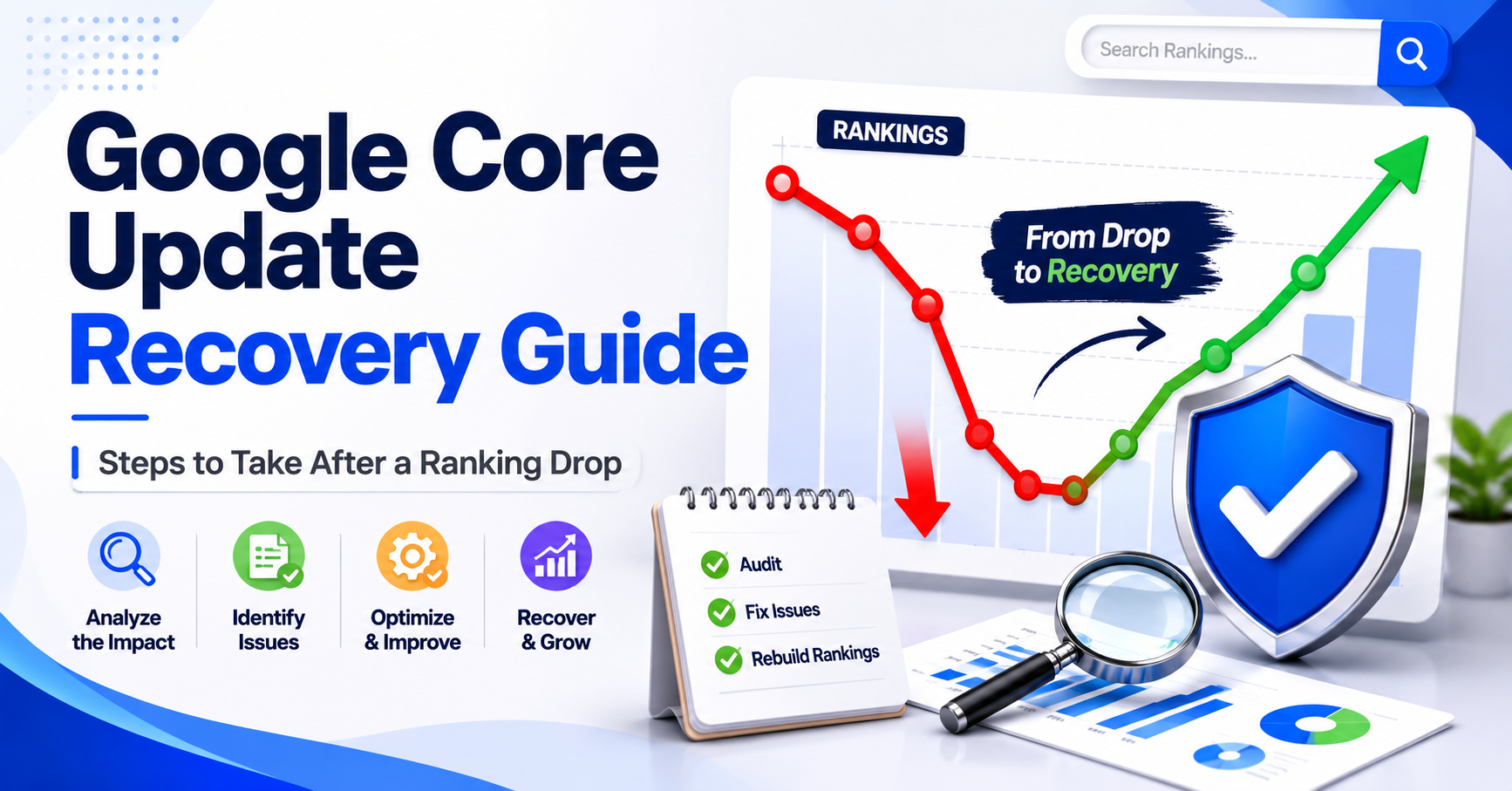
Google Core Update Recovery: 8 Proven Steps to Regain Lost Rankings Fast

So your rankings dropped overnight. You opened Google Search Console and the traffic graph looked like it fell off a cliff. If this happened to you after the Google May 2026 core update, you are not alone. Thousands of websites saw major ranking shifts starting May 21, 2026. At WebRank Infotech, we have been tracking this update since day one and helping businesses in Chandigarh and across India bounce back. This is your complete Google core update recovery plan — honest, practical, and easy to follow. What Is a Google Core Update and Why Did Your Rankings Drop? A Google core update is a broad change to Google’s main ranking systems. It is not a penalty — it is Google reassessing which pages deserve to rank higher based on quality, relevance, and trust. The May 2026 Google core update is the second core update of this year after March 2026. It uses Gemini-based AI quality models to evaluate content, making it significantly smarter at detecting thin, unhelpful, or AI-spun pages. A ranking drop after a core update means one thing: competing pages are currently scoring higher on Google’s quality signals than yours. That is fixable. Step 1: Wait for the Rollout to Complete Before Panicking The May 2026 core update started on May 21 and completes around June 4, 2026. Rankings are extremely volatile during this window. Do not do this while the update is rolling: Do this instead: Patience is not weakness here. It is strategy. Step 2: Identify Exactly Which Pages Were Hit Go to Google Search Console → Performance Report. Compare the two weeks before May 21 against the current period. Look for: Group pages by type: blog posts, service pages, homepage. Each group needs a different fix. For further analysis, check tools like Google Search Console and Ahrefs to compare ranking changes before and after the update. Step 3: Run a Content Quality Audit on Every Dropped Page This is where most Google core update recovery work happens. The May 2026 update specifically targets: For every page that dropped, ask honestly: Is this genuinely helpful? Not just accurate — useful to someone with a real problem. Does it answer the query completely? Partial answers cause bounces. Google notices. Does it show real expertise? Specific examples, original insights, practical detail that goes beyond generic information. Is it up to date? Outdated content on fast-moving topics like SEO loses trust signals fast. Rewrite weak sections. Add specific examples. Update statistics. Do not just add words — add value. Step 4: Strengthen Your E-E-A-T Signals E-E-A-T — Experience, Expertise, Authoritativeness, Trustworthiness — is central to the May 2026 update. Here is what to fix: Author bios on every blog post. “Posted by Admin” tells Google nothing. Add a proper author page with name, photo, credentials, experience, and LinkedIn link. Show business credentials clearly. Team experience, Google certifications, industries served, and client results should be visible on your homepage and About page — not buried in a footer. Get third-party validation. Google Business Profile reviews, Clutch profiles, and GoodFirms listings build the off-site authority signals that Google cross-references with your on-site claims. Add trust elements. Privacy policy, real address, phone number, and a clear About page all contribute to trustworthiness scores. Step 5: Fix Technical SEO Issues Amplifying the Drop Core updates amplify existing technical problems. Run your site through Google PageSpeed Insights and fix: Also check: Step 6: Add Schema Markup to Every Page Zero schema markup means zero eligibility for rich results or Google AI Overviews. For a digital marketing agency, add: Schema markup is one of the top signals for appearing in Google AI Overviews — the most visible real estate in search results right now. Step 7: Build Off-Page Authority Strong content on a weak domain will still struggle after a core update. Fix your off-page signals: List your business on Clutch and GoodFirms. These are the platforms Google and AI engines like ChatGPT and Perplexity cite when recommending service providers. A complete profile with real reviews makes you citable. Earn backlinks through original content. Research posts, data studies, and comprehensive guides attract natural links. Guest posts on reputable Indian digital marketing blogs build relevant authority fast. Fix NAP consistency. Your Name, Address, and Phone number must match exactly across your website, Google Business Profile, Justdial, Sulekha, and every directory. One mismatch breaks local trust signals. Step 8: Monitor Recovery and Stay Consistent Google core update recovery follows a predictable timeline: Consistency between updates is what separates websites that recover from those that stay stuck. The Bottom Line A Google core update recovery is not about tricks or shortcuts. It is about building a website that genuinely deserves to rank — helpful content, real expertise, solid technical foundation, and trusted brand signals. The May 2026 Google core update is not the end for your website. For businesses willing to do the work, it is the starting point of a stronger, more sustainable search presence. At WebRank Infotech, we offer hands-on core update recovery audits for businesses in Chandigarh, Mohali, and across India. Contact us today to find out exactly what your website needs to recover and grow. Frequently Asked Questions on Google Core Update Recovery What is Google core update recovery? Google core update recovery is the process of identifying why your website lost rankings after a broad Google algorithm update and systematically improving content quality, technical SEO, and authority signals to regain and improve those rankings. How long does Google core update recovery take? Recovery typically takes 1 to 3 months of consistent improvement. The biggest gains usually happen after the next core update when Google re-evaluates your improved pages. Did the May 2026 Google core update penalise my website? No. Core updates are not penalties. A ranking drop means competing pages scored higher on Google’s quality assessment. There is no manual action and no disavow process needed — only content and trust improvements. Which pages should I fix first for Google core update

Google Core Update Recovery: 8 Proven Steps to Regain Lost Rankings Fast Read More »

Scroll to Top