
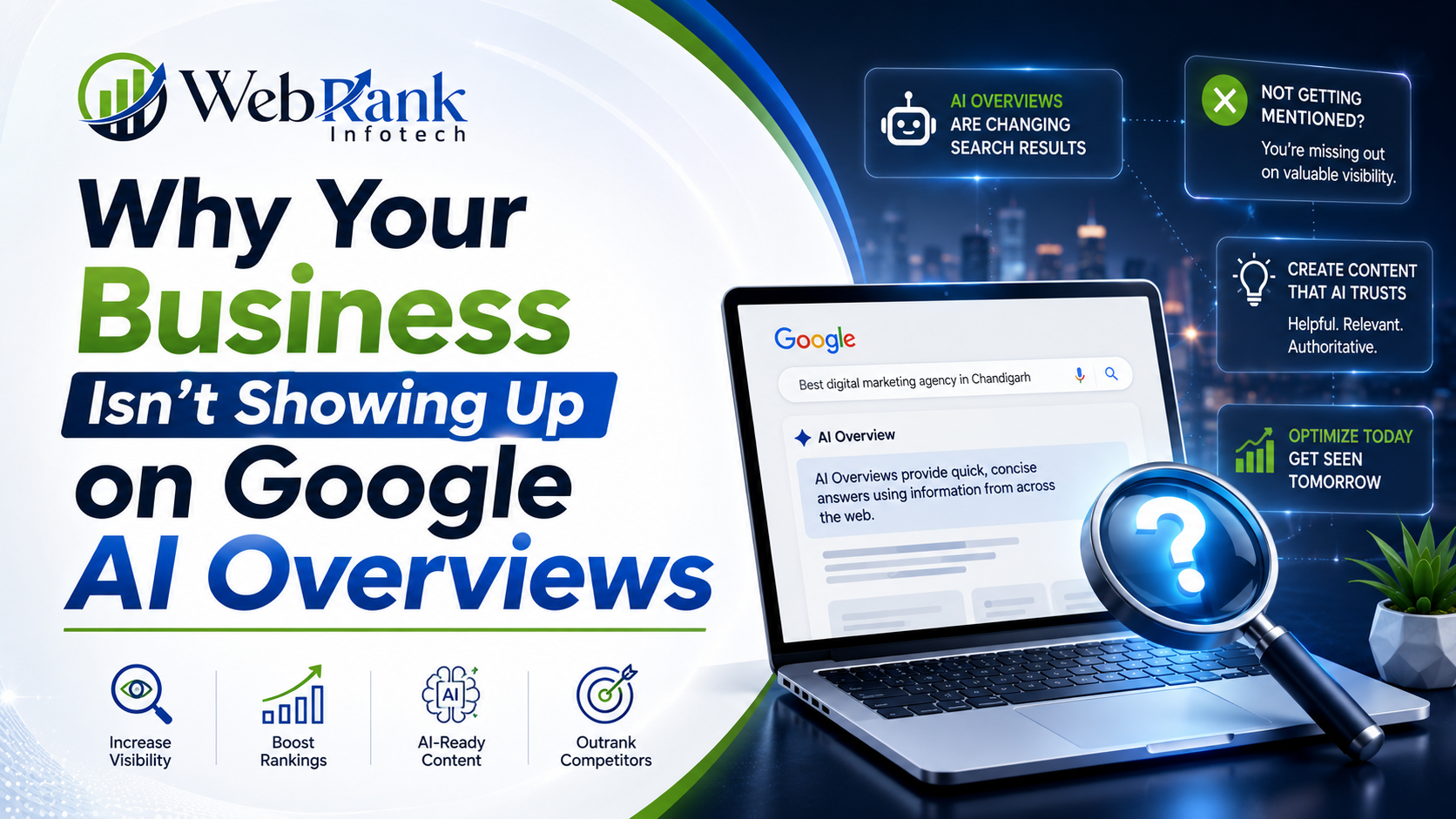
Here’s the short version: a business gets left out of Google AI Overviews for one of six fixable reasons — weak entity signals, content that doesn’t answer questions directly, missing structured data, thin topical authority, weak trust signals, or targeting the wrong kind of keywords. Below is a full diagnostic breakdown, a step-by-step fix-it guide, and a self-scoring checklist to test AI Overview readiness before spending another rupee on content that doesn’t get cited.
What Are Google AI Overviews, and Why Do They Matter for Your Business?
Google AI Overviews are the AI-generated summaries that now appear above the traditional list of search results for many queries, pulling information from multiple sources to answer a question directly on the results page. Instead of clicking through ten blue links, a searcher gets an instant, synthesized answer — and the sources that get cited inside that answer receive visibility even when the searcher never clicks through to a website.
This matters because AI Overviews reduce clicks to the traditional top-ranking result while still driving brand visibility for whichever sources get named or linked inside the summary. A business that ranks well on Google but never gets cited inside an AI Overview is increasingly invisible for exactly the queries that used to send it the most traffic. Being cited inside an AI Overview functions almost like a new, higher-value ranking position — one that traditional SEO alone doesn’t guarantee.
In short: AI Overviews have become a new visibility layer sitting above traditional search results, and getting cited inside them now matters as much as ranking on page one used to.
Why Isn’t Your Business Showing Up on Google AI Overviews?
Most businesses assume there’s one single mistake blocking them, but it’s almost always a combination of these six issues.
Weak Entity Signals and Inconsistent NAP Information
Google’s AI systems need to recognize a business as a distinct, well-defined entity before it can be considered for citation. When a business name, address, and phone number (NAP) appear inconsistently across a website, Google Business Profile, directories, and social platforms, the AI receives conflicting signals and often defaults to a competitor with cleaner data instead.
Content That Doesn’t Answer the Question Directly
AI Overviews favor content that answers a question within the first few lines, in plain, conversational language. A page that buries its actual answer under three paragraphs of brand introduction gives an AI system nothing quotable near the top, so it moves on to a source that gets to the point faster.
Missing Structured Data and Schema Markup
Structured data — schema markup added to a webpage’s code — tells search engines and AI systems exactly what a page is about: a product, a service, an FAQ, a local business listing. Without it, AI systems have to guess at context, and when a system has to guess, it typically defaults to a source that removed the guesswork entirely. Schema.org, the standard used across major search engines, documents exactly which markup types apply to which content.
Low Topical Authority and Thin Content
A single blog post covering a topic in isolation rarely earns AI citation. Google’s AI systems tend to trust sources that demonstrate depth across a topic — multiple connected pages covering different angles of the same subject, linked together in a way that shows genuine expertise rather than a single surface-level post written to chase a keyword.
Weak E-E-A-T Signals
Experience, Expertise, Authoritativeness, and Trustworthiness (E-E-A-T) has become one of the clearest filters AI systems use to decide what to cite. Content written without any visible first-hand experience, author credentials, or real-world specifics reads as generic, and generic content rarely gets quoted when a more specific, experience-backed source is available.
Targeting the Wrong Type of Keywords
AI Overviews appear far more often for informational, conversational queries than for purely transactional ones. A page built entirely around “buy now” or “pricing” language is less likely to trigger or get cited in an AI Overview than a page built around answering a genuine question a potential customer is asking before they’re ready to buy.
In short: businesses get excluded from AI Overviews through a mix of unclear entity signals, weak content structure, missing schema, thin topical depth, low trust signals, and mismatched keyword intent — rarely just one of these alone.
How Do You Fix Your Website to Get Cited in AI Overviews?
This is the practical sequence worth following, in order, to start earning AI Overview citations.
Step 1: Test the Actual Queries First
Before changing anything, search the exact questions a potential customer would ask — not just the business name, but the problem it solves. Note which competitors get cited and which don’t appear at all. This shows exactly which queries are winnable and which content gaps need filling.
Step 2: Answer the Question in the First Few Lines
Every page targeting an informational query should answer that question directly within the opening two to three sentences, before any brand introduction. AI systems extract answers from the top of a page far more often than from content buried further down.
Step 3: Add Structured Data and Schema Markup
FAQ schema, LocalBusiness schema, and Service schema all make a page’s content explicit rather than implied. Adding these markup types gives AI systems a direct, unambiguous signal about what a page offers, which meaningfully increases citation odds for pages that previously had none.
Step 4: Fix NAP Consistency Across Every Platform
Business name, address, and phone number should match exactly across the website, Google Business Profile, directories, and social platforms. Even small inconsistencies — a missing suite number, an abbreviated street name — create the kind of conflicting signal that pushes AI systems toward a cleaner competitor listing.
Step 5: Build Topical Authority With Content Clusters
Instead of one isolated blog post, build a cluster: a central pillar page covering a topic broadly, linked to several supporting posts covering specific angles of that same topic, all interlinked. This structure signals genuine depth rather than a single opportunistic post.
Step 6: Strengthen E-E-A-T Signals
Add real author bios with credentials, cite specific first-hand results and examples, and link out to authoritative sources where relevant. Google’s own guidance on how AI features and AI Overviews work confirms that these systems prioritize dependable, well-sourced information — a direct incentive to make expertise visible rather than assumed.
Step 7: Earn Mentions on Other Authoritative Websites
AI systems weigh how often and how credibly a business gets mentioned elsewhere — press coverage, industry directories, guest content, partner websites. A business only ever describing itself, with no third-party validation anywhere online, has a much weaker trust profile than one with visible outside mentions.
In short: fixing AI Overview visibility follows a specific sequence — diagnose winnable queries, restructure content to answer fast, add schema, clean up NAP data, build topical depth, strengthen trust signals, and earn outside mentions — and skipping steps usually means the fix doesn’t stick.
Does Local SEO Affect AI Overview Visibility?
Local SEO plays a bigger role in AI Overview visibility than most business owners expect. Google Business Profile data, local citations, and review signals feed directly into how confidently an AI system can identify and recommend a local business for “near me” and location-based queries. A business with a fully optimized Google Business Profile, consistent local citations, and a steady flow of genuine reviews gives AI systems a far cleaner entity signal than one with an incomplete or inconsistent profile.
This means the same fundamentals that drive strong local search rankings — accurate business information, consistent citations, and active review management — double as AI Overview readiness work. Businesses investing in solid Local SEO are frequently already halfway toward AI Overview visibility without realizing it.
In short: Local SEO and AI Overview visibility overlap heavily, since both depend on Google being able to confidently identify and trust a business’s core information.
What’s the Difference Between Traditional SEO and AI Search Optimization?
| Factor | Traditional SEO | AI Search Optimization (AEO/GEO) |
|---|---|---|
| Primary goal | Rank in the list of search results | Get cited directly inside an AI-generated answer |
| Content structure | Keyword-optimized pages, flexible structure | Answer-first structure, direct response in opening lines |
| Key signals | Backlinks, keyword density, page authority | Entity clarity, structured data, E-E-A-T, topical depth |
| Success metric | Ranking position, organic traffic | Citation frequency inside AI answers, brand mentions |
| Content format | Long-form articles targeting keywords | FAQ-style, conversational, clearly structured answers |
Traditional SEO and AI search optimization aren’t separate strategies — AEO and GEO build directly on top of solid SEO fundamentals rather than replacing them. A page with strong traditional SEO but no answer-first structure or schema markup often ranks well while still missing AI Overview citations entirely.
In short: traditional SEO earns a ranking position, while AI search optimization earns a citation inside the answer itself, and the strongest strategy treats the second as an extension of the first rather than a separate effort.
How Should You Score Your Website’s AI Overview Readiness?
A simple five-point scorecard works well here, rating each category out of 5 based on what’s actually implemented on the site today.
| Evaluation Criteria | What’s Being Scored | Score Out of 5 |
|---|---|---|
| Entity clarity | Consistent NAP, clear business categorization | 5 / 5 |
| Answer-first content | Direct answers within the opening lines of key pages | 5/ 5 |
| Structured data | FAQ, LocalBusiness, and Service schema implemented | 5 / 5 |
| Topical authority | Content clusters covering a topic in depth, not isolated posts | 5 / 5 |
| Trust signals | Author credentials, outside mentions, review activity | 5/ 5 |
A total below 15 signals significant AI Overview readiness gaps worth addressing before investing further in content volume. A score above 20 suggests a site with a genuinely strong foundation for AI citation.
In short: scoring a website against entity clarity, answer-first content, structured data, topical authority, and trust signals turns AI Overview readiness into something measurable rather than guesswork.
Frequently Asked Questions
Why isn’t my business showing up in Google AI Overviews?
A business typically stays out of AI Overviews due to a combination of weak entity signals, content that doesn’t answer questions directly, missing schema markup, thin topical authority, weak trust signals, or targeting purely transactional keywords instead of informational ones. A local service business with a strong Google presence but a website that never directly answers common customer questions is a common example — technically well-ranked, but never cited, because the content requires too much digging to extract a clear answer.
How long does it take to start appearing in AI Overviews after making changes?
Most businesses see initial movement within four to eight weeks of implementing schema markup, restructuring key pages to answer questions directly, and cleaning up NAP consistency, with stronger citation frequency building over two to four months as topical authority and trust signals accumulate. Fixes tend to compound — a single restructured FAQ page rarely creates lasting visibility on its own, but paired with schema and consistent local data, results build steadily.
Do I need schema markup to appear in AI Overviews?
Schema markup isn’t strictly mandatory, but it dramatically improves the odds of citation by removing the guesswork AI systems otherwise have to do. A page without any structured data forces an AI system to infer context from unstructured text, and when a competing page has explicit FAQ or LocalBusiness schema already in place, that competitor typically gets cited first simply because its intent is unambiguous.
What’s the difference between SEO and Answer Engine Optimization (AEO)?
SEO focuses on ranking a page within the list of search results, while AEO focuses on getting that content cited directly inside an AI-generated answer. The two work together rather than as alternatives — a page can rank well under traditional SEO while still missing AI Overview citations if it lacks answer-first structure, which is exactly the gap AEO work closes.
Does Local SEO help with AI Overview visibility?
Yes, and often more than businesses expect, since AI systems rely heavily on the same Google Business Profile data, local citations, and review signals that drive traditional local search rankings. A business with a fully optimized local profile and consistent citations gives AI systems a clean, trustworthy entity signal, which directly supports citation for location-based and “near me” style queries.
Can a small business compete with bigger brands for AI Overview citations?
Yes, because AI Overview citation depends more on content clarity, structured data, and topical depth than on brand size or advertising budget. A smaller business with a tightly organized content cluster, clean schema markup, and consistent local data frequently outperforms a much larger competitor whose website still relies on generic, unstructured brochure-style content.
Final Takeaway
AI Overview visibility comes down to the same core signals every time: a business Google can clearly identify, content that answers questions fast, structured data that removes ambiguity, and enough topical depth and trust to be worth citing over a competitor. None of this requires starting SEO over from scratch — it means extending existing SEO services to account for how AI systems actually select and cite sources.
WebRank Infotech builds exactly this kind of AI-ready foundation into its SEO and local search strategies for businesses across Chandigarh and beyond, including a free audit scored against the same readiness checklist above. Explore the full range of digital marketing services or get in touch directly to run that audit on a specific website.