webrankinfotech

WebRank Infotech is a digital marketing agency helping businesses grow online through smart SEO, Google Ads, and web solutions. We turn clicks into customers.

Best-SEO-Company-in-Chandigarh

Best SEO Company in Chandigarh — How to Choose the Right Digital Marketing Agency

Here’s the short version: the best SEO company in Chandigarh isn’t the one with the loudest “#1 agency” claim on its homepage — it’s the one that can show real data, explain its process in plain language, and understands how search actually works in 2026, including AI Overviews and answer engines. Below is a step-by-step framework for evaluating any SEO agency, what SEO services should actually include, what they cost in Chandigarh, and a scorecard for rating an agency before signing anything. What Makes an SEO Company Actually “The Best” in Chandigarh? The honest answer is that “best” depends entirely on what a business is optimizing for. A company that’s excellent for a local restaurant chasing Google Maps visibility isn’t necessarily the right fit for a SaaS startup trying to rank nationally. Instead of chasing a generic “best” label, the smarter approach is checking for fit: does the agency understand the industry in question, can it show proof of results for a similar business, and does it explain its SEO services clearly instead of hiding behind jargon. It’s also worth checking whether an agency treats Chandigarh as a market with its own search behavior, rather than just a location tag stuffed into a homepage. How people search for services across Chandigarh, Mohali, Panchkula, and Zirakpur differs from how someone searches in Mumbai or Bangalore, and agencies that understand that nuance tend to deliver stronger local SEO results. In short: there’s no single “best” SEO company for every business — there’s the right agency for a specific set of goals, and that fit gets judged using the process below rather than any ranking claim on an agency’s own website. How Should a Business Choose the Right Digital Marketing Agency in Chandigarh? This is the exact step-by-step process worth running before hiring any agency. Step 1: Check Their Local SEO Track Record First Before anything else, look at how well an agency has performed for other Chandigarh-based or Tricity businesses. The right question to ask directly: which local clients have you worked with, what were their Google Business Profile rankings before and after, and can the actual keyword movement be shown. If an agency can’t point to a specific local business with specific ranking improvements, that’s a serious gap, not a minor one. Step 2: Ask for Real Case Studies, Not Testimonials A five-star quote proves very little. What matters is a case study with numbers — organic traffic growth from Google Search Console, specific keywords ranked, and the actual timeframe it took. Agencies confident in their work tend to share this data without hesitation, while agencies relying on vague promises tend to deflect the question. Step 3: Understand Their Full SEO Process A credible agency should be able to explain technical SEO, on-page SEO, off-page SEO, and local SEO separately, because each one solves a different problem. Technical SEO covers site speed, crawlability, and structured data. On-page SEO covers content and keyword targeting. Off-page SEO covers backlinks and brand mentions. Local SEO covers Google Business Profile optimization and local citations. If there’s no clear answer on how these four pieces fit together for a specific website, that’s a reason to keep looking. Step 4: Ask How They Handle AI Search and AI Overviews This is the step most business owners skip, and it’s become one of the most important ones in 2026. Google’s AI Overviews now answer a large share of queries directly, and tools like ChatGPT and Perplexity are increasingly where people research before they even open Google. A strong agency should be able to explain how it optimizes content so AI systems cite it — often called Answer Engine Optimization or AEO. If an agency’s entire pitch is still “keywords and backlinks,” its strategy is likely a few years behind where search is heading. Google’s own documentation on how search works is a useful baseline to compare an agency’s explanation against, available directly on Google Search Central. Step 5: Review Their Reporting Style Ask exactly how often reports arrive, and whether those reports show real business outcomes — leads, calls, form submissions — instead of only impressions or “visibility scores” that sound impressive but don’t map to revenue. Agencies proud of their results tend to report proactively rather than waiting to be asked. Step 6: Check Whether They Offer Full-Service Support SEO rarely succeeds in isolation. Campaigns often stall because the website itself is slow or poorly structured, or because a business has no presence on social platforms to reinforce brand trust signals. Agencies that can also support PPC advertising, social media marketing, and online reputation management tend to deliver stronger overall results, since these all directly influence how well SEO performs, not just how a brand looks. Step 7: Watch for Red Flags and Unrealistic Promises Be cautious of any agency promising a guaranteed #1 ranking within days, suspiciously cheap pricing for “unlimited keywords,” or vague answers about where its backlinks come from. Sustainable SEO typically takes three to six months to show meaningful movement. Promises of instant, guaranteed results usually signal tactics that risk a Google penalty later. In short: the strongest agencies get evaluated on local proof, transparent process, AI-search readiness, honest reporting, full-service capability, and the absence of red flags — in that order, and step 4 is the clearest signal of whether an agency is actually current. Why Does Local SEO Matter So Much for Chandigarh Businesses? Local SEO is the single biggest lever most businesses in Chandigarh leave underused. Most local searches — “best gym near me,” “SEO company Mohali,” “dentist Sector 34” — trigger Google’s local pack before anything else, and if a Google Business Profile isn’t optimized, the business becomes invisible on that first screen regardless of how good its website is. Local SEO comes down to three things: an accurate and fully filled-out Google Business Profile, consistent business citations (name, address, and phone number matching exactly across directories), and a steady stream of genuine customer reviews. Businesses that get

Best SEO Company in Chandigarh — How to Choose the Right Digital Marketing Agency Read More »
Core Web Vitals SEO: Why Your Slow Website Is Losing Rank

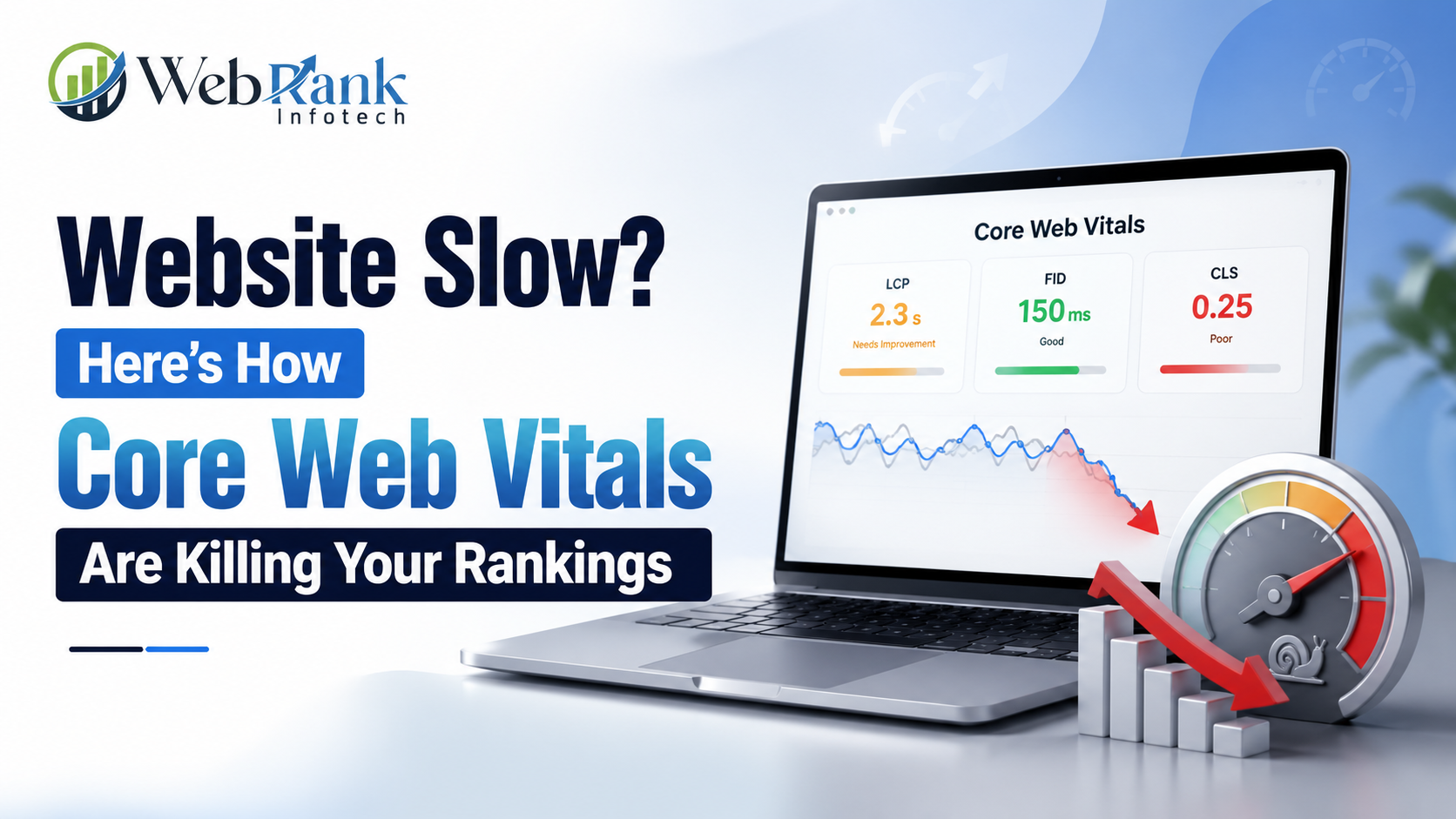
Website Slow? Here’s How Core Web Vitals Are Killing Your Rankings

Core Web Vitals SEO is the reason your website can have great content and still lose rankings to a competitor with a faster page. If your website takes more than 2.5 seconds to show its main content, reacts slowly when someone taps a button, or jumps around while loading, Google is quietly marking you down — even if your content is the best on the page. I’ve audited enough websites to say this plainly: Core Web Vitals aren’t a “nice to have” anymore, they’re a pass/fail gate that decides whether your SEO work even gets a chance to work. I want to walk you through exactly what’s happening on your website, how to check it in the next five minutes, and how to fix it — step by step, in the order I actually use for Core Web Vitals SEO on client sites. What Is Core Web Vitals SEO and Why Does It Matter? Core Web Vitals are three metrics Google uses to measure real user experience on a page: how fast your main content loads, how quickly your page responds when someone clicks or taps, and how much your layout shifts around while loading. I think of them as Google’s way of asking, “did this page feel good to use, or did it feel broken?” Google has confirmed these signals are part of its page experience ranking system, which means a page that fails Core Web Vitals is competing with one hand tied behind its back, regardless of how strong the content is. Here’s what makes this different from older “site speed” advice: Core Web Vitals are measured from real visitors on real devices, not just a lab test. So you can’t fake it with a single speed plugin — Google is watching how your actual traffic experiences your site. Skim summary: Core Web Vitals are Google’s real-user experience metrics (loading speed, responsiveness, visual stability), and they’re a direct ranking factor — not a suggestion. Why Is Your Website Actually Slow? Before I fix anything, I look for the same handful of culprits every time. In my experience, it’s rarely one big issue — it’s three or four small ones stacking up. Skim summary: Website slowness is almost always caused by heavy images, excess scripts, weak hosting, and render-blocking code — not one single problem, but several small ones combined. How Do I Check My Core Web Vitals Score? I never guess — I check. Any real Core Web Vitals SEO process starts with data, not assumptions. Here’s the toolset I actually use, and my honest take on each one after years of running audits. Tool Best For My Rating (out of 5) Google PageSpeed Insights Real user data + lab data in one report 4.5/5 Google Search Console (Core Web Vitals report) Site-wide trends across real visitors 4.5/5 GTmetrix Deep waterfall analysis for developers 4/5 Chrome DevTools (Lighthouse) Quick in-browser diagnostics 4/5 My honest feedback: I judge these tools on three things — accuracy of real-user data, how actionable the recommendations are, and how beginner-friendly the report is. PageSpeed Insights wins because it blends Google’s own field data (from actual Chrome users) with lab data and tells you exactly which element is hurting each metric. Search Console is where I check trends over 28 days before I tell a client “it’s fixed,” since a single test can look good while real users still struggle. GTmetrix is excellent if you want a waterfall chart to hand to a developer, but it can overwhelm a business owner who just wants a yes/no answer. Skim summary: Use PageSpeed Insights for a quick real-user diagnosis and Search Console to confirm the fix is working site-wide over time; GTmetrix and Lighthouse are best left to developers doing deeper digging. What Are LCP, INP, and CLS — and How Do You Fix Each One? Each Core Web Vital measures a different part of the user’s experience. I always explain it to clients in plain language first, then show the fix. Metric What It Measures Good Score Needs Improvement Poor LCP (Largest Contentful Paint) Time until the main content loads Under 2.5s 2.5s – 4s Over 4s INP (Interaction to Next Paint) How fast the page responds to a click/tap Under 200ms 200ms – 500ms Over 500ms CLS (Cumulative Layout Shift) How much the layout jumps while loading Under 0.1 0.1 – 0.25 Over 0.25 How Do You Fix LCP (Slow Loading)? Step 1: Compress and modernize your images I convert hero images and above-the-fold visuals to WebP or AVIF format — this alone often cuts load time by 30-40% without any visible quality loss. Step 2: Set fetchpriority=”high” on your main image This tells the browser to load your primary content first instead of treating it like just another asset in the queue. Step 3: Fix your server response time If your hosting is slow, no amount of front-end fixing will save you. I move clients to faster hosting or add a CDN when server response time (TTFB) is consistently above 600ms. How Do You Fix INP (Slow Responsiveness)? Step 1: Cut down third-party JavaScript I audit every script on the page and remove anything that isn’t earning its keep — old tracking pixels are the most common offender I find. Step 2: Break up long JavaScript tasks Long-running scripts block the browser from responding to clicks. Splitting them into smaller chunks keeps the page reactive. How Do You Fix CLS (Layout Shifting)? Step 1: Reserve space for images and ads I always set explicit width and height attributes so the browser knows how much space to leave before the image loads. Step 2: Avoid inserting content above existing content Cookie banners and promo bars are the biggest CLS offenders I see — if they load late and push content down, that’s counted against you. Skim summary: LCP is fixed through image optimization and faster servers, INP through leaner JavaScript, and CLS through reserved space for images and dynamic elements — each requires

Website Slow? Here’s How Core Web Vitals Are Killing Your Rankings Read More »

SEO Audit Checklist: 20 Things Every Website Should Check

SEO Audit Checklist: 20 Things Every Website Should Check

Rankings never drop for one reason. They drop because three or four small things break at the same time — a blocked page here, a slow server there, a missing meta description somewhere else. This guide lays out the exact 20-point checklist to follow, in the order it should be checked, so the real blockers surface instead of guesswork. An SEO audit is not a one-time report to file away. It is a diagnostic process, and like any diagnosis, it only works when things get checked in the right order. Plenty of time gets wasted rewriting meta descriptions on a site Google was not even crawling in the first place — this checklist exists to prevent exactly that mistake. What Is an SEO Audit and Why Does Every Website Need One? An SEO audit is a structured review of every factor that affects how a site gets discovered, crawled, indexed, and ranked by search engines. It gets run whenever traffic plateaus, drops, or when someone inherits a site they have never touched before. It reveals what is broken, what is working, and what needs fixing first. Treat an audit as triage, not a vanity exercise. Google’s own Search Essentials documentation confirms that crawlability and indexability come before anything else — content quality means nothing if the page never gets seen. That single principle shapes the priority order of this entire checklist. Skim summary: An SEO audit is a full diagnostic of a website’s search health, run in priority order — crawlability first, then technical health, then on-page, content, backlinks, local signals, and AI-search readiness — because fixing content before fixing crawl access wastes effort. What Do You Need Before Starting an SEO Audit? No audit should start without three things: admin access to Google Search Console, a crawler tool, and a clear list of the site’s 10–20 most important pages (the ones that make money or drive leads). Without these, the audit runs blind. H3: Access to Request First H3: Business Context to Gather Skim summary: Before touching a single page, gather Search Console access, analytics data, and a priority page list — this prep step defines what “success” looks like for this specific site before any boxes get checked. Which SEO Audit Tools Are Actually Worth Using? Here is an honest, no-fluff rating of the tools used most often in real audits, out of 5, based on ease of use, depth of data, and value for the price. Tool Ease of Use Data Depth Value for Money Overall Rating Google Search Console 5/5 4/5 5/5 (free) 4.7/5 Screaming Frog SEO Spider 3/5 5/5 4/5 4.3/5 Ahrefs 4/5 5/5 3/5 4.2/5 Semrush 4/5 5/5 3/5 4.1/5 PageSpeed Insights / web.dev 5/5 4/5 5/5 (free) 4.6/5 These ratings come down to three things: how fast an answer surfaces, how deep that answer goes, and whether the price justifies it for a small business budget. Search Console wins because it is free and it is Google’s own data — nothing else confirms indexing truth the way Search Console does. Screaming Frog loses half a point only because the interface feels dated, but the crawl data itself is unmatched. When Ahrefs or Semrush is not in budget, Search Console plus Screaming Frog realistically covers 80% of what a paid audit tool offers. Skim summary: Google Search Console and PageSpeed Insights rate highest because they are free and authoritative, while Screaming Frog, Ahrefs, and Semrush earn their keep through crawl depth and competitive data — pick based on budget, not hype. How Do You Check If Search Engines Can Crawl and Index a Site? This is where every audit begins, because none of the later steps matter if Google cannot reach the page in the first place. 1. Robots.txt File Open yourdomain.com/robots.txt directly and check for accidental “Disallow” rules blocking entire folders. Live blogs get completely blocked from Google more often than expected, usually because a developer left a staging-site rule in place after launch. 2. XML Sitemap Validity Confirm the sitemap exists, is submitted inside Search Console, and lists only URLs that return a 200 status and are meant to be indexed — not redirected or noindexed pages. 3. Index Coverage Report Inside Search Console’s Pages report, look for “Crawled – currently not indexed” and “Discovered – currently not indexed” pages. A high count here usually points to thin content or internal linking gaps. 4. Canonical Tags Check that every page has a self-referencing canonical tag unless it is intentionally pointing elsewhere, since missing or conflicting canonicals split ranking signals across duplicate URLs. Skim summary: Crawlability comes down to four checks — robots.txt, sitemap validity, index coverage, and canonical tags — and these get fixed before anything else because a page Google cannot crawl cannot rank, no matter how good the content is. What Technical SEO Checks Matter Most for Site Health? Once crawl access is confirmed, the checks that affect user experience and ranking signals directly come next. 5. Core Web Vitals and Page Speed Test key templates (homepage, a product/service page, a blog post) using PageSpeed Insights, focusing on Largest Contentful Paint and Interaction to Next Paint, since INP replaced FID as the responsiveness metric Google measures. 6. Mobile-Friendliness Check the site on an actual phone, not just a browser’s device toolbar, because touch targets and font scaling issues often only show up on real devices. 7. HTTPS and Security Confirm the SSL certificate is valid, there is no mixed content warning, and HTTP automatically redirects to HTTPS across the entire site, not just the homepage. 8. Broken Links and 404s Crawl the site with Screaming Frog and export every 4xx and 5xx status code, then prioritize fixing internal broken links before external ones, since internal links waste crawl budget when broken. 9. URL Structure and Redirect Chains Look for redirect chains longer than one hop (A → B → C), which noticeably slow down crawling and dilute link equity on sites that have changed URL structures multiple times over

SEO Audit Checklist: 20 Things Every Website Should Check Read More »

Small Business SEO Tips: Compete with Big Brands in Local Search Results

Small Business SEO Tips: Compete with Big Brands in Local Search Results

Ranking above a national brand in local search is not about outspending them. It is about outmaneuvering them. Big brands win on domain authority and budget, but they consistently lose on proximity, specificity, and genuine local trust — three ranking signals that Google rewards heavily in local search, and that a well-run small business can win almost every time. Most small business owners assume local SEO is a budget war they cannot win. That assumption is wrong, and it costs businesses real customers every month. Google’s local algorithm does not rank the biggest advertiser first. It ranks the business that proves it is the most relevant, most trusted, and most active option near the searcher. This guide breaks down exactly how to build that proof, step by step, without a national marketing budget. What Is Local SEO and Why Does It Matter for Small Businesses? Local SEO is the process of optimizing a business’s online presence so it appears in location-based searches — think “plumber near me” or “best bakery in Chandigarh.” Unlike traditional SEO, which competes for broad national visibility, local SEO competes for the map pack, local organic results, and “near me” queries where intent to buy is already high. This matters more for small businesses than almost any other digital marketing lever because local search traffic converts faster. A person searching “emergency electrician near me” is not researching — they are ready to call. Local SEO puts a small business directly in front of that decision-making moment, and it does it without competing against national brands on their turf. Skim summary: Local SEO targets location-based, high-intent searches, and it is the fastest, most cost-effective way small businesses generate qualified leads without competing against big brands on broad national keywords. Why Do Big Brands Struggle to Dominate Local Search? Big brands are built for scale, not specificity. Their content teams manage thousands of pages across hundreds of locations, which means they cannot produce the hyper-local, neighborhood-level content that ranks for long-tail searches. According to Ahrefs’ keyword research, the majority of all search queries are long-tail — specific, multi-word phrases — and this is exactly where big brands underperform and small businesses win. Ranking Factor Big Brand Advantage Small Business Advantage Domain Authority Very high Low to moderate Content Budget Very high Low Proximity to Searcher Weak (one location per city) Strong (deeply embedded) Review Volume & Authenticity Diluted across locations Concentrated, personal Local Citation Accuracy Often inconsistent Easy to control Hyperlocal Content Depth Rarely produced Highly achievable Community/Local Backlinks Minimal Naturally accessible Skim summary: Big brands dominate on domain authority and budget, but local SEO ranking factors like proximity, review authenticity, and hyperlocal content favor small, focused businesses — a genuine structural advantage that doesn’t require a big spend to use. How Can a Small Business Beat Big Brands in Local Search? (Step-by-Step Guide) This is the practical part. Each step below builds on the last, and skipping steps is the most common reason local SEO efforts stall. We recommend working through this in order rather than cherry-picking tactics. Step 1: Optimize Your Google Business Profile Completely Google Business Profile (GBP) is the single most influential local ranking factor because it feeds directly into the map pack. An incomplete or inactive profile is invisible no matter how good the website is. What a complete profile includes Why this works Google prioritizes profiles that show consistent activity and completeness because it signals a real, currently operating business — something a national brand’s local listing often fails to maintain across every branch. Step 2: Fix NAP Consistency Across Directories NAP stands for Name, Address, Phone number. If these details differ even slightly across Google, Yelp, Bing Places, and Facebook, Google treats it as a trust signal problem. Directory Common NAP Error Fix Google Business Profile Old phone number Update directly in GBP dashboard Yelp Abbreviated address Match exact GBP formatting Facebook Missing suite/unit number Standardize across all platforms Bing Places Duplicate listing Merge or remove duplicates Skim summary: Consistent NAP data across every directory builds the trust signal Google needs to confidently rank a business in local results — inconsistency is one of the most common, and most fixable, local SEO mistakes. Step 3: Target Long-Tail, Hyperlocal Keywords Instead of chasing “restaurant Chandigarh,” a small business should target “best butter chicken restaurant Sector 34 Chandigarh.” Lower volume, dramatically lower competition, and far higher purchase intent. How to find these keywords Step 4: Build Local Backlinks and Citations Backlinks from local news sites, community blogs, local business associations, and event sponsorships carry more local ranking weight than generic high-authority links from unrelated industries. Practical ways to earn them Step 5: Generate and Respond to Reviews Strategically Review volume, recency, and response rate all factor into local ranking. A small business with 50 recent, responded-to reviews often outranks a big brand location with 200 old, unanswered ones. A simple review system Step 6: Publish Locally-Relevant Content Neighborhood guides, local event coverage, and location-specific service pages let a small business own searches that no national content calendar has time for. Step 7: Add Local Business Schema Markup Schema markup is structured code that tells Google exactly what a business does, where it operates, and what it offers. Most competitor content skips the technical detail here, but this is a genuine ranking lever. What to mark up Step 8: Optimize for Mobile and Page Speed Most “near me” searches happen on mobile, often while someone is walking or driving. A slow-loading site loses that visitor before it ever explains what the business offers. Skim summary: Winning local search is a sequence, not a single tactic — GBP optimization, NAP consistency, hyperlocal keywords, local backlinks, review management, location content, schema markup, and mobile speed all compound together to outrank bigger, less specific competitors. How Long Does It Take to Rank in Local Search? Business Situation Typical Timeline New GBP, no prior optimization 8–12 weeks for initial movement Existing profile, inconsistent NAP fixed 4–8 weeks

Small Business SEO Tips: Compete with Big Brands in Local Search Results Read More »

Google AI Overviews: Complete Ranking Guide

Google AI Overviews: Complete Ranking Guide

Here is the crux of everything covered in this guide: AI Overviews do not reward the page that ranks #1, they reward the page that answers one specific sub-question in the cleanest, most self-contained way. That single shift in understanding changes how content should be structured, and it directly affects citation rate. Anyone staring at Google Search Console wondering why traffic dropped while rankings stayed the same is not imagining things. AI Overviews now show up on a huge share of informational searches, and this guide breaks down exactly how to rank content inside them. Table of Contents What Are Google AI Overviews and Why Do They Matter in 2026? Google AI Overviews are AI-generated summaries that Google places above the traditional blue links. Instead of forcing users to click into ten different pages, Google’s Gemini model reads across its index, breaks a query into smaller sub-questions (known as “query fan-out”), and stitches together an answer using passages pulled from multiple sites. This matters because the numbers are no longer small. AI Overviews now appear on roughly 48% of tracked queries as of early 2026, and in categories like B2B tech, education, and restaurants, that figure climbs to 78–83%. This isn’t a side feature anymore. For a huge chunk of searches, the AI Overview is the first, and sometimes only, thing a user sees. Skimmable summary: Google AI Overviews are AI-written answer summaries shown above organic results, generated by breaking a query into sub-questions and pulling supporting passages from indexed, ranking-eligible pages. They now appear on close to half of all searches, which means visibility inside the Overview matters as much as, or more than, position in the blue links. How Does Google Actually Decide What Goes Into an AI Overview? Google has been fairly direct about this part, and most guides skip over it. Google’s own documentation states that its generative AI features are “rooted in our core Search ranking and quality systems.” That means a page has to already be eligible to rank organically, with a real snippet, before it can ever be considered for an Overview. But here’s the part that trips people up: ranking on page one does not guarantee a citation. Pages ranking 4th or 5th regularly get pulled into the Overview while the #1 result gets ignored, simply because the lower-ranked page answered the specific sub-query more directly. Research from AI Mode Boost found that 47% of AI Overview citations now come from pages ranking below position #5. Traditional domain authority correlation has also dropped to around r = 0.18, down from 0.23 in 2024. So the working model here is simple: organic ranking earns a seat at the table, but passage-level clarity earns the citation. Skimmable summary: Google’s AI Overviews pull from its existing web index and quality systems, so a page must already be eligible to rank organically. However, the actual citation goes to whichever indexed page answers a specific sub-question most clearly and completely, not necessarily to the page ranking #1. Nearly half of all citations now come from pages ranking below position 5. How to Rank in Google AI Overviews: A Step-by-Step Process This is the exact process to follow when publishing new content aimed at AI Overview visibility. Step 1: Win a Real Organic Ranking First Classic SEO fundamentals still come first — keyword research, on-page optimization, and internal linking — before any AI Overview tactic gets applied. None of the extraction techniques matter if the page isn’t indexed and eligible to rank. Weak foundational SEO should be addressed through proper SEO services before layering AI Overview tactics on top. Step 2: Write the Answer in the First 40–60 Words Gemini’s passage-extraction window is short. The cite-worthy passage almost always sits within the first 80–120 words after the heading, and rarely below a comparison table or interactive element. So under every H2 and H3, the direct answer should come first, with explanation following. Step 3: Keep Each Passage Self-Contained Each section should make complete sense even if it’s the only paragraph someone reads — no “as mentioned above” or “see the next section.” A roughly 130–160 word block usually holds enough context and evidence to stand alone, which matches the chunk size AI Overviews tend to extract. Step 4: Add Schema Markup Correctly, Not Excessively FAQPage, Article, and BreadcrumbList schema should be applied based on page type. Schema validity matters far more than schema volume — three correctly typed schemas beat twelve loosely implemented ones. Always validate through Google’s Rich Results Test before publishing. Step 5: Build Real E-E-A-T Signals Author bios with actual credentials, citations to primary sources, and outbound links to authoritative references like Google Search Central all strengthen trust. AI Overviews favor content that demonstrates real experience, not just expertise claimed on paper. Step 6: Target Long-Tail and Local Intent For Local SEO campaigns specifically, AI Overviews tend to be especially aggressive on local, service-based queries such as “best dentist near me” or “SEO agency in Chandigarh.” Location-specific pages need to answer the exact local intent instead of running generic, city-agnostic content. Step 7: Track AIO Share of Voice Rankings alone no longer tell the full story — tracking how often pages get cited inside AI Overviews for target queries is becoming the real visibility KPI in 2026. Most modern rank tracking tools now flag AIO appearances separately from organic position. Skimmable summary: Ranking in AI Overviews starts with winning a real organic position through solid SEO, then front-loading the direct answer in the first 40–60 words of every section, keeping each passage self-contained at roughly 130–160 words, adding clean and valid schema, building genuine E-E-A-T signals, targeting long-tail and local intent queries, and tracking AIO citations as a separate KPI from organic rank. What Content Format Gets Cited the Most? A clear pattern shows up across the content that consistently gets pulled into Overviews versus content that doesn’t. Content Format Why It Gets Cited Citation Success Rate Direct-answer paragraph under a question H2/H3 Matches

Google AI Overviews: Complete Ranking Guide Read More »

Best Digital Marketing Course in Chandigarh: Which Institute Should You Choose?

Best Digital Marketing Course in Chandigarh: Which Institute Should You Choose?

Every institute in Chandigarh claims to be “the best,” yet that claim rarely comes with proof. The best digital marketing course in Chandigarh is not the one with the loudest ad campaign – it is the one whose curriculum, trainers, and practical exposure match a student’s actual goal: a job, a freelance career, or in-house marketing skills for a business. This guide breaks down the exact checklist used to judge an institute before recommending it to anyone. Most “top 10 institute” blogs ranking for this keyword are written by the institutes themselves or by writers paid to rank them first. This guide walks through how to evaluate an institute independently, step by step, so the decision stops depending on whichever ad shows up next on Instagram – and it uses WebRank Infotech’s own digital marketing course in Chandigarh as the working example throughout, since its curriculum was built specifically to satisfy every checkpoint listed below. What Makes a Digital Marketing Course in Chandigarh Actually the “Best” One? A course earns the label “best” only when it satisfies four things at once: a curriculum built around what employers and clients are actually hiring for right now, trainers who currently work on live campaigns (not just teach from a slide deck), enough hands-on practice to run a real campaign by the end of the course, and a fee that matches the depth being delivered – not the size of the institute’s hoarding on the highway. Almost every institute in Chandigarh claims to be “No. 1.” Few show placement data broken down by role and salary, and fewer still offer a genuine trial class before payment. That hesitation is the real filter. An institute that avoids showing real student outcomes or refuses a trial class reveals more through that refusal than its homepage ever will. WebRank Infotech’s digital marketing course is built to pass this exact filter – a live trial class is offered before enrolment, and the training is run by the same team that manages SEO and PPC campaigns for real, paying clients. Skimmable summary The “best” digital marketing course in Chandigarh is defined by four factors together – relevant curriculum, currently practicing trainers, hands-on project work, and fair pricing – not by an institute’s self-declared ranking or advertising spend. A genuine trial class and real placement data are the two things worth requesting before enrolling anywhere. How to Choose the Right Digital Marketing Institute in Chandigarh Here is the exact process recommended for shortlisting and finalising an institute. Step 1: Define the Actual Goal Decide first whether the goal is a job, a freelance career, or business-owner-level skills. This single decision changes everything else – a job-seeker needs placement support and a recognised certificate, a freelancer needs deep practical skills across SEO, PPC, and social media, and a business owner mostly needs enough strategy knowledge to brief and audit an agency. Step 2: Shortlist 3-4 Institutes, Not 15 Comparing every institute in Chandigarh wastes time. Three or four institutes, shortlisted through genuine referrals from people who actually completed a course there, work far better than a list pulled from Google Ads or Instagram reels. Step 3: Request a Trial Class Before Paying Anything Every credible institute allows this. One live session shows how a trainer handles a tool demo or a doubt – that single class reveals more about teaching quality than ten testimonials. WebRank Infotech offers this trial class upfront for its digital marketing course, precisely so students can judge teaching quality before committing. Step 4: Verify the Trainer’s Live Work Ask the trainer directly what campaigns they are currently managing outside the classroom. A trainer who has not run a live Google Ads account or handled real SEO rankings in the last six months is teaching theory, not practice. Step 5: Check the Certification’s Actual Value A certificate only helps if employers or clients recognise it. Google’s own certifications, offered free through Google Career Certificates, carry more industry weight than most private institute certificates in Chandigarh, so it is worth asking whether the course includes these alongside the institute’s own certification. Step 6: Confirm Fees Match the Depth, Not the Brand Name A written breakdown of what each module covers, requested before paying the full fee, prevents surprises. Institutes sometimes charge a premium purely for brand recall while covering the exact same modules as a cheaper competitor. Skimmable summary Choosing the right institute is a six-step process: define the goal, shortlist a few options through real referrals, take a trial class, verify the trainer’s current live work, check whether the certification is industry-recognised, and confirm the fee matches the actual curriculum depth rather than the institute’s marketing budget. What Should Be Included in a Solid Digital Marketing Curriculum? A course that skips any of the core pillars below leaves a gap in a student’s skill set that clients or interviewers notice immediately. Module What It Covers Why It Matters SEO (Search Engine Optimization) On-page, off-page, technical SEO, keyword research, local SEO Drives long-term organic traffic without ongoing ad spend PPC (Pay-Per-Click) Google Ads, Meta Ads, bid strategy, campaign structuring Delivers fast, measurable results for businesses that need leads now SMO (Social Media Optimization) Profile optimization, content strategy, organic growth on Instagram/LinkedIn/Facebook Builds brand visibility and audience trust without paid budget Social Media Marketing Paid social campaigns, audience targeting, creative testing Converts social attention into actual leads and sales ORM (Online Reputation Management) Review monitoring, negative content suppression, brand sentiment management Protects brand credibility, which directly affects conversion rates Content & Email Marketing Copywriting, content calendars, email automation, lead nurturing Keeps the funnel warm between the first click and the final sale Analytics & Reporting Google Analytics, Search Console, campaign dashboards Proves ROI and guides every future decision with data, not guesswork Several institutes in Chandigarh skip ORM entirely and treat SMO as a footnote inside social media marketing, when in reality these are two separate, hireable skill sets. If a syllabus does not give SEO, PPC, SMO,

Best Digital Marketing Course in Chandigarh: Which Institute Should You Choose? Read More »

SEO-Training-in-Mohali-Become-Job-Ready-in-Weeks

SEO Training in Mohali: Become Job-Ready in Weeks

If you’re searching for SEO training in Mohali, the real question isn’t whether you can learn SEO online for free — it’s whether that free knowledge will actually get you hired or land you your first client. WebRank Infotech trains people to bridge exactly that gap, using live projects instead of theory-only lessons. WebRank Infotech runs digital marketing training out of Chandigarh and Mohali, and this course was built after noticing the same problem across dozens of interviews: candidates could define “backlink” and “meta tag,” but couldn’t actually rank a website. That gap is what SEO training in Mohali should fix, and it’s what this program is designed around. Why Do So Many SEO Courses Fail to Get People Hired? Most SEO courses teach concepts in isolation — keyword research one week, backlinks the next — without ever connecting the dots on a live website. Students walk out knowing terminology but never having faced a real ranking drop, a Google algorithm update, or a client asking “why isn’t my site on page one yet.” In short: theory-only courses produce candidates who can talk about SEO but can’t execute it under real conditions, which is exactly what hiring managers test for in interviews. What Does WebRank Infotech’s SEO Training in Mohali Actually Cover? The course is structured around what agencies genuinely do day to day, not a generic syllabus copied from a textbook: Module What You’ll Do On-Page & Technical SEO Audit real websites, fix crawl errors, optimize live pages Keyword & Content Strategy Build keyword maps for actual client-style projects Off-Page SEO & Link Building Run outreach and backlink campaigns, not simulations Local SEO Optimize Google Business Profiles for real Chandigarh/Mohali businesses Analytics & Reporting Read Google Search Console and Analytics like an agency would AI SEO & Search Trends Understand how AI Overviews and AI search are reshaping rankings In short: every module is built around a task you’ll actually be asked to do on the job, not an exam question, which is the core difference between this training and most generic SEO courses in the region. Why Choose WebRank Infotech Over Other Institutes in Mohali? WebRank Infotech isn’t a training-only company — it runs SEO, PPC, and ORM campaigns for live clients every day as a working digital marketing agency in Chandigarh. That means this SEO training in Mohali isn’t recycled slides — it’s built from campaigns the team is actively running, so students learn what’s working right now, not what worked three years ago. In short: training built by a company that still runs live SEO campaigns gives students exposure no purely academic institute can match, because they’re learning from current, real-world results rather than outdated theory. Who Should Join This SEO Training in Mohali? This course works well for college graduates exploring digital careers, working professionals switching into marketing, business owners who want to manage their own SEO in-house, and freelancers looking to add a high-demand, billable skill. In short: whether the goal is a job, a freelance income stream, or managing a business’s own visibility, the same core SEO skill set applies — WebRank Infotech adjusts the projects to match each student’s goal. Is a Digital Marketing Course a Better Fit Than SEO Alone? For broader career flexibility — covering SEO, PPC, social media, and analytics together — WebRank Infotech’s Digital Marketing Course in Chandigarh covers all of it in one structured program, while the SEO training in Mohali goes deeper specifically into search rankings for those who want to specialize. In short: choose the focused SEO track to specialize fast, or the full digital marketing course for a broader skill set across every major marketing channel. Ready to Start? WebRank Infotech keeps batches small so real project work can be reviewed individually rather than teaching to a room. To see whether this training fits your goals, reach out to WebRank Infotech for the current batch schedule, project structure, and what you’ll be able to do by the end of it. Frequently Asked Questions Do I need a technical or coding background to join this SEO training in Mohali? No — most students join with zero coding experience. The course is built for beginners as well as working professionals switching fields, and technical concepts like crawl errors or schema markup are taught hands-on with real websites rather than assuming prior knowledge. How long does the SEO training take to complete? Batch duration varies based on whether you’re covering SEO alone or the full digital marketing track, and WebRank Infotech keeps batches small so the schedule can flex around live project work. Reach out for the current batch’s exact timeline. Will I actually get to work on live websites, or just practice assignments? You’ll work on live, client-style projects — audits, keyword maps, and Google Business Profile optimization for real Chandigarh/Mohali businesses — since WebRank Infotech runs an active agency alongside the training, not mock exercises. Is this course enough to get me a job, or will I still need more experience? The course is designed specifically to close that gap — it includes placement guidance for freelance, in-house, and agency roles, plus a portfolio of real project work you can show in interviews, which is usually what’s missing from theory-only courses. What’s the difference between joining the SEO training alone versus the full Digital Marketing Course? The SEO training in Mohali goes deep into search rankings if you want to specialize quickly, while the Digital Marketing Course in Chandigarh covers SEO, PPC, social media, and analytics together for broader career flexibility. Choose based on whether you want to specialize or stay generalist.

SEO Training in Mohali: Become Job-Ready in Weeks Read More »

Agentic-Search-Optimization-Why-Its-the-Next-Big-Shift-in-SEO

Agentic Search Optimization: Why It’s the Next Big Shift in SEO

Agentic search optimization is the practice of making your business the one an autonomous AI agent actually selects and acts on — not just the one it mentions. At WebRank Infotech, we’ve spent the last year watching search shift from “rank for a human clicking a link” to “get cited inside an AI answer,” and now we’re watching the next shift happen in real time: AI agents that don’t just answer questions, they complete tasks — booking, comparing, buying — without a human ever opening your website. If your business isn’t structured for an agent to evaluate and choose you, you become invisible at the exact moment the decision gets made. We did not expect to be rewriting our SEO playbook again this soon after adapting for AI Overviews and generative engines. But agentic search is a genuinely different layer, not a rebrand of what we were already doing, and we want to walk you through what it actually is, how it differs from SEO and GEO, and exactly what we’re doing for our clients to prepare for it. What Is Agentic Search Optimization? Agentic search optimization (often shortened to ASO or agentic SEO) is the discipline of structuring your website, product data, and trust signals so autonomous AI agents can evaluate your business and select it on a user’s behalf — without a human reading every word first. Where traditional SEO earns a ranking position and GEO earns a citation inside an AI-generated answer, agentic search optimization earns something more direct: inclusion in the shortlist an agent actually acts on. This distinction matters because the “user” reading your page is no longer always a person. Google’s own agent capabilities, Chrome’s emerging agent-web standards, and shopping agents built on top of models like Claude and GPT are already comparing prices, checking availability, and completing purchases autonomously. We follow Google’s own commentary on this shift closely, and their Search Central blog is the most reliable place to track how search infrastructure itself is adapting to agent traffic. Skim summary: Agentic search optimization means preparing your site for autonomous AI agents that evaluate and act on behalf of users, not just for humans clicking links or AI systems generating a cited answer. It’s a distinct third layer built on top of traditional SEO and GEO, not a replacement for either. How Is Agentic Search Different From SEO and GEO? Agentic search is different because the “audience” changes from a human or a language model generating text, to a machine actively deciding and acting. Each layer has its own goal and its own unit of visibility, and we’ve found the clearest way to explain this to clients is side by side: Layer Who/What It’s For Goal Unit of Visibility Traditional SEO Humans clicking search results Rank high enough to get the click Ranking position GEO (Generative Engine Optimization) AI answer engines (ChatGPT, AI Overviews, Perplexity) Get cited inside the generated answer Citation frequency Agentic Search Optimization Autonomous AI agents acting for a user Get selected into the shortlist the agent acts on Consideration-set inclusion None of these layers replace each other — they stack. An agent still relies on search indexes to discover candidates, so if your technical SEO is weak, an agent never finds you in the first place. And the trust signals that earn GEO citations (clear claims, structured data, third-party validation) are the same signals an agent checks before deciding to act on your business. We treat SEO services and AI SEO as the foundation everything else in this stack is built on, which is exactly the layered approach we use across every client engagement. Skim summary: SEO gets you ranked for humans, GEO gets you cited inside AI-generated answers, and agentic search optimization gets you selected by autonomous agents that act rather than just recommend. Each layer depends on the one below it — you can’t skip straight to agentic optimization without a solid SEO and GEO foundation. How to Optimize for Agentic Search: A Step-by-Step Guide We approach this the same practical way we approach any new SEO discipline — starting with the foundation an agent needs to even find you, then building up to the trust signals it needs to act on you. Step 1: Confirm Your Technical SEO Foundation Is Agent-Crawlable Agents still discover candidate sites through search indexes, so clean crawlability, fast load times, and indexed pages remain non-negotiable. If your technical SEO has gaps, no amount of agent-specific optimization fixes the fact that you’re invisible from the start. Step 2: Make Pricing and Availability Machine-Readable Agents deprioritize or skip businesses that hide pricing behind “Contact us” — an agent has no way to compare an ambiguous offer against a competitor’s clear one. We now push every client to display starting prices, tiers, or a clear estimator directly on the page, even if final pricing is customized. Step 3: Structure Content With Schema Markup an Agent Can Parse FAQPage, Product, Organization, and Person schema give an agent a structured, unambiguous way to read your claims instead of guessing from prose. We build this into every site we manage now, tying each schema node back to the core Organization entity so an agent can confirm consistency across the site. Step 4: Keep Your Claims Consistent Everywhere You’re Mentioned An agent cross-checks what your website says against what review sites, directories, and third-party sources say about you. Inconsistent claims — different pricing, different service descriptions — reduce an agent’s confidence and increase the odds it skips you in favor of a cleaner, more consistent competitor. Step 5: Build Genuine Third-Party Authority Signals Agents weigh independent validation heavily, since a business can’t inflate its own trust signals the way it once could with self-published claims. Reviews, press mentions, and citations from authoritative sources all feed into how confidently an agent selects you over an unverified competitor. Step 6: Monitor How Agents Are Already Interacting With Your Site Agent traffic currently shows up in your server logs differently

Agentic Search Optimization: Why It’s the Next Big Shift in SEO Read More »

Local-SEO-fo- Small-Business-Why-Your-Phone-Stays-Quiet

Local SEO: The Reason Your Competitor’s Phone Rings and Yours Doesn’t

If your competitor’s phone keeps ringing and yours stays quiet, the gap almost never comes down to a better product or a bigger budget — it comes down to local SEO for small business done right. We have watched businesses with a weaker offer out-rank stronger businesses simply because they showed up first when a customer typed “near me.” In this guide, we walk you through exactly how to find the leak in your local visibility and fix it, step by step, using the same process we use for our own SEO Services clients. We have sat across the table from business owners who tell us the same thing: “My competitor isn’t even better than me, but they’re always the one people call first.” Every time, the answer is sitting in plain sight — Google Business Profile, on-page signals, reviews, or citations. Once we fix those, the phone starts ringing again. That is the entire premise of this article. What Is Local SEO and Why Does It Decide Whose Phone Rings? Local SEO is the process of optimizing your online presence so Google shows your business to people searching in your city, neighborhood, or service area. It is different from general SEO because it is not about ranking nationally — it is about ranking in the Local Pack (the map + 3-listing box) and in local organic results for searches like “plumber in Ludhiana” or “dentist near me.” Here is why this decides whose phone rings and whose doesn’t: when someone searches “near me,” Google is not comparing your entire website against the entire internet. It is comparing you against the handful of businesses physically close enough and relevant enough to answer that specific query. That is a much smaller, winnable competition — which is exactly why one business dominates and the other disappears. We explain this in more depth in our Search Engine Optimization services, where we break down how local ranking factors differ from national SEO factors. Skim summary: Local SEO controls visibility for “near me” and city-specific searches through the Local Pack and local organic results. It’s a smaller competitive pool than national SEO, which is why fixing a few specific signals can flip who gets found first — you or your competitor. How Do You Know If Your Local SEO Is Broken? You know your local SEO is broken when you rank on the map but your competitor still gets the call, or when you don’t show up on the map at all for your core service + city search. We check three things first with every client: Symptom What It Usually Means You don’t appear in the Local Pack (map box) for your main service Your Google Business Profile is incomplete, unverified, or miscategorized You appear in the pack but rank 2nd or 3rd below a competitor Weaker review count/rating, inconsistent NAP (Name, Address, Phone), or fewer local citations You rank fine but calls don’t convert Your Business Profile or website lacks trust signals — photos, hours, response to reviews, clear service list You show up for your brand name but not for “[service] near me” Your website has no location-specific content or keywords If any of these match what you’re seeing, the fix is not a redesign of your website — it’s a targeted local SEO correction, which is what the next section walks through. Skim summary: Broken local SEO shows up as one of four patterns — missing from the map, ranking below competitors, ranking but not converting, or invisible for “near me” searches. Each pattern points to a specific, fixable cause rather than a full website overhaul. How to Fix Your Local SEO: A Step-by-Step Guide We use this exact sequence with every business we work with, in this order, because each step builds trust signals the next step depends on. Step 1: Claim and Fully Optimize Your Google Business Profile Claim your listing on Google Business Profile if you haven’t, then fill in every single field — categories, service list, business hours, service area, and at least 10 real photos. We have seen businesses jump into the Local Pack within weeks purely from completing a profile that was 40% filled out. Step 2: Fix On-Page Local Signals on Your Website Add your city and service area naturally into your title tags, H1, and page copy — not stuffed, just present where it reads naturally. We always add a dedicated “Areas We Serve” section and embed a Google Map on the contact page. Step 3: Build NAP-Consistent Citations NAP stands for Name, Address, Phone number. We audit every directory listing (Justdial, Sulekha, Google, Facebook, industry directories) to confirm they match exactly. Inconsistent NAP is one of the most common reasons a business plateaus below its competitor. Step 4: Build a Review Engine, Not Just a Few Reviews We set up a simple system — a QR code or link sent right after service — so happy customers can leave a review in under 30 seconds. Review count and recency both influence local ranking, and businesses that reply to every review (good or bad) build more trust with future customers reading them. Step 5: Earn Local Backlinks We reach out to local news sites, industry associations, and community pages for backlinks. A backlink from a genuinely local, relevant source tells Google your business is a real part of that community — which weighs more than ten generic backlinks from unrelated sites. Step 6: Build Dedicated Location and Service Pages If you serve more than one area, each deserves its own page with unique content — not a copy-pasted template with the city name swapped. We write these to answer what a real customer in that area is searching for. Step 7: Optimize for AI SEO, Not Just Google’s Blue Links This is the step most local businesses still skip. AI SEO means structuring your content and business data so AI Overviews, ChatGPT, and Perplexity can pull your business into their answers —

Local SEO: The Reason Your Competitor’s Phone Rings and Yours Doesn’t Read More »

AI Search Visibility: 7 Proven Fixes Using SEO, GEO & AIEO

AI Search Visibility: 7 Proven Fixes Using SEO, GEO & AIEO

Your customers stopped scrolling through ten blue links. They started asking ChatGPT, Google AI Overviews, and Perplexity direct questions and trusting the answer they get back. If your business isn’t the answer being cited, you’re invisible — no matter how well you rank on page one. Fixing that takes three connected disciplines: SEO to earn the click, GEO to earn the citation, and AIEO to earn the AI’s trust. Search behavior has shifted more in the last eighteen months than in the previous five years combined. We used to tell clients “get to page one and you’re done.” Not anymore. Now the message is simple: page one doesn’t matter much if the AI Overview sitting above it never mentions your name. Here’s exactly how we diagnose weak AI search visibility and fix it, step by step. The short version, before we go deep: What Does It Mean When Your Business Is “Invisible” on AI Search? Invisibility on AI search doesn’t mean your website is broken or unindexed. It just means AI tools like Google AI Overviews, ChatGPT, and Perplexity never bring up your brand, your product, or your expertise when someone asks a question you could easily answer. You can rank #3 on Google and still be completely missing from the AI-generated summary sitting right above that ranking. This happens constantly — a client’s site pulls decent organic traffic, but the moment someone asks ChatGPT or Perplexity the exact question their landing page targets, their name never shows up. That’s poor AI search visibility in 2026: not a ranking problem, a recognition problem. In short: being invisible on AI search means AI tools skip your brand entirely when generating an answer, even if your traditional SEO looks healthy. Why Is AI Changing the Way People Search for Businesses Like Yours? People now expect a direct answer, not a list of links to sift through, and that’s changing everything about search. A Pew Research Center analysis found users clicked on a traditional search result in just 8% of searches with an AI summary present, compared to nearly double that rate on searches without one. We’ve watched this play out in client analytics too — click-through rates on informational queries have dropped even while rankings held steady or improved. The traffic isn’t going to a competitor anymore; the AI answer is simply absorbing it. That’s why success today gets measured less by rank position and more by how often a brand gets cited inside the AI answer itself. Simply put: AI answers are replacing the click. If your content isn’t structured to be quoted by AI, you lose visibility even while ranking well. What Is the Difference Between SEO, GEO, and AIEO? These three disciplines solve different problems, and it helps to think of it this way: SEO gets you found, GEO gets you quoted, and AIEO gets you trusted at scale. Discipline What It Optimizes For Primary Goal Where It Shows Up SEO (Search Engine Optimization) Traditional search engine rankings Rank on page one of Google/Bing Organic search results GEO (Generative Engine Optimization) Being cited inside AI-generated answers Get quoted or summarized by AI Google AI Overviews, Perplexity, AI Mode AIEO (AI Engine Optimization) How AI systems judge your overall trust and authority Long-term credibility across every AI platform ChatGPT, Claude, Gemini, voice assistants Show Image Technical health, on-page structure, and backlinks still matter, which is why SEO Services remain the foundation for every client we work with. GEO builds on top of that by shaping how content gets pulled into AI summaries. AIEO sits above both, since it’s less about a single page and more about whether AI systems, over time, decide your brand is worth referencing at all. Strong AI search visibility almost always comes from running all three together, not picking just one. For a closer look at how the technical and on-page side comes together, check out our SEO services page. Quick summary: SEO ranks you, GEO gets you quoted by AI, and AIEO builds the long-term trust that keeps you visible everywhere. They work together, not as substitutes for each other. How Do You Check Your AI Search Visibility Today? You find out by testing, not guessing. Here’s the checklist we run through with every client before touching a single page. Run the Direct-Question Test Ask ChatGPT, Perplexity, and Google AI Mode the exact question your ideal customer would type — not your brand name, the actual problem they’re trying to solve. If your business doesn’t show up in the answer, that’s a visibility gap. Check Your AI Overview Presence Search your top five money keywords on Google and note whether an AI Overview appears, and whether your domain gets cited inside it. Keeping a simple monthly spreadsheet for this per client makes patterns easy to spot. Audit Your Structured Data Missing or broken schema markup is one of the most common reasons AI systems can’t parse a site correctly. Google’s own structured data documentation is worth bookmarking for every audit. Review Your Off-Site Trust Signals AI systems weigh reviews, mentions, and third-party citations heavily. If your brand rarely shows up outside your own website, that’s a trust gap AIEO needs to close — which is exactly why AIEO work often goes hand in hand with online reputation management for clients with a thin review footprint. In one line: test your visibility with real questions across three AI tools, check schema, and audit off-site trust — that combination tells you exactly where you’re invisible and why. How to Fix Weak AI Search Visibility: A Step-by-Step Process This is the sequence we follow with clients, and skipping a step usually means redoing it later. Step 1: Audit Current AI and Search Visibility Start by documenting where things currently stand — rankings, AI Overview appearances, and citation frequency across ChatGPT and Perplexity. Without this baseline, there’s no way to prove improvement later. Step 2: Fix the Technical and On-Page SEO Foundation GEO and AIEO can’t fix a

AI Search Visibility: 7 Proven Fixes Using SEO, GEO & AIEO Read More »

Scroll to Top