
SEO and AEO strategy is no longer optional — it is the foundation of modern digital visibility. As search behaviour shifts from traditional Google results to AI-generated answers from Claude, ChatGPT, and Gemini, brands that master both Search Engine Optimization and Answer Engine Optimization will dominate every channel. This guide covers the exact framework, measurement systems, and action steps you need to rank on Google and win AI citations.
What is SEO and AEO strategy and why does it matter?
Most marketers are familiar with SEO — optimizing pages to rank in Google search results. But AEO, or Answer Engine Optimization, is the newer discipline focused on making your content the source that AI engines cite when answering user prompts. A combined SEO and AEO strategy ensures your brand wins in both environments simultaneously.
Claude AI, ChatGPT, and Gemini all favour content that is factually authoritative, well-structured, and consistently cited across the web. Without AEO, your site may rank on Google but remain completely invisible to the growing audience that relies on AI answers.
SEO core focus — building Google visibility
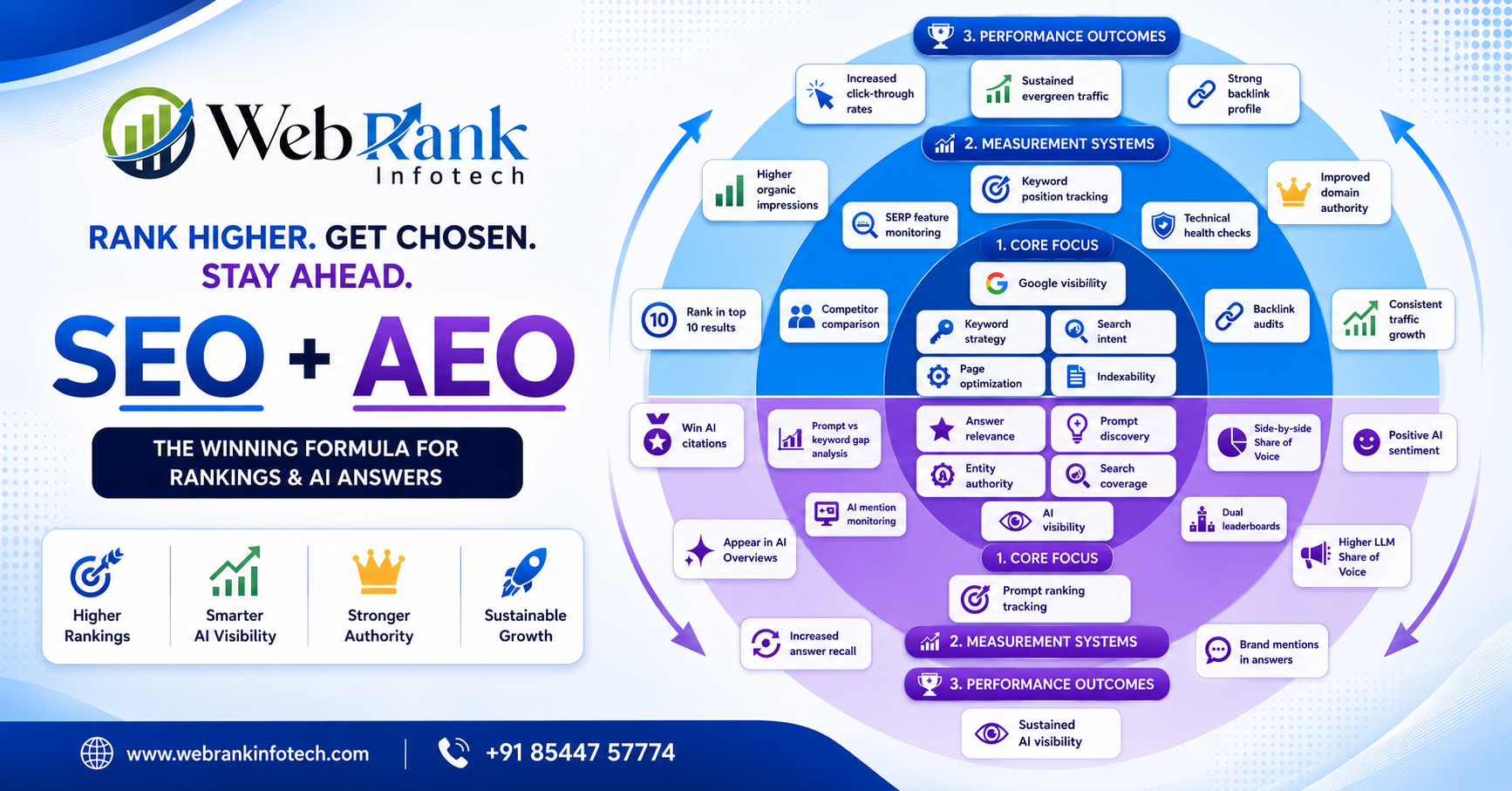
The SEO side of the strategy rests on four pillars: keyword strategy, search intent alignment, page optimization, and indexability.
Keyword strategy means identifying the exact phrases your audience searches and mapping them to dedicated pages. Prioritize long-tail, question-format keywords that overlap with AI prompts.
Search intent alignment ensures every page matches what the user actually wants — informational content for research queries, transactional content for buying queries.
Page optimization covers title tags, meta descriptions, heading hierarchy (H1–H4), image alt attributes containing your focus keyword, internal linking, and schema markup.
Indexability means your robots.txt, sitemap, canonical tags, and Core Web Vitals are all healthy. A page that cannot be crawled cannot rank — on Google or in AI engines.
AEO core focus — building AI visibility
The AEO side of your SEO and AEO strategy targets four parallel pillars: answer relevance, prompt discovery, entity authority, and search coverage.
Answer relevance means writing a direct, complete answer to the target question within the first 100 words of every page. AI models extract the most direct answer — burying it loses citations.
Prompt discovery involves researching the exact prompts users submit to Claude and ChatGPT, not just Google keywords. These prompt-format queries reveal content opportunities invisible to traditional keyword tools.
Entity authority is built by ensuring your brand is consistently mentioned across trusted third-party publications, Wikipedia, Wikidata, and industry databases. Claude AI specifically weights sources with strong entity recognition.
Search coverage means covering every significant subtopic in your niche comprehensively. AI models prefer sources that can answer follow-up questions without sending users elsewhere.
SEO and AEO strategy measurement systems
Tracking performance across both lanes requires dedicated measurement for each.
For SEO, monitor keyword position tracking weekly using Google Search Console or Ahrefs. Run SERP feature monitoring to identify featured snippet opportunities. Conduct regular competitor comparisons and monthly technical health checks to catch crawl errors early.
For AEO, run prompt ranking tracking by manually testing your top 20 prompts in Claude, ChatGPT, and Gemini every week. Set up AI mention monitoring for brand citations. Maintain dual leaderboards — one for Google rankings, one for AI citation frequency — and run prompt versus keyword gap analysis to find topics missing from your AI-answer presence.
Performance outcomes of a unified SEO and AEO strategy
When executed correctly, a combined SEO and AEO strategy delivers outcomes across both channels.
On the SEO side: sustained evergreen traffic, top 10 Google rankings, higher organic impressions, increased click-through rates, a strong backlink profile, improved domain authority, and consistent traffic growth.
On the AEO side: winning AI citations from Claude, ChatGPT, and Gemini, appearing in AI Overviews, higher LLM Share of Voice, positive AI sentiment, brand mentions inside AI-generated answers, sustained AI visibility, and increased answer recall.
5 steps to implement your SEO and AEO strategy today
Step 1 — Audit your entity footprint. Search your brand in Claude and ChatGPT. If the model cannot describe you accurately, fix it by earning citations in established publications and building a Wikidata presence. For external reference, visit schema.org to implement structured data correctly.
Step 2 — Add direct answers to existing pages. Reformat your top traffic pages to include a clear, concise answer in the opening paragraph. Apply FAQ schema markup to make answers machine-readable.
Step 3 — Build prompt-optimized content. Write pages targeting exact questions users ask AI engines. Use the question as your H1, answer in 50–100 words, then expand with supporting detail.
Step 4 — Strengthen your backlink profile. One backlink from a domain authority 70+ publication does more for your SEO and AEO strategy than fifty low-quality links. Pursue guest posts, original research, and industry reports. Learn more at Ahrefs Blog for backlink building guidance.
Step 5 — Run a weekly AI citation audit. Every Monday, test your 20 most important prompts across Claude, ChatGPT, and Gemini. Log citations and track trends over 90 days.
Conclusion
A strong SEO and AEO strategy is the single most important investment a brand can make in today’s rapidly evolving digital landscape. Google traffic remains essential — but AI-generated answers are growing faster than any other discovery channel. Brands that build both lanes now, with unified measurement and compounding content authority, will own the next decade of digital visibility.
Start with your core focus areas, build measurement systems around both channels, and let the performance outcomes — rankings, citations, Share of Voice, and brand authority — compound over time.