
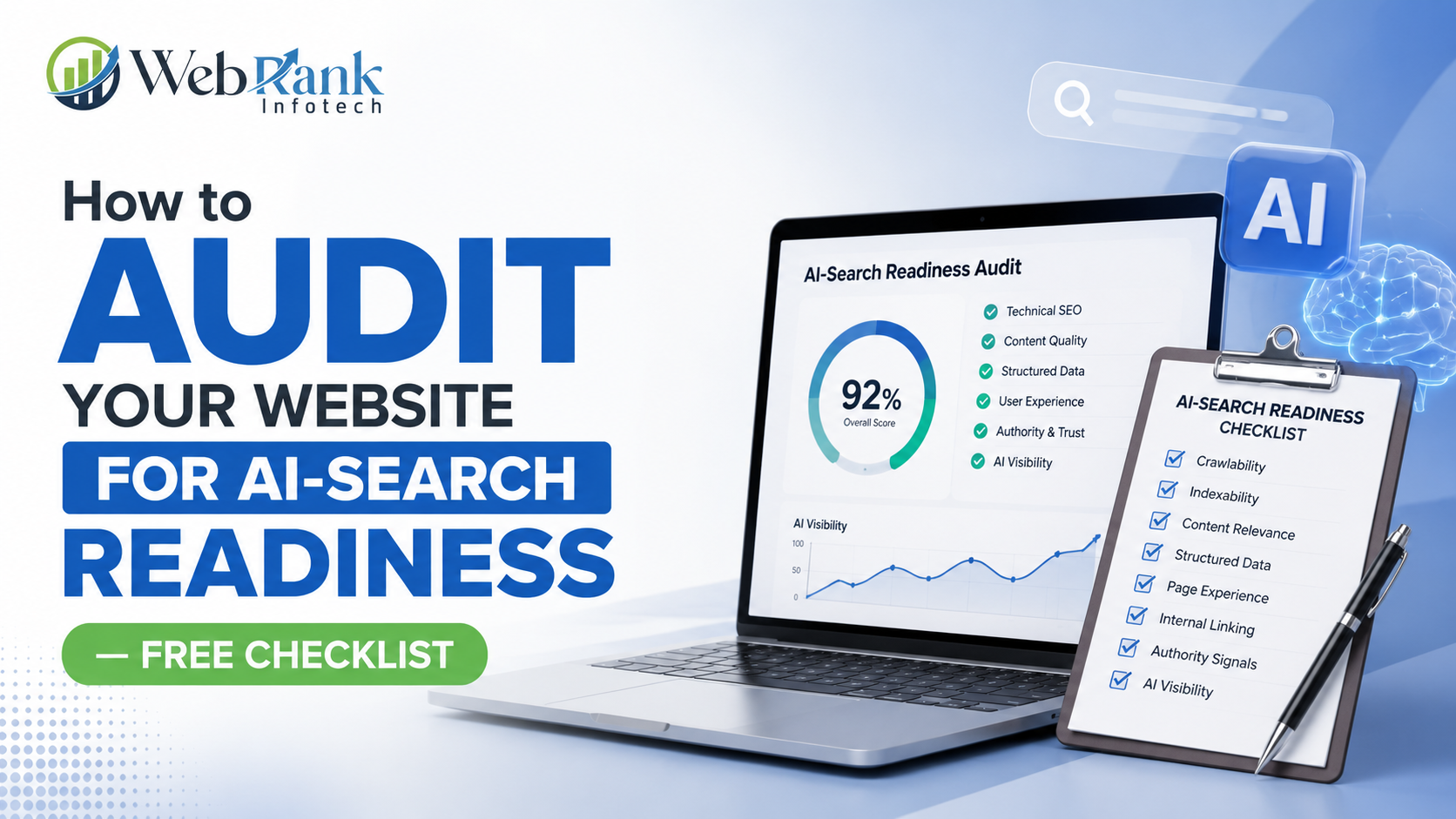
Here’s the short version: an AI-search readiness audit checks whether a website can be crawled, understood, and cited by AI systems like ChatGPT, Perplexity, and Google AI Overviews — and it comes down to seven checkable things: crawlability, answer-first content, structured data, entity clarity, topical depth, trust signals, and actual visibility testing. Below is the full step-by-step audit process, a free checklist table to run through page by page, and a scoring rubric to see exactly where a site stands today.
What Does “AI-Search Ready” Actually Mean for a Website?
A website counts as AI-search ready when an AI system can access its content, understand what each page is actually about, and confidently use that content inside a generated answer without needing to guess. This is a different bar than traditional SEO, which mainly asks whether a page ranks. AI-search readiness asks whether a page gets retrieved, correctly interpreted, and selected for citation — three separate hurdles a page can fail even while ranking well in traditional search.
Most websites built for traditional SEO already clear part of this bar without realizing it, since solid technical SEO, clear content structure, and topical authority all carry over. What’s usually missing is the layer built specifically for machine extraction — structured data, answer-first formatting, and consistent entity signals that remove ambiguity for an AI system deciding what to cite.
In short: AI-search readiness measures whether content can be found, understood, and confidently cited by AI systems, building directly on top of traditional SEO rather than replacing it.
How Do You Audit Your Website for AI-Search Readiness?
This is the exact seven-step sequence worth running through, in order, since each step depends on the one before it — a page that fails crawlability, for example, makes every later step irrelevant until that’s fixed.
Step 1: Check If AI Crawlers Can Actually Access the Site
Before anything else, confirm that important pages aren’t blocked from AI crawlers through robots.txt rules, that critical content isn’t hidden behind heavy client-side JavaScript rendering, and that XML sitemaps only contain clean, live URLs without redirect chains. A page an AI crawler can’t fully access never makes it into consideration for citation, regardless of content quality.
Step 2: Test Whether Pages Answer Questions Directly
Open the key pages on the site and check whether the core question a visitor came to answer gets addressed within the first two to three sentences, in plain language. Pages that bury the actual answer under a long brand introduction give AI systems nothing extractable near the top, which usually means a competitor’s more direct page gets cited instead.
Step 3: Check for Structured Data and Schema Markup
Review whether key page types — services, FAQs, local business listings, products — have appropriate schema markup implemented. Structured data removes the guesswork an AI system would otherwise have to do about what a page represents. Schema.org documents the exact markup types available and how to implement them correctly for each content type.
Step 4: Review Entity Clarity and NAP Consistency
Search the business name and confirm that name, address, and phone number match exactly across the website, Google Business Profile, directories, and social platforms. Inconsistent entity data creates conflicting signals that push AI systems toward a competitor with cleaner, more consistent information.
Step 5: Evaluate Topical Depth and Content Coverage
Check whether a topic is covered through a single isolated page or through a connected cluster of pages that address different angles of the same subject, linked together clearly. AI systems tend to trust sources demonstrating full topic coverage over single surface-level posts written to chase one keyword.
Step 6: Check Trust and E-E-A-T Signals
Review whether pages show visible author credentials, first-hand experience, specific real-world examples, and outbound links to credible sources where relevant. Generic, unattributed content reads as low-trust to AI systems, which tend to favor sources that demonstrate clear expertise and experience over generic advice.
Step 7: Test Actual Visibility Across AI Platforms
Search the exact questions a customer would ask directly in Google, ChatGPT, and Perplexity, and note whether the business gets cited, ignored, or replaced by a competitor. This step closes the loop — the previous six steps are diagnostic, but this step confirms whether fixes are actually translating into real citations.
In short: a full AI-search readiness audit runs through crawlability, answer-first content, structured data, entity clarity, topical depth, trust signals, and real visibility testing in that order, since each layer depends on the one before it working correctly.
What Should You Prioritize First When Auditing a Large Website?
Auditing an entire website at once rarely works well, especially for larger sites with dozens or hundreds of pages. The smarter approach is prioritizing the pages that matter most first — typically core service pages, high-traffic blog posts, and any page currently getting outranked or out-cited by a specific competitor. These pages usually offer the clearest return on audit effort, since improvements there are the easiest to measure and justify.
Once priority pages are fixed, the same process can expand outward to supporting content and the rest of the site. Trying to fix everything simultaneously usually means nothing gets fixed well, while a prioritized approach shows measurable movement faster.
In short: start an AI-search readiness audit with the highest-value pages — core services and top-performing content — before expanding to the rest of the site, since this delivers faster, more measurable results.
How Does Local SEO Fit Into an AI-Search Readiness Audit?
Local SEO overlaps heavily with AI-search readiness for any business serving a specific geographic area. Google Business Profile completeness, consistent local citations, and genuine review activity all feed directly into how confidently an AI system can identify and recommend a local business for “near me” and location-based queries. A business already investing properly in local SEO is frequently much closer to AI-search readiness than it realizes, since the same clean, consistent data that supports local rankings also supports AI citation.
Auditing this layer means checking that every field on the Google Business Profile is filled out, that service areas and categories are specific rather than generic, and that reviews are being actively managed and responded to. These are quick wins compared to a full content restructuring project, and they often move the needle fastest.
In short: Local SEO fundamentals double as AI-search readiness work, since both depend on Google confidently trusting a business’s core identity and location data.
What’s the Free AI-Search Readiness Checklist?
Here’s the actual checklist to run through, page by page, for any priority page on a website.
| # | Checklist Item | Pass Criteria |
|---|---|---|
| 1 | Page is crawlable | Not blocked by robots.txt, no critical content hidden in JavaScript rendering |
| 2 | Sitemap is clean | XML sitemap contains only live, status-200 URLs |
| 3 | Answer appears early | Core question answered within the first 2-3 sentences |
| 4 | Schema markup present | FAQ, Service, or LocalBusiness schema implemented where relevant |
| 5 | NAP consistency | Business name, address, phone match exactly across all platforms |
| 6 | Topical depth | Topic covered across a linked content cluster, not one isolated page |
| 7 | Author credentials visible | Real author bio or business credentials shown on key pages |
| 8 | Outbound authoritative links | Page links out to credible sources where relevant |
| 9 | Google Business Profile complete | Every field filled out, consistent with website data |
| 10 | Visibility tested directly | Business checked manually against target queries in Google, ChatGPT, and Perplexity |
A page passing eight or more of these ten items is in strong shape for AI citation. A page passing five or fewer needs prioritized attention before expecting any AI Overview or ChatGPT visibility.
In short: this ten-point checklist covers crawlability, content structure, structured data, entity consistency, trust signals, and direct visibility testing, and can be run against any priority page in under fifteen minutes.
How Do You Score Your Website’s AI-Search Readiness?
Beyond the page-level checklist, a broader five-point scorecard works well for evaluating the site as a whole, rating each category out of 5.
| Evaluation Criteria | What’s Being Scored | Score Out of 5 |
|---|---|---|
| Technical accessibility | Crawlability, clean sitemaps, no JavaScript-blocked content | 5 / 5 |
| Content structure | Answer-first formatting across priority pages | 5 / 5 |
| Structured data coverage | Schema implemented across services, FAQs, local listings | 5 / 5 |
| Entity and trust signals | NAP consistency, author credentials, outbound authority links | 5/ 5 |
| Confirmed AI visibility | Actual citations found across Google AI Overviews, ChatGPT, Perplexity | 5 / 5 |
A total below 15 signals significant gaps worth addressing before investing further in new content. A score above 20 suggests a site with a genuinely strong AI-search foundation already in place.
In short: scoring a website across technical accessibility, content structure, structured data, trust signals, and confirmed visibility turns AI-search readiness into a measurable, repeatable process rather than a one-time guess.
Frequently Asked Questions
What is an AI search readiness checklist?
An AI search readiness checklist is a structured set of checks that evaluate whether a website’s content can be crawled, understood, and cited by AI systems like ChatGPT, Perplexity, and Google AI Overviews. A local service business running through this checklist typically discovers its core service pages are technically fine for traditional SEO but missing schema markup and answer-first structure, which explains solid Google rankings paired with zero AI citations.
How is an AI search audit different from a regular SEO audit?
A regular SEO audit focuses on rankings, keywords, and traffic, while an AI search audit focuses on whether content gets retrieved and cited inside AI-generated answers. A page can pass a traditional SEO audit with strong rankings while still failing an AI search audit, most often because it lacks structured data or buries its answer instead of leading with it — the fix in that case is different from any traditional ranking fix.
How often should a website run an AI search readiness audit?
A full audit makes sense at least twice a year, with a lighter check on high-priority pages monthly, since AI platforms continue evolving how they select and cite sources. A business publishing new service pages or blog content regularly benefits from folding this checklist into the publishing process itself, checking each new page before it goes live rather than auditing everything retroactively months later.
Does fixing AI search readiness also help regular Google rankings?
Yes, in most cases, since AI-search readiness builds directly on solid technical SEO, clear content structure, and topical authority — the same fundamentals that support traditional rankings. A business that fixes crawlability issues and adds structured data as part of an AI readiness audit typically sees improvements in traditional organic visibility as a side effect, not just AI citations.
Can a small business realistically compete for AI Overview citations against bigger brands?
Yes, because AI citation depends more on content clarity, structured data, and entity consistency than on brand size or budget. A small business with a tightly organized service page, clean schema markup, and a complete Google Business Profile frequently outperforms a much larger competitor whose website still relies on generic, unstructured content without any machine-readable signals.
What tools can be used to test AI search visibility?
Direct manual testing works well as a starting point — searching target questions in Google, ChatGPT, and Perplexity and noting whether the business appears. Google’s own Search Console remains useful for confirming technical crawlability and indexing status, which is the foundational layer this entire audit depends on, and can be checked directly through Google Search Console.
Final Takeaway
AI-search readiness isn’t a separate discipline that replaces existing SEO work — it’s an extension of it, layered on top of the same fundamentals that already drive strong organic visibility: crawlable pages, clear content structure, and consistent trust signals. Running through this checklist on a handful of priority pages usually reveals exactly where the gaps sit, without needing to overhaul an entire site at once.
WebRank Infotech builds AI-search readiness directly into its SEO services for businesses across Chandigarh and beyond, including a free audit scored against this same checklist. Explore the full range of digital marketing services or get in touch directly to run this audit on a specific website.